These species profiles show how members of the group differ. Their biology describes each named species, rather than every fish in the group.
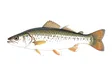
The golden shiner (Notemigonus crysoleucas) is a species of freshwater ray-finned fish belonging to the family Leuciscidae. This fish occurs in eastern North America. It is the sole member of its genus. Commonly used as a bait fish, it is probably the most widely pond-cultured fish in the United States. It can be found in Quebec and elsewhere in southeastern Canada west to Manitoba or Saskatchewan, and its French name is Méné jaune or Chatte de l'Est.
Taxonomy
It is the only North American member of the subfamily Leuciscinae, within which it occupies a relatively basal position, though still rather derived. All other members of this subfamily are found in Eurasia. Fossil remains of Notemigonus sp. have been recovered from the Late Miocene –aged Montbrook fossil site of Florida, US.
Description
Though it has been known to reach a total length (TL) of 36.7 cm (14.4 in), in the wild mature golden shiners are usually between 7 and 20 cm (2.8 and 7.9 in) TL. The body is laterally compressed (deep-bodied). The back is dark green or olive, and the belly is a silvery or brassy white. The sides are silver in smaller individuals, and in clear or turbid water, but golden in larger ones living in stained water. There can be a faint dusky stripe along the sides. The anal fin is large and has 8–19 rays, while the dorsal fin comprises seven to nine rays, typically eight. Scales are relatively large in the adult and easily lost when the fish is handled. The mouth is small and upturned. The eyes are yellow-green, as are the median and pelvic fins, though spawning males can develop orange coloration in these fins, especially in their distal leading rays.
Two characteristics can distinguish the golden shiner from all other North American minnows: (1) the lateral line has a pronounced downward curve, with its lowest point just above the pelvic fins; and (2) there is a fleshy keel lacking scales on the belly between the pelvic fins and the base of the anal fin.
Distribution
The golden shiner is found throughout the eastern half of North America, north to the St Lawrence River, Great Lakes, and Lake Winnipeg, and west to the Dakotas and Texas. It is found as far south as southern Florida and Texas. Because of its use as bait, it has also been introduced in many places outside this native range, especially in western North America.
 Read the full species guide.
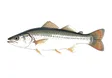
The Comely shiner (Notropis amoenus) is a small species of North American ray-finned fish belonging to the family Cyprinidae. It was described by Charles Conrad Abbott in 1874.
Description
The comely shiner is a thin, silvery minnow. It can be identified by its dorsal and ventral fins of equal curvature, slender and compressed body, and posterior-sided stripe. The scales are crowded from its anterior fin to the pelvic fin. It is pale in color, but a darker olive green on its top. They can grow up to 8.8 cm in length.
Distribution and habitat
The comely shiner lives from the southern Hudson River to the Cape Fear River system in North Carolina. They breed in the spring and summer seasons. The comely shiner prefers streams and other bodies of water 2 or more feet deep. It tends to live in pools and backwaters of swift streams.
 Read the full species guide.
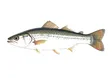
The bridle shiner (Notropis bifrenatus) is a species of freshwater ray-finned fish belonging to the family Leuciscidae, the shiners, daces and minnows. This species has been identified as being of Special Concern by the Committee on the Status of Endangered Wildlife in Canada (COSEWIC).
Distribution
The bridle shiner is found in eastern North America, from eastern Lake Ontario, east to Maine, and south to South Carolina. In Ontario, it is found in lowland areas in the eastern Lake Ontario drainage and the Saint Lawrence River. The most stable population is found around the Thousand Islands.
Habitat and life history
The bridle shiner is found in quiet areas of streams and occasionally in lakes. It is usually associated with abundant submersed aquatic vegetation and a river bottom composed of silt and sometimes sand. It uses the vegetation for protection, feeding, and spawning. It has been found in moderately turbid water but prefers clear water.
Diet
The bridle shiner mainly feeds on zooplankton and aquatic insect larvae such as chironomids. Plant materials make up a small portion of its diet.
 Read the full species guide.
