Pugnose Shiner

Notropis anogenus

Leuciscidae · freshwater water fish

5 minute read · Species guide

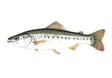
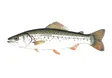
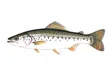
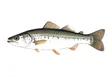
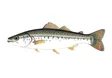
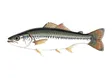
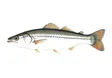
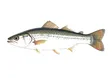
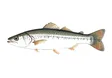
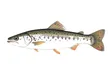
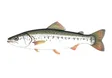
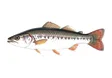
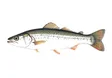
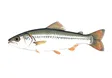
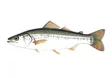
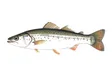
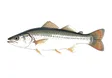
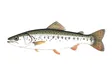
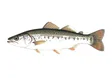
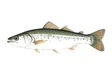
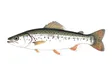
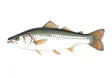
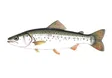
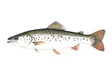
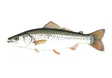
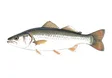
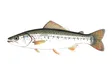
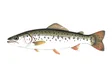
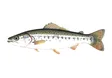
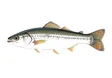
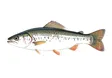
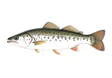
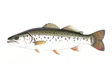
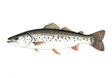
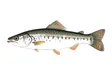
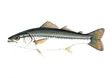
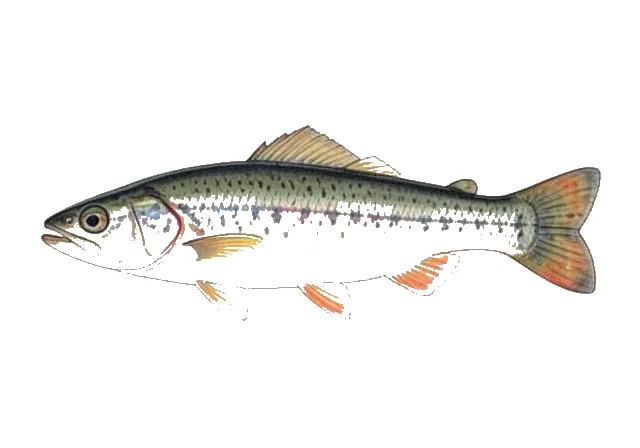
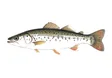
Pugnose Shiner field guide illustration

About Pugnose Shiner

The pugnose shiner (Notropis anogenus) is a species of ray-finned fish in the genus Notropis. It is in the family Leuciscidae which consists of freshwater shiners, daces and minnows. Its distribution has been decreasing due to the removal of aquatic plants in order to create swimming beaches and boating access in freshwater lakes and is now mostly found in Minnesota, Wisconsin, and Michigan.

Distribution

The pugnose shiner is a non-abundant species of Notropis and within the United States, it is distributed across parts of Minnesota, Wisconsin, and Michigan. It is native to North America and its historic range was from eastern Ontario and Western New York to North Dakota, Illinois, Indiana, and Ohio, ending in the St. Lawrence River drainage. The population that was once in North Dakota is now thought to be extirpated due to turbidity and uprooted vegetation within the freshwater lakes and streams. This minnow can also be found in a few areas of Canada but those ranges have also decreased throughout time so now the Canadian population mostly lies within Ontario.

Description

The pugnose shiner is a type of minnow that can live for up to 3 years and is able to reach sizes between 20–60mm, although it is about 47mm on average. It has a lateral dark stripe on the side of its body that runs from the tip of the caudal fin, through the eye, and to the nose tip. It has a small, terminal mouth angled upwards, giving it the pug-nose appearance. The abdominal region is yellow, and it has a clear-colored tail fin. Each fish has about 34–37 round, silver cycloid scales covering its body which has a fusiform shape to help the pugnose shiner swim against the constant stream currents. The pelvic fins are in the abdominal position. Because it is a ray-finned species, the fin rays are used as elements to support the skeletal features. The pugnose shiner has an 8-rayed dorsal fin on top of the dusky-colored back, a feature separating it from the pugnose minnow. This fish is also the only Minnesota Notropis species that has a darkly pigmented peritoneum.

Ecology

Although it is not an abundant species, the pugnose shiner can be found inhabiting weedy, clear lakes and slow-moving streams throughout its temperate, freshwater range. When temperatures are warmer, this fish is found in shallow water but when it cools down in the winter months, it is found in waters as deep as 2 meters. The pugnose shiner is a great indicator for healthy ecosystems because it is very sensitive to its environment because it is intolerant to turbidity. Their diets tend to consist of filamentous algae and cladocera (water fleas), eggs, insects, worms, and anything else under 2mm. Their predators consist of any omnivorous fish that is larger than this shiner. They are mid to low level consumers and therefore take little part in the transfer of nutrients.

Reproduction

The pugnose shiner reaches sexual maturity between the ages of 1 and 2 for both the male and female genders. They are an oviparous species and spawning and fertilization occur in summer between May and July. The female distributes her eggs in shallow water in areas of dense vegetation in which she lays between 530 and 1275 eggs. Once the eggs are fertilized, they generally hatch within one or two days. This species does not spend energy in parental investment so after the eggs are laid and fertilized, the male and female leave the eggs. In pugnose shiners, sexual dimorphism occurs and they have a polygynandrous mating system, meaning that both males and females have multiple mates. Sexes are physically different in that the males' pelvic fins go beyond the anal openings while the females' don't.

Conservation status

The conservation status of the pugnose shiner has been changing quite a bit in the past few years. This is partly because its status is dependent on where the species population is. In Canada, the pugnose shiner is currently listed as endangered but the status varies by state in the United States. This species has been declining through the upper midwest because of turbidity, decreasing vegetation, and invasive species within its home. There are multiple subpopulations of pugnose shiner but there is limited connection between the different populations because of low dispersal potential. It was listed as Near Threatened in 2010 but as of 2014, the pugnose shiner has been of Least Concern status. It has patterns of population decline so it is continually on concern conservation attention.

Etymology

The pugnose shiner genus name Notropis comes from Greek descent and it is a name given to shriveled-like specimens. It translates to the words "back keel ". The species name anogenus is also from Greek descent and it translates to "without a chin".

Article text: Wikipedia contributors, Pugnose shiner (source revision). Licensed under CC BY-SA 4.0. Retrieved 2026-10-11.
Diet and feeding

The FishTraits compilation records these diet categories for this species: algae or phytoplankton; aquatic or other vascular plants; invertebrates or larval fish. These are broad categories, not a claim that every individual consumes every example in a category.
Reported feeding positions include surface or water-column feeding. The compilation combines published observations; diets can vary with age, locality, and available food.

Habitat preferences

Reported habitat associations include medium to large rivers, streams and small rivers, creeks, still-water habitats.

The source records associations with muck, clay or silt, sand, vegetation. An association indicates reported use, rather than an exclusive requirement.

Reproduction and parental care

The compilation reports a representative maturity age of 3 years. Its maturity field summarizes mean, median, or modal estimates, usually for females; male estimates can be used when female data are unavailable. It is not a fixed age at which every fish first breeds.

Recorded spawning months are May, Jun, Jul for the source’s reporting region (WI). This is a regional calendar, not a range-wide schedule.

The reproductive-guild classification includes spawning on open substrates without guarding the brood.

Size and recorded longevity

FishTraits reports a maximum total length of 6 centimetres. Some entries use an estimated asymptotic length; this value should not be treated as a certified record catch.

Recorded longevity in the compilation is 3 years. Wild observations were preferred, but captive records were accepted where wild records were unavailable, and unspecified records were assumed wild. The value is not a guaranteed wild lifespan or an aquarium life expectancy.

Range

Where it lives

Share of 202 GBIF observation records with a state location, across 13 states.
0%
26.7%
Share of 202 GBIF observation records with a state location, across 13 states.

Habitat

Water and movement

Water
WoRMS records this species in fresh water.
Migration
Undetermined

Classification

Taxonomy

Kingdom
Animalia
Phylum
Chordata
Superclass
Actinopterygii
Class
Teleostei
Order
Cypriniformes
Genus
Notropis
Species
Notropis anogenus
ITIS TSN
163424
WoRMS AphiaID
1019835
GBIF key
2362240
Outside the US
ITIS also files it in Canada.

Common questions about Pugnose Shiner

What is the scientific name of Pugnose Shiner?
The scientific name is Notropis anogenus, in the family Leuciscidae. Classification follows ITIS.
Does Pugnose Shiner live in fresh water or salt water?
WoRMS records this species in fresh water.
Where has Pugnose Shiner been recorded in the United States?
GBIF has observations in 13 states, with the most records in Michigan, Illinois, New Jersey. The map shows observation records, which do not establish the complete natural range.

Closest relatives

Other Notropis species

Arkansas River Shiner5 states
Notropis girardiLeuciscidaeNative and introducedFresh
Bedrock Shiner3 states
Notropis rupestrisLeuciscidaeNativeFresh
Bigeye Shiner17 states
Notropis boopsLeuciscidaeNative and introducedFresh
Bigmouth Shiner21 states
Notropis dorsalisLeuciscidaeNative and introducedFresh
Blackchin Shiner13 states
Notropis heterodonLeuciscidaeNativeFresh
Blackmouth Shiner3 states
Notropis melanostomusLeuciscidaeNativeFresh
Blacknose Shiner21 states
Notropis heterolepisLeuciscidaeNative and introducedFresh
Blackspot Shiner5 states
Notropis atrocaudalisLeuciscidaeNativeFresh
Bluntnose Shiner3 states
Notropis simusLeuciscidaeNativeFresh
Bridle Shiner22 states
Notropis bifrenatusLeuciscidaeNativeFresh
Burrhead Shiner3 states
Notropis asperifronsLeuciscidaeNativeFresh
Cahaba Shiner1 states
Notropis cahabaeLeuciscidaeNativeFresh
Cape Fear Shiner1 states
Notropis mekistocholasLeuciscidaeNativeFresh
Carmine Shiner16 states
Notropis percobromusLeuciscidaeNativeFresh
Channel Shiner15 states
Notropis wickliffiLeuciscidaeNativeFresh
Chihuahua Shiner1 states
Notropis chihuahuaLeuciscidaeNative and introducedFresh
Chub Shiner4 states
Notropis potteriLeuciscidaeNative and introducedFresh
Coastal Shiner8 states
Notropis petersoniLeuciscidaeNativeFresh
Comely Shiner11 states
Notropis amoenusLeuciscidaeNative and introducedFresh
Coosa Shiner9 states
Notropis xaenocephalusLeuciscidaeNative and introducedFresh
Dusky Shiner6 states
Notropis cummingsaeLeuciscidaeNativeFresh
Emerald Shiner35 states
Notropis atherinoidesLeuciscidaeNative and introducedFresh
Fluvial Shiner3 states
Notropis edwardraneyiLeuciscidaeNativeFresh
Ghost Shiner16 states
Notropis buchananiLeuciscidaeNative and introducedFresh

Same family

More Leuciscidae

Alabama Shiner4 states
Cyprinella callistiaLeuciscidaeNativeFresh
Allegheny Pearl Dace19 states
Margariscus margaritaLeuciscidaeNative and introducedFresh
Altamaha Shiner1 states
Cyprinella xaenuraLeuciscidaeNativeFresh
Alvord Chub2 states
Siphateles alvordensisLeuciscidaeNativeFresh
Apalachee Shiner3 states
Pteronotropis grandipinnisLeuciscidaeNativeFresh
Arkansas River Shiner5 states
Notropis girardiLeuciscidaeNative and introducedFresh
Arroyo Chub1 states
Gila orcuttiiLeuciscidaeNative and introducedFresh
Bandfin Shiner5 states
Luxilus zonistiusLeuciscidaeNative and introducedFresh
Bannerfin Shiner5 states
Cyprinella leedsiLeuciscidaeNativeFresh
Beautiful Shiner3 states
Cyprinella formosaLeuciscidaeNativeFresh
Bedrock Shiner3 states
Notropis rupestrisLeuciscidaeNativeFresh
Bigeye Chub25 states
Hybopsis amblopsLeuciscidaeNative and introducedFresh
Bigeye Shiner17 states
Notropis boopsLeuciscidaeNative and introducedFresh
Bigmouth Chub3 states
Nocomis platyrhynchusLeuciscidaeNativeFresh
Bigmouth Shiner21 states
Notropis dorsalisLeuciscidaeNative and introducedFresh
Blackchin Shiner13 states
Notropis heterodonLeuciscidaeNativeFresh
Blackmouth Shiner3 states
Notropis melanostomusLeuciscidaeNativeFresh
Blacknose Shiner21 states
Notropis heterolepisLeuciscidaeNative and introducedFresh
Blackside Dace2 states
Chrosomus cumberlandensisLeuciscidaeNativeFresh
Blackspot Shiner5 states
Notropis atrocaudalisLeuciscidaeNativeFresh
Blacktail Shiner14 states
Cyprinella venustaLeuciscidaeNative and introducedFresh
Blacktip Shiner4 states
Lythrurus atrapiculusLeuciscidaeNative and introducedFresh
Bleeding Shiner8 states
Luxilus zonatusLeuciscidaeNativeFresh
Blotched Chub6 states
Erimystax insignisLeuciscidaeNativeFresh

All 267 species in Leuciscidae