Weed Shiner

Notropis texanus

Leuciscidae · freshwater water fish

5 minute read · Species guide

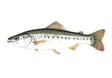
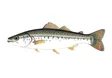
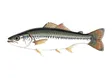
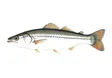
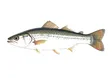
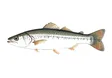
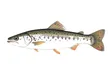
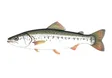
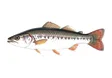
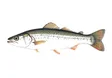
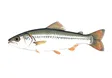
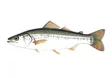
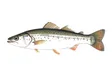
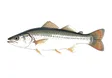
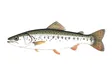
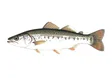
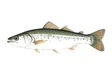
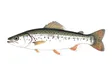
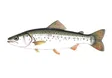
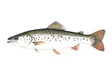
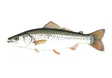
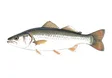
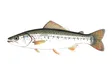
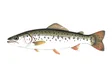
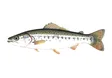
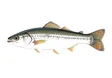
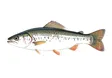
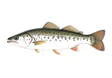
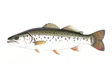
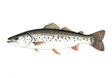
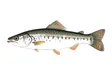
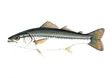
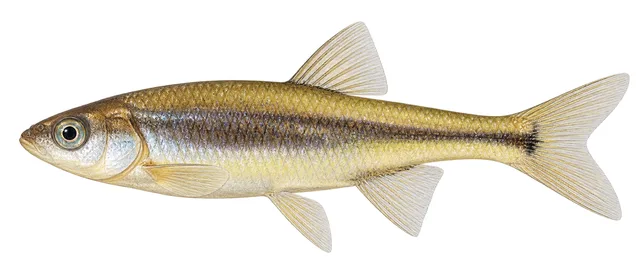
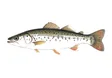
Weed Shiner field guide illustration

About Weed Shiner

The weed shiner (Alburnops texanus) is a species of freshwater ray-finned fish in the family Leuciscidae, the shiners, daces and minnows. Prior to 1958, this species was named Notropis roseus.

Description

The weed shiner, Alburnops texanus, is a member of the family Cyprinidae. It is a medium-sized minnow with a broad, dark lateral band down and a dark spot at the base of the caudal fin. The posterior 3–4 anal rays often have a dark pigment. Weed shiners have a somewhat compressed body, a large terminal to subterminal mouth, a gently rounded snout, and an eye diameter less than or equal to its snout length. The lateral line system is completely pored with 34–36 scales and is slightly decurved anteriorly. The dorsal surface of this fish tends to be olive-yellow with a silvery overlay and has dark-edged scales, giving off a checkerboard appearance. The ventral surface is white with silver tones. Weed shiners have a total of 6–8 gill rakers, 8 dorsal rays, 7 anal rays, 13–14 pectoral rays, and 8 pelvic rays.

Diet

Weed shiners feed during the day, with peaks in activity after sunrise or during mid-afternoon. During the wet season, their diet is mostly composed of organic detritus (81% by volume). During the wet season, their diet includes surface animal prey (20% by volume), midwater prey (5%), benthic animal prey (39%), and organic detritus (35%).

Habitat

Weed shiners are commonly found in the lower third of the water column in small to moderate sized streams of slow to moderate flow. They can be found in man-made ponds, reservoirs, and natural oxbow lakes. Despite its name, these fish are prevalent in both vegetated and non-vegetated waterways.

Reproduction and life cycle

Weed shiners spawn from March through September (sometimes early October), in water temperatures between 14 and 29 °C. Female weed shiners produce multiple clutches of eggs during the breeding season; therefore, it is hard to accurately estimate annual egg production.

Larval development has not yet been described in weed shiners. Growth of this species is very rapid in the beginning stages of development. They reach about 60% of their maximum length after one year of growth. Although some weed shiners manage to reach their fourth year of life, most of them die after their third year of life.

Distribution

The weed shiner occurs in the Mississippi River Basin from Minnesota and Wisconsin down to the Gulf of Mexico. It ranges all throughout Gulf of Mexico drainage, from the Suwannee River of Florida and Georgia to the Nueces River of Texas, and is more abundant south of the Ohio-Tennessee River confluences. It has also been reported in the Red River of the North drainage in Minnesota and drainages of Lake Michigan and Lake Huron.

Etymology

Texanus is a reference to the type locality, Salado Creek, Texas.

Article text: Wikipedia contributors, Weed shiner (source revision). Licensed under CC BY-SA 4.0. Retrieved 2026-10-12.
Diet and feeding

The FishTraits compilation records these diet categories for this species: algae or phytoplankton; aquatic or other vascular plants; detritus or unidentified plant material; invertebrates or larval fish. These are broad categories, not a claim that every individual consumes every example in a category.
Reported feeding positions include bottom feeding and surface or water-column feeding. The compilation combines published observations; diets can vary with age, locality, and available food.

Habitat preferences

Reported habitat associations include medium to large rivers, streams and small rivers, creeks.

The source records associations with sand, gravel, cobble, bedrock, vegetation. An association indicates reported use, rather than an exclusive requirement.

Reproduction and parental care

The compilation reports a representative maturity age of 1 years. Its maturity field summarizes mean, median, or modal estimates, usually for females; male estimates can be used when female data are unavailable. It is not a fixed age at which every fish first breeds.

Batch or serial spawning has been reported somewhere in the species’ range. This does not establish the same spawning pattern for every population.

Recorded spawning months are Jun, Jul for the source’s reporting region (WI). This is a regional calendar, not a range-wide schedule.

The reproductive-guild classification includes spawning on open substrates without guarding the brood.

Size and recorded longevity

FishTraits reports a maximum total length of 8.6 centimetres. Some entries use an estimated asymptotic length; this value should not be treated as a certified record catch.

Recorded longevity in the compilation is 3.5 years. Wild observations were preferred, but captive records were accepted where wild records were unavailable, and unspecified records were assumed wild. The value is not a guaranteed wild lifespan or an aquarium life expectancy.

Native range

Lowlands in Great Lakes, Hudson Bay (Red River), and Mississippi River basins from Michigan, Wisconsin, and Minnesota south to Gulf; Gulf Slope drainages from Suwannee River, Georgia and Florida, to Nueces River, Texas (Page and Burr 1991).

Introduction history

According to Bart et al. (1994), this species may have entered the Ocmulgee River by stream capture from the Flint River, or as an introduction via bait bucket release. These authors noted that Ocmulgee specimens exhibit the same unique features (deep bodies and higher numbers of body circumferential scales) as do Flint River specimens. Georgia Department of Natural Resources personnel found the species in the Ocmulgee system during 1988-1990 fish survey work. Bart et al. (1994) speculated that it appeared in the Ocmulgee system after construction of the High Falls dam because the species is apparently restricted to the area above the reservoir. The dam was completed in the early 1900s. Notropis texanus apparently invaded the Tennessee drainage from the Mobile basin by way of a canal connection, the Tennessee-Tombigbee Waterway (Etnier and Starnes 1993).

Ecological impacts

Unknown. According to Etnier and Starnes (1993), range expansion of Notropis texanus in Tennessee would bring it into potential contact with the very similar bigeye shiner N. boops.

Range

Where it lives

Share of 7,889 GBIF observation records with a state location, across 27 states. The orange dots are USGS stream-survey sites where this species was caught.
0%
22.5%
Share of 7,889 GBIF observation records with a state location, across 27 states. The orange dots are USGS stream-survey sites where this species was caught.

A blank area on the dot layer usually means nobody sampled there, not that the fish is absent. Turn on “every survey site” to see where the survey looked.

The USGS stream survey caught it at 388 of its sites, in 12 states. That survey and the GBIF records are two different counts of two different things, so the site keeps them apart.

Habitat

Water and movement

Water
WoRMS records this species in fresh water.
USGS NAS habitat
Freshwater
US status
Native transplant — native to part of the United States, moved to other waters inside it.
Migration
Undetermined

Classification

Taxonomy

Kingdom
Animalia
Phylum
Chordata
Superclass
Actinopterygii
Class
Teleostei
Order
Cypriniformes
Genus
Notropis
Species
Notropis texanus
ITIS TSN
163420
WoRMS AphiaID
1019547
GBIF key
2362312
Outside the US
ITIS also files it in Canada.

Common questions about Weed Shiner

What is the scientific name of Weed Shiner?
The scientific name is Notropis texanus, in the family Leuciscidae. Classification follows ITIS.
Does Weed Shiner live in fresh water or salt water?
WoRMS records this species in fresh water.
Where has Weed Shiner been recorded in the United States?
GBIF has observations in 27 states, with the most records in Alabama, Texas, Mississippi. The map shows observation records, which do not establish the complete natural range.

Closest relatives

Other Notropis species

Arkansas River Shiner5 states
Notropis girardiLeuciscidaeNative and introducedFresh
Bedrock Shiner3 states
Notropis rupestrisLeuciscidaeNativeFresh
Bigeye Shiner17 states
Notropis boopsLeuciscidaeNative and introducedFresh
Bigmouth Shiner21 states
Notropis dorsalisLeuciscidaeNative and introducedFresh
Blackchin Shiner13 states
Notropis heterodonLeuciscidaeNativeFresh
Blackmouth Shiner3 states
Notropis melanostomusLeuciscidaeNativeFresh
Blacknose Shiner21 states
Notropis heterolepisLeuciscidaeNative and introducedFresh
Blackspot Shiner5 states
Notropis atrocaudalisLeuciscidaeNativeFresh
Bluntnose Shiner3 states
Notropis simusLeuciscidaeNativeFresh
Bridle Shiner22 states
Notropis bifrenatusLeuciscidaeNativeFresh
Burrhead Shiner3 states
Notropis asperifronsLeuciscidaeNativeFresh
Cahaba Shiner1 states
Notropis cahabaeLeuciscidaeNativeFresh
Cape Fear Shiner1 states
Notropis mekistocholasLeuciscidaeNativeFresh
Carmine Shiner16 states
Notropis percobromusLeuciscidaeNativeFresh
Channel Shiner15 states
Notropis wickliffiLeuciscidaeNativeFresh
Chihuahua Shiner1 states
Notropis chihuahuaLeuciscidaeNative and introducedFresh
Chub Shiner4 states
Notropis potteriLeuciscidaeNative and introducedFresh
Coastal Shiner8 states
Notropis petersoniLeuciscidaeNativeFresh
Comely Shiner11 states
Notropis amoenusLeuciscidaeNative and introducedFresh
Coosa Shiner9 states
Notropis xaenocephalusLeuciscidaeNative and introducedFresh
Dusky Shiner6 states
Notropis cummingsaeLeuciscidaeNativeFresh
Emerald Shiner35 states
Notropis atherinoidesLeuciscidaeNative and introducedFresh
Fluvial Shiner3 states
Notropis edwardraneyiLeuciscidaeNativeFresh
Ghost Shiner16 states
Notropis buchananiLeuciscidaeNative and introducedFresh

Same family

More Leuciscidae

Alabama Shiner4 states
Cyprinella callistiaLeuciscidaeNativeFresh
Allegheny Pearl Dace19 states
Margariscus margaritaLeuciscidaeNative and introducedFresh
Altamaha Shiner1 states
Cyprinella xaenuraLeuciscidaeNativeFresh
Alvord Chub2 states
Siphateles alvordensisLeuciscidaeNativeFresh
Apalachee Shiner3 states
Pteronotropis grandipinnisLeuciscidaeNativeFresh
Arkansas River Shiner5 states
Notropis girardiLeuciscidaeNative and introducedFresh
Arroyo Chub1 states
Gila orcuttiiLeuciscidaeNative and introducedFresh
Bandfin Shiner5 states
Luxilus zonistiusLeuciscidaeNative and introducedFresh
Bannerfin Shiner5 states
Cyprinella leedsiLeuciscidaeNativeFresh
Beautiful Shiner3 states
Cyprinella formosaLeuciscidaeNativeFresh
Bedrock Shiner3 states
Notropis rupestrisLeuciscidaeNativeFresh
Bigeye Chub25 states
Hybopsis amblopsLeuciscidaeNative and introducedFresh
Bigeye Shiner17 states
Notropis boopsLeuciscidaeNative and introducedFresh
Bigmouth Chub3 states
Nocomis platyrhynchusLeuciscidaeNativeFresh
Bigmouth Shiner21 states
Notropis dorsalisLeuciscidaeNative and introducedFresh
Blackchin Shiner13 states
Notropis heterodonLeuciscidaeNativeFresh
Blackmouth Shiner3 states
Notropis melanostomusLeuciscidaeNativeFresh
Blacknose Shiner21 states
Notropis heterolepisLeuciscidaeNative and introducedFresh
Blackside Dace2 states
Chrosomus cumberlandensisLeuciscidaeNativeFresh
Blackspot Shiner5 states
Notropis atrocaudalisLeuciscidaeNativeFresh
Blacktail Shiner14 states
Cyprinella venustaLeuciscidaeNative and introducedFresh
Blacktip Shiner4 states
Lythrurus atrapiculusLeuciscidaeNative and introducedFresh
Bleeding Shiner8 states
Luxilus zonatusLeuciscidaeNativeFresh
Blotched Chub6 states
Erimystax insignisLeuciscidaeNativeFresh

All 267 species in Leuciscidae