Sand Shiner

Notropis stramineus

Leuciscidae · freshwater water fish

7 minute read · Species guide

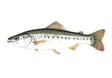
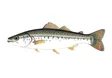
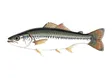
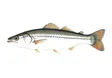
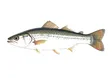
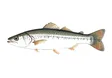
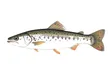
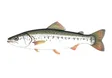
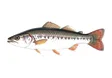
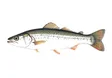
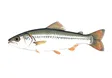
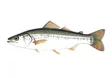
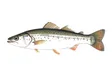
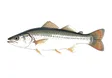
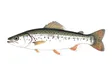
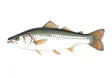
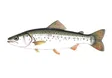
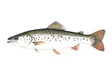
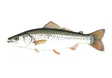
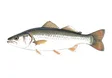
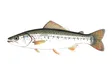
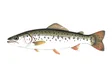
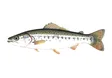
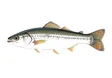
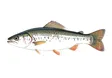
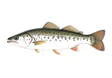
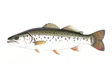
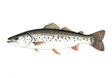
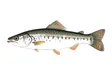
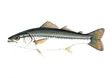
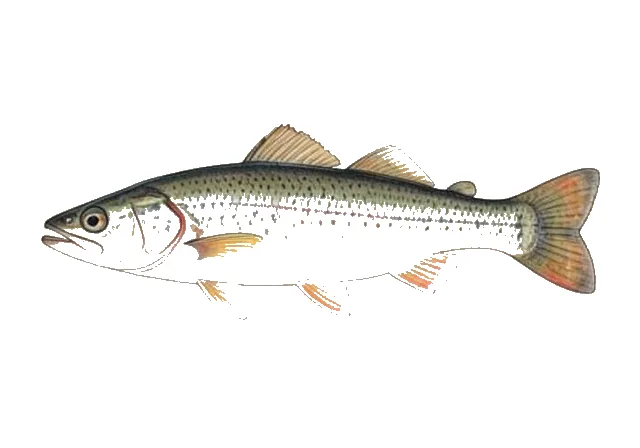
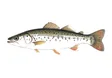
Sand Shiner field guide illustration

About Sand Shiner

The sand shiner (Miniellus stramineus) is a species of freshwater ray-finned fish belonging to the family Leuciscidae, the shiners, daces and minnows. Sand shiners live in open clear water streams with sandy bottoms where they feed in schools on aquatic and terrestrial insects, bottom ooze and diatoms.

Distribution

The sand shiner is extremely widespread, known from central part of the United States and southern Canada. The range stretches from Saint Lawrence - Great Lakes, Hudson Bay and Mississippi River basins which are part of the St. Lawrence River in Quebec to Saskatchewan in Canada. The range also stretches south to Tennessee and Texas; west to Montana, Wyoming, Colorado and New Mexico; Trinity River to Rio Grande in Texas and New Mexico, and Mexico.

Name

The specific epithet stramineus means of straw, making reference to the fish's overall pale amber body color. Notropis ludibundus is a senior synonym of M. stramineus, however, the specific name M. stramineus is conserved and N. ludibundus is suppressed.

Physical characteristics

Sand shiners have a compressed, slender body covered in leptoid scales, more specifically cycloid scales which are generally round and lack a tooth-like cteni. They have a subterminal mouth position (the end of the snout projects only slightly past the mouth) and a homocercal tail (the vertebral column does not enter the caudal fin). Sand Shiners usually have seven anal soft rays, fewer than 10 dorsal fin soft rays, and fewer than 45 lateral line scales. They have no spinous rays meaning none of their rays are hard. Their pharyngeal teeth count is 0,4-4,0. The average total length of a Sand Shiner is about 44 mm with a maximum length of approximately 82 mm. They have a silvery head and sides with a dark middorsal strip extending to the dorsal fin. At the base of the dorsal fin are two distinct black dashes separated by a clear space when viewed from above. Their back scales are an olivaceous color and are outlined with melanophores. Each pore within the lateral line system, is also accented with paired melanophores which creates the appearance of a thin midlateral strip. The abdomen is a whitish color with indistinct spots at the base of the caudal fin. During spawning, colors intensify in males.

Habitat

The sand shiner requires clear water with a sandy, gravel-rubble bottom in order to survive. It is irregularly distributed amongst streams of diverse sizes and inhabits a wide variety of habitats within the medium to large streams and rivers but is rarely found in upland areas. Sand Shiners tend to seek areas deeper than 20 cm which have little to no aquatic vegetation and a slow-moving current. Habitats with acidic or alkaline conditions are avoided, however, in the Southwest, pH values of around 8.0 are common in streams which Sand Shiners occupy. Habitat locations change slightly throughout the seasons. During spawning season in August, sand shiners form large schools in shallow water which has a slight current and a sandy bottom. In the fall, concentrations of sand shiners are found in deep pools. In late summer and fall, the sand shiners tend to move into shallow water over a rubble bottom during dusk.

Diet and feeding behavior

Sand shiners are omnivorous fish, feeding on aquatic and terrestrial insects, bottom ooze and diatoms and are often observed in large schools which frequently feeding in shallow waters. Overall, this species is an opportunistic feeder primarily taking bottom particulate matter, as well as plant material and terrestrial and aquatic insects. More explicitly, their summer diet consists of bottom ooze (68% of volume), aquatic nymphs and larvae, Ephemeroptera nymphs, Tricoptera larvae, adult terrestrial insects, adult and emerging Ephemeroptera, dipterans, corixids, and a small amount of plant matter. During late summer, sand shiners show more surface-oriented feeding behaviors, feeding on adult aquatic and terrestrial insects. These feeding habits are similar to the closely related Cape Fear shiner and swallowtail shiner.

Conservation status

Populations of sand shiners in the southern United States are currently stable. They are not listed as endangered by the federal government or any state governments. The state of New Mexico provides limited protection as precipitous decline in Pecos River may becoming a potential threat. This decline is partially as a consequence of water management practices.

Reproduction

The total reproductive period of sand shiners extends from May or June through August with slight variation in time of spawning depending upon latitude. The peak of activity occurs in July and August when water temperature is high (27– 37 °C) and there is minimal rain and runoff allowing for lower water levels. Summerfelt and Minckley hypothesis spawning during the hot-dry portion of the summer is adaptive for survival as it may enhance the survival of the young. The sand shiner is a broadcast spawner that lays demersal, adhesive eggs, suggesting that the sand shiners spawning is not correlated with flow spikes. Eggs are laid in shallow water over sandy substrate in which the eggs rapidly settle to and attach to loose gravel, failing to become buoyant. Following hatching, most growth is achieved during the first year of life. A length of 10.5 mm has been reported for the size of the sand shiner at time of scale formation. Once fish reach age I or II, spawning can occur with the former being more numerous. Fecundity varies from 150 to 1,000 eggs per female per year. There is an increase in fecundity with standard length (or age) of the fish. Egg diameter ranges from 0.75 to 0.95 mm. On average, the sand shiner has a longevity of three summers.

Article text: Wikipedia contributors, Sand shiner (source revision). Licensed under CC BY-SA 4.0. Retrieved 2026-10-12.
Diet and feeding

The FishTraits compilation records these diet categories for this species: algae or phytoplankton; aquatic or other vascular plants; detritus or unidentified plant material; invertebrates or larval fish. These are broad categories, not a claim that every individual consumes every example in a category.
Reported feeding positions include bottom feeding and surface or water-column feeding. The compilation combines published observations; diets can vary with age, locality, and available food.

Habitat preferences

Reported habitat associations include medium to large rivers, streams and small rivers, creeks.

The source records associations with sand, gravel. An association indicates reported use, rather than an exclusive requirement.

Reproduction and parental care

The compilation reports a representative maturity age of 1 years. Its maturity field summarizes mean, median, or modal estimates, usually for females; male estimates can be used when female data are unavailable. It is not a fixed age at which every fish first breeds.

Batch or serial spawning has been reported somewhere in the species’ range. This does not establish the same spawning pattern for every population.

Recorded spawning months are May, Jun, Jul, Aug for the source’s reporting region (NC). This is a regional calendar, not a range-wide schedule.

The reproductive-guild classification includes spawning on open substrates without guarding the brood.

Size and recorded longevity

FishTraits reports a maximum total length of 8.1 centimetres. Some entries use an estimated asymptotic length; this value should not be treated as a certified record catch.

Recorded longevity in the compilation is 3 years. Wild observations were preferred, but captive records were accepted where wild records were unavailable, and unspecified records were assumed wild. The value is not a guaranteed wild lifespan or an aquarium life expectancy.

Identification and appearance

Becker (1983); Sublette et al. (1990); Page and Burr (1991); Jenkins and Burkhead (1994); Pflieger (1997); a commonly used synonym is Notropis ludibundus (Mayden and Gilbert 1989). The International Commission on Zoological Nomenclature (ICZM) voted to conserve the name N. stramineus because it had been more widely used that the resurrected name of N. ludibundus (Poly 2004).

Native range

Saint Lawrence-Great Lakes, Hudson Bay (Red River), and Mississippi River basins from St. Lawrence River, southern Quebec, to eastern Saskatchewan, and south to Tennessee and Texas; west to eastern Montana, Wyoming, Colorado, and New Mexico; Gulf Slope from Trinity River to Rio Grande, Texas, New Mexico, and Mexico (Page and Burr 1991).

Introduction history

In Arizona, this species was reportedly stocked by accident along with shipments of largemouth bass from Dexter, New Mexico, in 1935, into East Clear Creek and perhaps Chevalon Creek (Minckley 1973). In his list of introduced fishes of Arizona and the lower Colorado River, Rinne (1995) reported it as an accidental introduction and gave the year as 1938. Although uncertain, it may have entered the Shawangunk Kill of New York via the Delaware-Hudson Canal system (Smith 1985). This species may have been introduced into other western states as a bait fish. It was introduced to Willard Bay Reservoir, Utah in 1982 (Sigler and Sigler 1987). The Sand Shiner was first collected in the upper Colorado basin (Dolores River) in 1971 (Holden and Stalnaker 1975a, 1975b). Based on its numbers and distribution, Holden and Stalnaker (1975b) suggested that this species had been present in the Colorado basin for several years, perhaps introduced as a baitfish, as it is common in the South Platte River system of eastern Colorado.

Ecological impacts

Largely unknown. This species was reported to be "a problem" in the Yampa River in Colorado (Whitmore 1997). Muth and Snyder (1995) showed that Sand Shiners had a low to moderate degree of dietary overlap with young-of-year Colorado squawfish Ptychocheilus lucius.

Range

Where it lives

Share of 18,784 GBIF observation records with a state location, across 30 states. The orange dots are USGS stream-survey sites where this species was caught.
0%
17.4%
Share of 18,784 GBIF observation records with a state location, across 30 states. The orange dots are USGS stream-survey sites where this species was caught.

A blank area on the dot layer usually means nobody sampled there, not that the fish is absent. Turn on “every survey site” to see where the survey looked.

The USGS stream survey caught it at 4,916 of its sites, in 27 states. That survey and the GBIF records are two different counts of two different things, so the site keeps them apart.

Habitat

Water and movement

Water
WoRMS records this species in fresh water.
USGS NAS habitat
Freshwater
US status
Native transplant — native to part of the United States, moved to other waters inside it.
Migration
Undetermined

Classification

Taxonomy

Kingdom
Animalia
Phylum
Chordata
Superclass
Actinopterygii
Class
Teleostei
Order
Cypriniformes
Genus
Notropis
Species
Notropis stramineus
ITIS TSN
163419
WoRMS AphiaID
1020955
GBIF key
2362216
Outside the US
ITIS also files it in Canada, Mexico.

Common questions about Sand Shiner

What is the scientific name of Sand Shiner?
The scientific name is Notropis stramineus, in the family Leuciscidae. Classification follows ITIS.
Does Sand Shiner live in fresh water or salt water?
WoRMS records this species in fresh water.
Where has Sand Shiner been recorded in the United States?
GBIF has observations in 30 states, with the most records in Oklahoma, Illinois, New Mexico. The map shows observation records, which do not establish the complete natural range.

Closest relatives

Other Notropis species

Arkansas River Shiner5 states
Notropis girardiLeuciscidaeNative and introducedFresh
Bedrock Shiner3 states
Notropis rupestrisLeuciscidaeNativeFresh
Bigeye Shiner17 states
Notropis boopsLeuciscidaeNative and introducedFresh
Bigmouth Shiner21 states
Notropis dorsalisLeuciscidaeNative and introducedFresh
Blackchin Shiner13 states
Notropis heterodonLeuciscidaeNativeFresh
Blackmouth Shiner3 states
Notropis melanostomusLeuciscidaeNativeFresh
Blacknose Shiner21 states
Notropis heterolepisLeuciscidaeNative and introducedFresh
Blackspot Shiner5 states
Notropis atrocaudalisLeuciscidaeNativeFresh
Bluntnose Shiner3 states
Notropis simusLeuciscidaeNativeFresh
Bridle Shiner22 states
Notropis bifrenatusLeuciscidaeNativeFresh
Burrhead Shiner3 states
Notropis asperifronsLeuciscidaeNativeFresh
Cahaba Shiner1 states
Notropis cahabaeLeuciscidaeNativeFresh
Cape Fear Shiner1 states
Notropis mekistocholasLeuciscidaeNativeFresh
Carmine Shiner16 states
Notropis percobromusLeuciscidaeNativeFresh
Channel Shiner15 states
Notropis wickliffiLeuciscidaeNativeFresh
Chihuahua Shiner1 states
Notropis chihuahuaLeuciscidaeNative and introducedFresh
Chub Shiner4 states
Notropis potteriLeuciscidaeNative and introducedFresh
Coastal Shiner8 states
Notropis petersoniLeuciscidaeNativeFresh
Comely Shiner11 states
Notropis amoenusLeuciscidaeNative and introducedFresh
Coosa Shiner9 states
Notropis xaenocephalusLeuciscidaeNative and introducedFresh
Dusky Shiner6 states
Notropis cummingsaeLeuciscidaeNativeFresh
Emerald Shiner35 states
Notropis atherinoidesLeuciscidaeNative and introducedFresh
Fluvial Shiner3 states
Notropis edwardraneyiLeuciscidaeNativeFresh
Ghost Shiner16 states
Notropis buchananiLeuciscidaeNative and introducedFresh

Same family

More Leuciscidae

Alabama Shiner4 states
Cyprinella callistiaLeuciscidaeNativeFresh
Allegheny Pearl Dace19 states
Margariscus margaritaLeuciscidaeNative and introducedFresh
Altamaha Shiner1 states
Cyprinella xaenuraLeuciscidaeNativeFresh
Alvord Chub2 states
Siphateles alvordensisLeuciscidaeNativeFresh
Apalachee Shiner3 states
Pteronotropis grandipinnisLeuciscidaeNativeFresh
Arkansas River Shiner5 states
Notropis girardiLeuciscidaeNative and introducedFresh
Arroyo Chub1 states
Gila orcuttiiLeuciscidaeNative and introducedFresh
Bandfin Shiner5 states
Luxilus zonistiusLeuciscidaeNative and introducedFresh
Bannerfin Shiner5 states
Cyprinella leedsiLeuciscidaeNativeFresh
Beautiful Shiner3 states
Cyprinella formosaLeuciscidaeNativeFresh
Bedrock Shiner3 states
Notropis rupestrisLeuciscidaeNativeFresh
Bigeye Chub25 states
Hybopsis amblopsLeuciscidaeNative and introducedFresh
Bigeye Shiner17 states
Notropis boopsLeuciscidaeNative and introducedFresh
Bigmouth Chub3 states
Nocomis platyrhynchusLeuciscidaeNativeFresh
Bigmouth Shiner21 states
Notropis dorsalisLeuciscidaeNative and introducedFresh
Blackchin Shiner13 states
Notropis heterodonLeuciscidaeNativeFresh
Blackmouth Shiner3 states
Notropis melanostomusLeuciscidaeNativeFresh
Blacknose Shiner21 states
Notropis heterolepisLeuciscidaeNative and introducedFresh
Blackside Dace2 states
Chrosomus cumberlandensisLeuciscidaeNativeFresh
Blackspot Shiner5 states
Notropis atrocaudalisLeuciscidaeNativeFresh
Blacktail Shiner14 states
Cyprinella venustaLeuciscidaeNative and introducedFresh
Blacktip Shiner4 states
Lythrurus atrapiculusLeuciscidaeNative and introducedFresh
Bleeding Shiner8 states
Luxilus zonatusLeuciscidaeNativeFresh
Blotched Chub6 states
Erimystax insignisLeuciscidaeNativeFresh

All 267 species in Leuciscidae