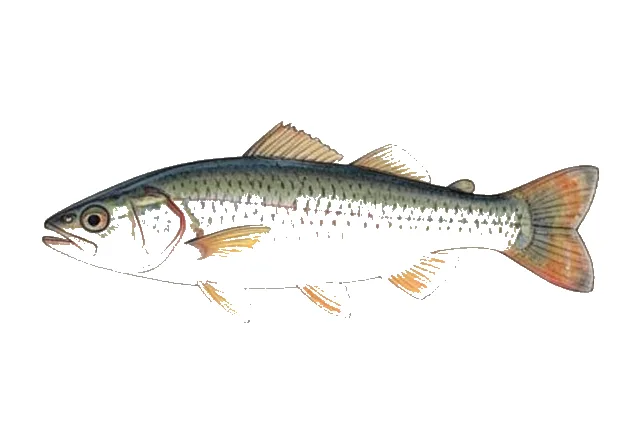
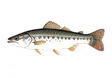
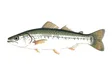
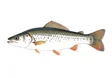
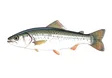
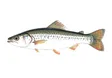
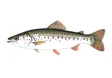
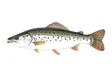
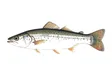
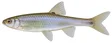
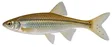
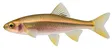
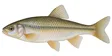
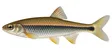
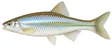
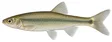
The fish reaches a maximum length of about 15 centimeters. It lives in creeks, rivers, and pools.
Additional field notes
Bluntface shiner use both pools and flowing runs across several central United States river systems.
Sources: Cyprinella camura species summary
Stream settings
FishBase records adults in creeks and small to medium rivers, over sandy as well as rocky beds. Occupied water can be clear or turbid, so clarity by itself is not a reliable presence-or-absence test. The range includes tributaries of the Mississippi and Tennessee rivers in the former Mississippi Embayment, alongside the Arkansas River drainage in parts of Missouri, Kansas, Arkansas, and Oklahoma.
Sources: Cyprinella camura species summary
Guide sources
Research reviewed 2026-10-19.
Article text: Wikipedia contributors, Bluntface shiner (source revision). Licensed under CC BY-SA 4.0. Retrieved 2026-10-11.
Diet and feeding
The FishTraits compilation records these diet categories for this species: invertebrates or larval fish. These are broad categories, not a claim that every individual consumes every example in a category.
Reported feeding positions include bottom feeding and surface or water-column feeding. The compilation combines published observations; diets can vary with age, locality, and available food.
Habitat preferences
Reported habitat associations include medium to large rivers, streams and small rivers, creeks.
The source records associations with sand, gravel, cobble. An association indicates reported use, rather than an exclusive requirement.
Reproduction and parental care
The compilation reports a representative maturity age of 1.5 years. Its maturity field summarizes mean, median, or modal estimates, usually for females; male estimates can be used when female data are unavailable. It is not a fixed age at which every fish first breeds.
Batch or serial spawning has been reported somewhere in the species’ range. This does not establish the same spawning pattern for every population.
Recorded spawning months are May, Jun, Jul, Aug for the source’s reporting region (TN). This is a regional calendar, not a range-wide schedule.
The reproductive-guild classification includes hiding a brood without subsequent guarding.
Size and recorded longevity
FishTraits reports a maximum total length of 11 centimetres. Some entries use an estimated asymptotic length; this value should not be treated as a certified record catch.
Recorded longevity in the compilation is 3 years. Wild observations were preferred, but captive records were accepted where wild records were unavailable, and unspecified records were assumed wild. The value is not a guaranteed wild lifespan or an aquarium life expectancy.