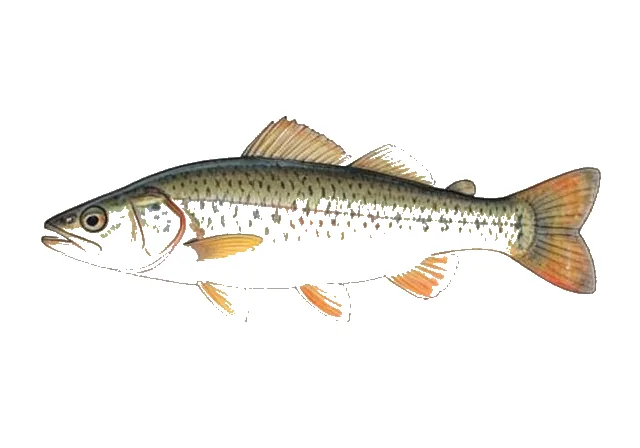
Golden Shiner

Notemigonus crysoleucas

Leuciscidae · freshwater and brackish water fish

9 minute read · Species guide

Golden Shiner field guide illustration

About Golden Shiner

The golden shiner (Notemigonus crysoleucas) is a species of freshwater ray-finned fish belonging to the family Leuciscidae. This fish occurs in eastern North America. It is the sole member of its genus. Commonly used as a bait fish, it is probably the most widely pond-cultured fish in the United States. It can be found in Quebec and elsewhere in southeastern Canada west to Manitoba or Saskatchewan, and its French name is Méné jaune or Chatte de l'Est.

Taxonomy

It is the only North American member of the subfamily Leuciscinae, within which it occupies a relatively basal position, though still rather derived. All other members of this subfamily are found in Eurasia. Fossil remains of Notemigonus sp. have been recovered from the Late Miocene –aged Montbrook fossil site of Florida, US.

Description

Though it has been known to reach a total length (TL) of 36.7 cm (14.4 in), in the wild mature golden shiners are usually between 7 and 20 cm (2.8 and 7.9 in) TL. The body is laterally compressed (deep-bodied). The back is dark green or olive, and the belly is a silvery or brassy white. The sides are silver in smaller individuals, and in clear or turbid water, but golden in larger ones living in stained water. There can be a faint dusky stripe along the sides. The anal fin is large and has 8–19 rays, while the dorsal fin comprises seven to nine rays, typically eight. Scales are relatively large in the adult and easily lost when the fish is handled. The mouth is small and upturned. The eyes are yellow-green, as are the median and pelvic fins, though spawning males can develop orange coloration in these fins, especially in their distal leading rays.

Two characteristics can distinguish the golden shiner from all other North American minnows: (1) the lateral line has a pronounced downward curve, with its lowest point just above the pelvic fins; and (2) there is a fleshy keel lacking scales on the belly between the pelvic fins and the base of the anal fin.

The lack of scales on the keel is important to differentiate the golden shiner from the very similar-looking rudd, Scardinius erythrophtalmus, a European species that has been introduced in a few places in North America. The rudd also has a midventral keel, but that keel bears scales. Golden shiner and rudd can in fact hybridize, and hybrids have a few scales on their midventral keel.

Distribution

The golden shiner is found throughout the eastern half of North America, north to the St Lawrence River, Great Lakes, and Lake Winnipeg, and west to the Dakotas and Texas. It is found as far south as southern Florida and Texas. Because of its use as bait, it has also been introduced in many places outside this native range, especially in western North America.

Habitat

Golden shiners prefer quiet waters and are therefore found in lakes, ponds, sloughs, and ditches. They are sometimes found in the quietest parts of rivers, and like weedy areas. They are fairly tolerant of pollution, turbidity, and low oxygen content. They can also tolerate temperatures as high as 40 °C (104 °F), which is unusually high for a North American minnow.

Diet

Golden shiners are omnivorous and crepuscular planktivores. They eat zooplankton, phytoplankton, microcrustaceans, insects, plants, and algae. They can feed at the surface, in mid-water, or at the bottom. They can locate prey visually, or filter-feed on high-density zooplankton without resorting to visual cues. They are themselves food for all manner of game fish such as trout and bass (black bass and temperate bass,) hence their popularity as bait fish.

Reproduction

In the southern parts of their range, golden shiners can start reproducing at one year of age; in Canada, first breeding is more commonly at three years of age. Females lay up to 200,000 sticky eggs each amid vegetation. There is no parental care. Occasionally, like a few other minnows, golden shiners can deposit their eggs in the occupied nests of pumpkinseed, largemouth bass or bowfin (the latter two can be predators of shiners). This behavior is called egg dumping and resembles the brood parasitism of birds such as cuckoos, inasmuch as the shiner eggs will benefit from the parental care that the nest's owner will provide to the content of their nests. In contrast to parasitism by cuckoos, however, the parent's eggs do not suffer from the presence of parasitic eggs, and may actually benefit from a dilution effect when predators attack the brood.

Behavior

Golden shiners live in large groups (shoals) that roam widely. Several laboratory studies have shown that the movements of a shoal can be determined by a minority of individuals at the front of it. For example, an individual that knows when and where food is available within a large tank can lead many other fish to the right place at the right time of day. If all fish have similar knowledge, there is still a tendency for some individuals to be found always at the front of a moving shoal, possibly because they are intrinsically hungrier and more motivated to find food. Small fish are also found more often at the front of a shoal than larger fish, again possibly because they are more motivated to find food.

Like other minnows, golden shiners are sensitive to the release of an alarm substance, or schreckstoff, contained within special skin cells. If a predator catches and bites into a minnow, the skin is broken, the substance is released, and other minnows in the vicinity can detect the substance and react to it by leaving the area. The substance can also survive intact in the feces of a predator, and minnows can thus detect the presence of a minnow-eating predator through the presence of its feces. In the laboratory, golden shiners were found to react strongly to water that contained feces from snakes that had eaten other golden shiners, but not nearly as much to water laden with feces from snakes that had eaten green swordtails (Xiphophorus hellerii), a fish that does not possess an alarm substance.

Like other fishes, golden shiners have a good daily time sense and can anticipate the arrival of food when this food is made available at the same time of the day or night. They can also do this when there is more than one mealtime a day. This anticipation is expressed as swimming and positioning towards the food source, and other naive individuals can perceive this and join the anticipating fish in the hope of sharing its food.

Golden shiners are also capable of time-place learning (associating different places with different times of day). They can be taught to feed in one part of an aquarium in the morning and a different part in the afternoon; or to feed in one part in the morning, a different part at mid-day, and back to the first part in the afternoon.

Negative effects of environmental toxicants

Researchers have found that long-term exposure of golden shiners to methylmercury can cause disadvantageous effects in the function of the nervous, reproductive, immune, and endocrine systems as well as in behavior. For example, golden shiners exposed to methylmercury showed a decline in reproduction through the inhibition of hypothalamus, pituitary, and gonadal function. Many fish showed higher concentrations of the chemical in the brain compared to the rest of the body. Fish exposed to high amounts of mercury showed signs of delayed shoaling after exposure to predators. These fish took up to nearly three times longer to return to pre-exposure behaviors compared to other groups exposed to lower amounts of mercury.

Studies have also seen relationships between tissue damage and exposure to mercury by examining macrophage aggregates in different fish tissues. Using histological analysis, a positive correlation was seen between the total area of macrophage aggregates and total mercury concentration of muscle tissues in the spleen of both male and female golden shiners.

Article text: Wikipedia contributors, Golden shiner (source revision). Licensed under CC BY-SA 4.0. Retrieved 2026-10-11.


Diet and feeding

The FishTraits compilation records these diet categories for this species: algae or phytoplankton; aquatic or other vascular plants; invertebrates or larval fish; fish or frog eggs. These are broad categories, not a claim that every individual consumes every example in a category.

Reported feeding positions include surface or water-column feeding. The compilation combines published observations; diets can vary with age, locality, and available food.

Habitat preferences

Reported habitat associations include medium to large rivers, streams and small rivers, creeks, still-water habitats.

The source records associations with vegetation, organic debris. An association indicates reported use, rather than an exclusive requirement.

Reproduction and parental care

The compilation reports a representative maturity age of 1 years. Its maturity field summarizes mean, median, or modal estimates, usually for females; male estimates can be used when female data are unavailable. It is not a fixed age at which every fish first breeds.

Batch or serial spawning has been reported somewhere in the species’ range. This does not establish the same spawning pattern for every population.

Recorded spawning months are Apr, May, Jun, Jul, Aug for the source’s reporting region (NC). This is a regional calendar, not a range-wide schedule.

The reproductive-guild classification includes spawning on open substrates without guarding the brood.

Size and recorded longevity

FishTraits reports a maximum total length of 30 centimetres. Some entries use an estimated asymptotic length; this value should not be treated as a certified record catch.

Recorded longevity in the compilation is 8 years. Wild observations were preferred, but captive records were accepted where wild records were unavailable, and unspecified records were assumed wild. The value is not a guaranteed wild lifespan or an aquarium life expectancy.

Identification and appearance

Golden Shiner can be distinguished from all other native North American minnows (Cyprinidae) by the presence of a fleshy scaleless keel along the belly between the pelvic and anal fins, along with an extremely compressed body and a strongly decurved lateral line. Golden Shiner are superficially similar to the introduced Rudd (Scardinius erythrophthalmus), and can be distinguished by the following characters (Howells 1990; Page and Burr 2011)

Native range

Atlantic and Gulf Slope drainages from Nova Scotia to southern Texas; Great Lakes, Hudson Bay (Red River), and Mississippi River basins west to Alberta, Montana, Wyoming, and western Oklahoma (Page and Burr 2011).

Introduction history

The Golden Shiner is widely used as bait and as an ornamental and therefore has been transplanted into many areas, including parks in the United States (e.g., Lee et al. 1980 et seq.; LoVullo and Stauffer 1993). According to Swift et al. (1993), the Golden Shiner arrived in San Diego County, California, in 1891 and quickly became widespread. Dill and Cordone (1997) stated this species was planted in parts of California as forage by the California Fish Commission during the late 1890s. It is the most commonly used bait fish in many regions, for instance California (Dill and Cordone 1997) and the Midwest (Burr, personal communication). Jenkins and Burkhead (1994) and Pflieger (1997) also noted that many populations probably became established through bait bucket introductions. The Golden Shiner has been stocked in the Great Basin as a forage fish (Sigler and Sigler 1987). According to Jenkins and Burkhead (1994), it has been sparingly introduced to the New River drainage (earliest records: North Carolina 1949; Virginia 1971; West Virginia 1970). These researchers also noted that the earliest record of this species in the Virginia portion of the upper Tennessee drainage was 1966. That record was from a site near a hatchery that used this species as forage.

Ecological impacts

A study by Shao (1997) showed that Golden Shiners that used brood nests made by Lepomis gibbosus resulted in reduced hatching success of L. gibbosus due to fungal infection from the presence of Golden Shiners. The reduced hatching success was offset by reduced predation on L. gibbosus eggs due to the presence of Golden Shiner eggs.

Record fish

State records in 3 states

  • Wisconsin0 lbs. 9.1 oz.

    Lake Mendota · Dane · 03/29/2021

  • Montana0.39 lbs.

    Lake Josephine · 4/28/25 · Jimmy Lee Boles III

  • Oklahoma0 lbs 5.28 ozs

    Grady Co. Pond · 05/01/2022 · Orlando Cheadle · rod and line

Each figure is the state agency’s own certified record. The site holds record tables for 11 states so far, so a state missing here has not been read yet. It is not a state where this fish holds no record.

Range

Where it lives

Share of 35,737 GBIF observation records with a state location, across 47 states. The orange dots are USGS stream-survey sites where this species was caught.
0%
13.8%
Share of 35,737 GBIF observation records with a state location, across 47 states. The orange dots are USGS stream-survey sites where this species was caught.

A blank area on the dot layer usually means nobody sampled there, not that the fish is absent. Turn on “every survey site” to see where the survey looked.

The USGS stream survey caught it at 3,031 of its sites, in 41 states. That survey and the GBIF records are two different counts of two different things, so the site keeps them apart.

Habitat

Water and movement

Water
WoRMS records this species in fresh water and brackish water.
USGS NAS habitat
Freshwater
US status
Native transplant — native to part of the United States, moved to other waters inside it.
Migration
Undetermined

Classification

Taxonomy

Kingdom
Animalia
Phylum
Chordata
Superclass
Actinopterygii
Class
Teleostei
Order
Cypriniformes
Genus
Notemigonus
Species
Notemigonus crysoleucas
ITIS TSN
163368
WoRMS AphiaID
159989
GBIF key
2363714
Outside the US
ITIS also files it in Canada.

Common questions about Golden Shiner

What is the scientific name of Golden Shiner?
The scientific name is Notemigonus crysoleucas, in the family Leuciscidae. Classification follows ITIS.
Does Golden Shiner live in fresh water or salt water?
WoRMS records this species in fresh water and brackish water.
Where has Golden Shiner been recorded in the United States?
GBIF has observations in 47 states, with the most records in Minnesota, Pennsylvania, Florida. The map shows observation records, which do not establish the complete natural range.

Same family

More Leuciscidae

Alabama Shiner4 states
Cyprinella callistiaLeuciscidaeNativeFresh
Allegheny Pearl Dace19 states
Margariscus margaritaLeuciscidaeNative and introducedFresh
Altamaha Shiner1 states
Cyprinella xaenuraLeuciscidaeNativeFresh
Alvord Chub2 states
Siphateles alvordensisLeuciscidaeNativeFresh
Apalachee Shiner3 states
Pteronotropis grandipinnisLeuciscidaeNativeFresh
Arkansas River Shiner5 states
Notropis girardiLeuciscidaeNative and introducedFresh
Arroyo Chub1 states
Gila orcuttiiLeuciscidaeNative and introducedFresh
Bandfin Shiner5 states
Luxilus zonistiusLeuciscidaeNative and introducedFresh
Bannerfin Shiner5 states
Cyprinella leedsiLeuciscidaeNativeFresh
Beautiful Shiner3 states
Cyprinella formosaLeuciscidaeNativeFresh
Bedrock Shiner3 states
Notropis rupestrisLeuciscidaeNativeFresh
Bigeye Chub25 states
Hybopsis amblopsLeuciscidaeNative and introducedFresh
Bigeye Shiner17 states
Notropis boopsLeuciscidaeNative and introducedFresh
Bigmouth Chub3 states
Nocomis platyrhynchusLeuciscidaeNativeFresh
Bigmouth Shiner21 states
Notropis dorsalisLeuciscidaeNative and introducedFresh
Blackchin Shiner13 states
Notropis heterodonLeuciscidaeNativeFresh
Blackmouth Shiner3 states
Notropis melanostomusLeuciscidaeNativeFresh
Blacknose Shiner21 states
Notropis heterolepisLeuciscidaeNative and introducedFresh
Blackside Dace2 states
Chrosomus cumberlandensisLeuciscidaeNativeFresh
Blackspot Shiner5 states
Notropis atrocaudalisLeuciscidaeNativeFresh
Blacktail Shiner14 states
Cyprinella venustaLeuciscidaeNative and introducedFresh
Blacktip Shiner4 states
Lythrurus atrapiculusLeuciscidaeNative and introducedFresh
Bleeding Shiner8 states
Luxilus zonatusLeuciscidaeNativeFresh
Blotched Chub6 states
Erimystax insignisLeuciscidaeNativeFresh

All 267 species in Leuciscidae





















