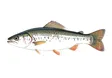
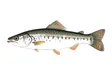
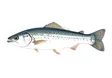
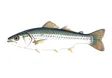
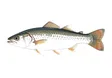
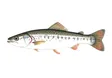
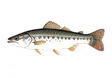
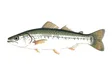
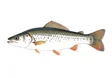
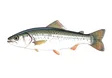
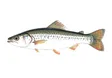
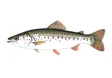
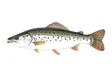
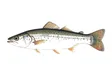
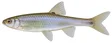
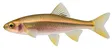
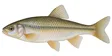
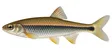
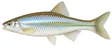
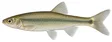
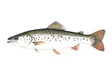
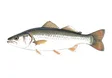
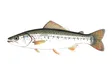
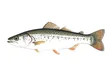
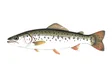
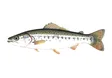
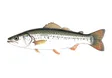
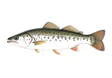
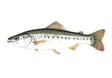
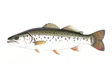
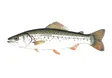
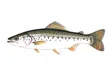
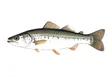
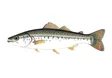
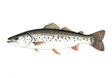
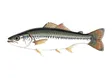
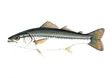
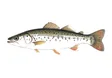
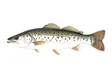
Adults may reach a maximum size of 16 cm (6.3 in) while mean length is 8.8 cm (3.5 in). The maximum age reported in this species was three years. C. whipplei lives in schools on rocky or sandy floors of creeks and small rivers.
The fish was named in honor of Lieut. Amiel Weeks Whipple (1818–1863), the military engineer/surveyor who led the boundary survey team that collected the type specimen.
Article text: Wikipedia contributors, Cyprinella whipplei (source revision). Licensed under CC BY-SA 4.0. Retrieved 2026-10-11.
Diet and feeding
The FishTraits compilation records these diet categories for this species: aquatic or other vascular plants; detritus or unidentified plant material; invertebrates or larval fish. These are broad categories, not a claim that every individual consumes every example in a category.
Reported feeding positions include bottom feeding and surface or water-column feeding. The compilation combines published observations; diets can vary with age, locality, and available food.
Habitat preferences
Reported habitat associations include medium to large rivers, streams and small rivers.
The source records associations with sand, gravel, cobble. An association indicates reported use, rather than an exclusive requirement.
Reproduction and parental care
The compilation reports a representative maturity age of 2 years. Its maturity field summarizes mean, median, or modal estimates, usually for females; male estimates can be used when female data are unavailable. It is not a fixed age at which every fish first breeds.
Recorded spawning months are Jun, Jul, Aug for the source’s reporting region (TN). This is a regional calendar, not a range-wide schedule.
The reproductive-guild classification includes hiding a brood without subsequent guarding.
Size and recorded longevity
FishTraits reports a maximum total length of 16 centimetres. Some entries use an estimated asymptotic length; this value should not be treated as a certified record catch.
Recorded longevity in the compilation is 4 years. Wild observations were preferred, but captive records were accepted where wild records were unavailable, and unspecified records were assumed wild. The value is not a guaranteed wild lifespan or an aquarium life expectancy.
Identification and appearance
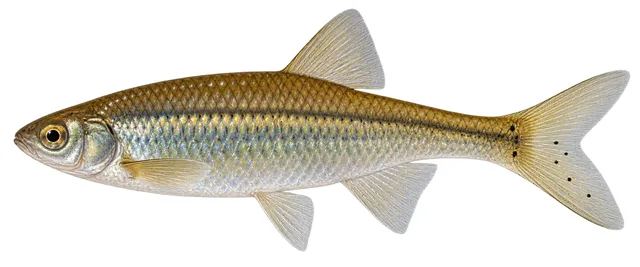
Cyprinella whipplei is a shiner fish with a laterally compressed body and a small subconical head (Ross 2001). The mouth is oblique and terminal to subterminal. The pharyngeal teeth are hooked, with narrow serrated surfaces. The eyes are small. The back and sides are blue to olive green, and the flanks are silvery. The breast and belly are completely scaled. The lateral line is decurved and completely pored. The dorsal and lateral scales are strongly outlined with melanophores, creating a cross-hatched pattern. The dorsal and ventral profiles of the body are similarly curved. The greatest body depth is in front of the dorsal fin origin. The dorsal fin origin is above or slightly posterior to the pelvic fin origin. There are nine anal rays. It can be distinguished from other members of the Cyprinella genus by the base of its caudal fin, which is not milky white.
Native range
Mississippi River basin, from Ohio and West Virginia to Illinois, Missouri, and eastern Oklahoma, and south to Northern Alabama and northern Louisiana; Black Warrior River system (Mobile Bay drainage), Alabama. Native to Monongahela, Little Kanawha, and Kanawha below the falls, Guyandotte, Big Sandy, small Ohio River tributaries in West Virginia, and the main channel of the Ohio River (Stauffer 2007). Mostly absent from Coastal Plain (Page and Burr 1991).
Habitat and ecology
Cyprinella whipplei inhabits low-to-moderate gradient streams that have permanent flow (Ross 2001) as well as medium to large sized streams (Miller and Robison 2004). It occurs in streams with sand or gravel substrates, such as riffle or pool segments (Ross 2001). This species has been recorded in streams with temperatures as low as freezing (Felley and Hill 1983) and as high as 25.0°C (Risch 2004). Cyprinella whipplei generally feeds on insects in the water column, and changes its diet seasonally (Ross 2001). They feed on terrestrial insects that fall into the stream in the summer and fall. Cyprinella whipplei shifts to feeding on benthic invertebrates during colder weather. During the winter and spring, they also feed on organic detritus. It preys on small crustaceans, mites, and earthworms (Stauffer 2007). Piscivorous animals such as gar, bass, sunfish, sturgeon, large chubs, kingfisher, heron, and turtles are known to feed on shiners (Mayden pers. comm. 2013). Spawning occurs between June and August. Most Cyprinella whipplei reaches sexual maturity after their second summer, but most do not spawn until after their third summer. They spawn in the crevices in logs and roots. Females who are ready to spawn move to a spawning log and may be approached by several males. Males compete with each other for the spawning female. Usually one male is successful in driving the other males away. The successful male mates with the female by pressing her against the spawning log. Males are territorial and defend their nest from other males. They display threats to males swimming near their nest by raising their dorsal fins and parallel swimming, or hitting the other male with their snouts. It is able to hybridize with Cyprinella camura in Greenleaf Creek. Cyprinella whipplei possesses alarm substances in their epidermal cells that are released when damaged, which chemically alert conspecifics to perform a fright reaction that may increase their chances of survival in the face of predators (Smith and Smith 1983). These alarm substance cells are lost during the spawning season. It has been suggested spawning may cause epidermal damage, and the absence of these alarm cells prevents the release of alarm substances during spawning, a situation where a fright reaction is not necessary for conspecifics.
Introduction history
Cyprinella whipplei has a moderate probability of introduction to the Great Lakes (Confidence level: High).
Potential pathway(s) of introduction: Dispersal
Cyprinella whipplei occurs in the Mississippi River basin, Ohio River, Muskingum River, and the Fox River drainage, which are near waters connected to the Great Lakes basin (Page and Burr 1991, Retzer and Batten 2005, Sanders 1992). There are electrical barriers between the Great Lakes and Mississippi River basins that function to prevent the spread of aquatic invasive species (Rasmussen et al. 2011). There is no evidence that suggests that Cyprinella whipplei is capable of hitchhiking or fouling ships. There are no records of the stocking, culture, or sale of Cyprinella whipplei in the Great Lakes region.