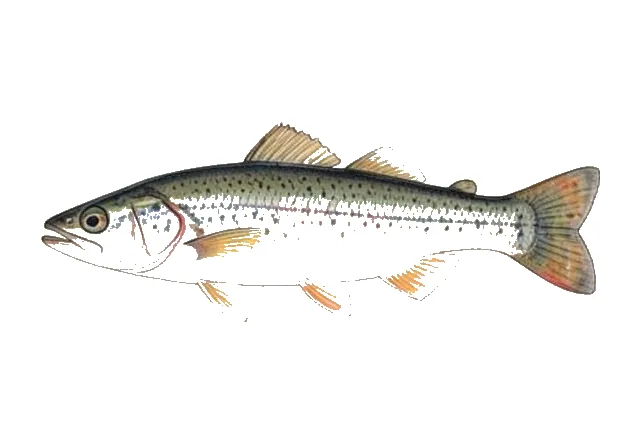
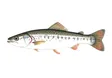
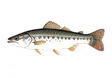
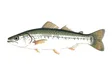
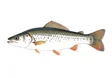
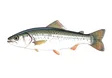
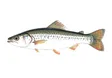
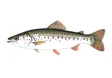
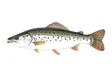
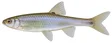
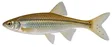
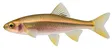
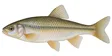
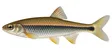
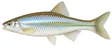
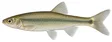
It is a freshwater fish that inhabits rivers and creeks, sometimes entering pools and riffles, and found from headwaters to areas near tidal influence. It eats insects, especially flies and mayflies. Spawning occurs in spring and summer, with individuals spawning several times over a season. The eggs are laid in cracks and crevices, under rocks, and on tree roots and wood debris. The male guards them until the young emerge in about one to two weeks, depending on temperature. The lifespan of the species is 3 to 4 years.
This species produces vocalizations that aid in species and sex recognition.
The specific epithet is derived from a name for Theodore Roosevelt Island (Analostan Island), as the type specimens were collected from Rock Creek, which enters the Potomac River opposite the river island.
Article text: Wikipedia contributors, Satinfin shiner (source revision). Licensed under CC BY-SA 4.0. Retrieved 2026-10-11.
Diet and feeding
The FishTraits compilation records these diet categories for this species: algae or phytoplankton; invertebrates or larval fish. These are broad categories, not a claim that every individual consumes every example in a category.
Reported feeding positions include surface or water-column feeding. The compilation combines published observations; diets can vary with age, locality, and available food.
Habitat preferences
Reported habitat associations include medium to large rivers, streams and small rivers, creeks.
The source records associations with muck, clay or silt, sand, vegetation, organic debris. An association indicates reported use, rather than an exclusive requirement.
Reproduction and parental care
The compilation reports a representative maturity age of 1.5 years. Its maturity field summarizes mean, median, or modal estimates, usually for females; male estimates can be used when female data are unavailable. It is not a fixed age at which every fish first breeds.
Batch or serial spawning has been reported somewhere in the species’ range. This does not establish the same spawning pattern for every population.
Recorded spawning months are Apr, May, Jun, Jul for the source’s reporting region (NC). This is a regional calendar, not a range-wide schedule.
The reproductive-guild classification includes hiding a brood without subsequent guarding.
Size and recorded longevity
FishTraits reports a maximum total length of 11 centimetres. Some entries use an estimated asymptotic length; this value should not be treated as a certified record catch.
Recorded longevity in the compilation is 4 years. Wild observations were preferred, but captive records were accepted where wild records were unavailable, and unspecified records were assumed wild. The value is not a guaranteed wild lifespan or an aquarium life expectancy.
Identification and appearance
Cyprinella analostana has a deep body with a straight or slightly convex dorsal fin edge. It has a somewhat rounded snout with a terminal mouth and tiny tubercles that are present on its head (Jenkins and Burkhead 1994). Males may exhibit breeding coloration characterized by a milky-white border surrounding all fins, a silver-blue color on their dorsal surface that grades into a milky-white ventral surface, and well-developed tubercles (Stout 1975). Cyprinella analostana is very similar in appearance to the closely related Steelcolor Shiner C. whipplei, but C. analostana has 13–14 pectoral rays and 33–38 lateral scales, whereas C. whipplei has 15 pectoral rays and 36–40 (usually 37–38) lateral scales (Page and Burr 2011).
Native range
Atlantic Slope from Hudson River drainage, New York, to Pee Dee River drainage, North Carolina; Lake America drainage, New York (Page and Burr 2011; Roth et al. 2013).
Habitat and ecology
Cyprinella analostana feeds on drifting items in the water column including larval fishes and eggs (Johnson and Dropkin 1992), algae (Jenkins and Burkhead 1994), and insects, particularly dipterans and ephemeropterans (Smith 1985).
In early April, C. analostana begins to migrate from their deeper winter habitat (1–1.3 m) to shallower spawning grounds where submerged materials are present (Stout 1975). Cyprinella analostana is believed to reach reproductive age by their first year of life (Stone 1940). Spawning begins in late May and extends into August when water temperatures are 20–30°C (Winn and Stout 1960; Stout 1975). In May, males set up territories around a suitable nest site that typically include rocks, logs, sticks and other debris (Stout 1975). Females deposit their eggs into the crevices of these submerged structures (Gale and Buynak 1978). During the spawning period, males tend to exhibit aggressive behavior towards other males by producing various “knocking” sounds and creating a lateral threat display where all fins are erect. Aggressive motions and attacks such as circling and nipping or beating their caudal fins toward each other have been observed in field and lab observations as well. Eventually one male will discontinue fighting and the dominant male will retain the territory. A male will then court a female with acoustic cues (knocks and purrs) when she enters his territory. If the female is successfully courted she will swim to the egg site and await fertilization (Stout 1975). Cyprinella analostana is a fractional spawner that can spawn several times during a season. Stout (1975) observed significant variation in spawning frequency among spawning pairs in his field observations. One pair was observed to spawn only twice while another pair spawned 20 times. However, the author did not mention the timespan of his observations and only observed five pairs of fish. Gayle and Buynak (1978) observed that pairs of fish spawned 3 to 11 times from June through August, releasing 6 to 634 eggs per event for a total of 381 to 3,268 eggs in a season. This study also noted two spawning peaks where events with large numbers of eggs released were separated by intervals of 3 to 31 days where relatively few eggs were released. The authors noted that eggs took 6–8 days to hatch in water ranging from 20–25°C and larvae started feeding 6 days after hatching when they were 5.9 mm in total length.
Introduction history
Assuming the above records represent introductions, the species may have gained access to the sites by way of bait bucket release or by canal. Gibbs (1963) suggested that the presence of this species in the Black River, New York, might have been the result of dispersal through the Black River Canal.