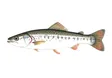
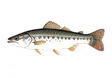
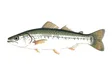
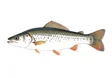
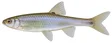
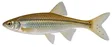
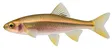
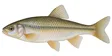
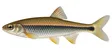
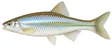
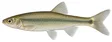
Red shiners can live up to three years. They are omnivorous; they eat both aquatic and terrestrial invertebrates, as well as algae. Red shiners have also been known to eat the eggs and larvae of native fish found in locations where they have been introduced.
Reproduction
The spawning season for red shiners is generally from mid-April through September. In addition to spawning in crevices like other members of the genus Cyprinella, red shiners also broadcast their eggs and attach them to rocks or vegetation. Females can release up to 16 batches per day with up to 71 eggs per batch. The average clutch size, however, is 585 eggs and they may have five to 19 clutches in one reproductive season. Red shiners are capable of generating viable hybrid offspring with closely related species, such as the blue shiner and the blacktail shiner.
Habitat
Red shiners are found naturally in a variety of aquatic habitats, including backwaters, creek mouths, streams containing sand and silt substrates, riffles, and pools. They are tolerant of areas of frequent high turbidity and siltation, but they tend to avoid waters with high acidity. Red shiner are habitat generalists in that they are adapted to favor a wide range of environmental conditions that are not ideal to most other fish species. These include habitats degraded by human disturbance, and those with poor water quality (such as polluted waterways), natural physiochemical extremes, and seasonally intermittent flows.
Range
The red shiner is naturally found in the Mississippi River basin from southern Wisconsin and eastern Indiana to South Dakota and Wyoming and south to Louisiana. It is also found as an introduced species in Arizona, Alabama, California, Colorado, Illinois, Georgia, Nebraska, North Carolina, South Carolina, Wyoming, Massachusetts, Utah, Virginia, Nevada, and New Mexico. Although the species is overall widespread and common, the subspecies from Maravillas Creek in Texas (Cyprinella lutrensis blairi) became extinct in the late 1950s due to competition from the invasive plains killifish.
Invasiveness
The red shiner is a common bait fish, and the emptying of bait buckets containing them is believed to be the main cause of introduction of this species into new areas. It is also commonly used as an aquarium fish. It has become a species of special concern in the United States, as it has been implicated in the decline of native fish populations in the areas where it has been introduced. As previously mentioned, red shiners have been known to eat the eggs of native fish and in doing so hinder the growth of those populations. They are also adapted to thrive in a variety of environments, and as generalists, may be better able to persist in disturbed habitats than native species of those areas. Red shiners are capable of hybridizing with the blacktail shiner (Cyprinella venusta stigmatura), a native species found in the Coosa River, which serves to dilute the gene pool of this species.
Article text: Wikipedia contributors, Red shiner (source revision). Licensed under CC BY-SA 4.0. Retrieved 2026-10-11.
Diet and feeding
The FishTraits compilation records these diet categories for this species: algae or phytoplankton; invertebrates or larval fish. These are broad categories, not a claim that every individual consumes every example in a category.
Reported feeding positions include bottom feeding. The compilation combines published observations; diets can vary with age, locality, and available food.
Habitat preferences
Reported habitat associations include medium to large rivers, streams and small rivers, creeks, still-water habitats.
The source records associations with clay or silt, sand, gravel. An association indicates reported use, rather than an exclusive requirement.
Reproduction and parental care
The compilation reports a representative maturity age of 1.5 years. Its maturity field summarizes mean, median, or modal estimates, usually for females; male estimates can be used when female data are unavailable. It is not a fixed age at which every fish first breeds.
Batch or serial spawning has been reported somewhere in the species’ range. This does not establish the same spawning pattern for every population.
Recorded spawning months are Mar, Apr, May, Jun, Jul, Aug, Sep for the source’s reporting region (OK). This is a regional calendar, not a range-wide schedule.
The reproductive-guild classification includes spawning on open substrates without guarding the brood.
Size and recorded longevity
FishTraits reports a maximum total length of 9 centimetres. Some entries use an estimated asymptotic length; this value should not be treated as a certified record catch.
Recorded longevity in the compilation is 3 years. Wild observations were preferred, but captive records were accepted where wild records were unavailable, and unspecified records were assumed wild. The value is not a guaranteed wild lifespan or an aquarium life expectancy.
Identification and appearance
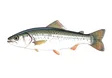
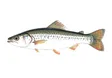
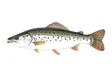
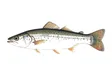
Cyprinella lutrensis is a deep-bodied minnow that is laterally compressed (Farringer et al. 1979; Page and Burr 2011). The mouth is terminal with a round snout (Page and Burr 1991). This species has silver sides with olive-green to blue coloration above the lateral line and a whitish abdomen (Mayden 1989; Page and Burr 2011). A dark stripe runs along the back with a dark, dusky colored dorsal fin (Page and Burr 2011). Breeding males have iridescent pink-purple-blue sides and a red crown and fins, except the dorsal fin which remains dark (Mayden 1989; Page and Burr 2011). There are 32–36 lateral scales, and the anal fin usually has nine rays (Page and Burr 2011).
Native range
Mississippi River basin from southern Wisconsin and eastern Indiana to South Dakota and Wyoming and south to Louisiana; Gulf drainages west of Mississippi River to Rio Grande, Texas, New Mexico, and Colorado. Absent in Ozark and Ouachita uplands (Page and Burr 2011).
Habitat and ecology
In a laboratory setting, Red Shiner survived up to 10 ppt salinity, pH 5–10, and dissolved oxygen concentrations down to 1.0 ppm at 24°C. They also tolerate extreme thermal shock, up to 43°C, down to 0°C (Matthews and Hill 1977; Matthews 1986) and sustained high temperatures in an experimental stream (37°C for 4 days) (Dekar et al. 2014).
Cyprinella lutrensis spawns over an extended period of time from spring into fall months, with a peak from early to mid-summer. Breeding season in Georgia is May through July, and in south central Oklahoma and central Texas it is from April to September (Farringer et al. 1979). Spawning may occur on riffles, on or near submerged objects, over vegetation beds, or in association with sunfish nests. Some individuals breed in two successive years, but very few breed in the same year they are hatched (Farringer et al. 1979). Females lay adhesive eggs in 5–19 clutches per reproductive season, ranging from approximately 400–700 eggs per batch and up to 16 batches per day (Gale 1986).
Adults typically school in midwater or near the surface. The species is thought to feed primarily on small invertebrates, plant matter and algae, and occasionally fish larvae (Laser and Carlander 1971). Red Shiners are forage fish and are consumed by various piscivores. In experimental units, Red Shiner survival was significantly negatively related to the abundance of Sunfish (Lepomis spp.) suggesting that predation can inhibit early stages of invasion by Red Shiners (Marsh-Matthews et al. 2011). Average life span of Red Shiner is 2–3 years in the wild (Herrington and DeVries 2008).
Introduction history
Initial introduction of Cyprinella lutrensis is often followed by its rapid population growth, dispersal, and aggressive colonization (e.g., Hubbs and Lagler 1958, Minckley and Deacon 1968, Minckley 1973). In some areas dispersal of introduced populations has been aided by the presence of irrigation ditches and canals (e.g., Jennings and Saiki 1990).
Ecological impacts
Ruppert et al. (1993) suggested that establishment of Red Shiner in Yampa River and Green River immediately below their confluence in Dinosaur National Monument, Colorado has led to predation on vulnerable larvae of native populations of razorback sucker (Xyrauchen texanus) and Colorado pikeminnow (Ptychocheilus lucius). This assumption was supported by a laboratory study that indicated that Red Shiner are a potential predator of razorback sucker larvae (Carpenter and Mueller 2008). In 2008, Schooley et al. (2008) found razorback sucker larvae in the guts of Red Shiners in Salt River and Sycamore Creek, Arizona.
The Red Shiner has also affected the distribution and abundance of native fishes. For example, populations in the Moapa and Virgin rivers, Nevada, have been implicated in the decline of the native fish of this region, including Spikedace (Meda fulgida), Woundfin (Plagopterus argentissimus), and Virgin River Chub (Gila seminuda) (Moyle 1976; Deacon 1988; U.S. Fish and Wildlife Service 1990). Members of this species may compete with and affect growth, condition, or survival of young Colorado Pikeminnow (Karp and Tyus 1990, Muth and Snyder 1995).
The Red Shiner may dilute the gene pools of native Cyprinella via hybridization (Mayden 1989, Burkhead and Huge 2002); studies have found that the Red Shiner is hybridizing with the Blacktail Shiner (Cyprinella venusta) in the Coosa River basin in Georgia and Alabama (Mettee et al. 1996, Burkhead and Huge 2002, Walters et al. 2007, Blum et al. 2010). The rate of hybridization between Red and Blacktail Shiners was higher due to increased premating social interactions in elevated turbidity (Glotzbecker et al. 2015).
The introduction of Red Shiner into Utah was probably how the Asian tapeworm entered the Virgin River; subsequent tapeworm infestation of Woundfin may be primarily responsible for the Woundfin's decline during the 1980s (Deacon 1988). The Red Shiner is one of the species that potentially introduced the Asian fish tapeworm (Bothriocephalus acheilognathi) to the Lower Colorado River (Choudhury et al. 2004). The introduction of Red Shiner to the Great Lakes may further the spread of Bothriocephalus acheilognathi within the basin (Marcogliese et al. 2016). Red Shiner are host to Pseudocapillaria tomentosa, a parasitic nematode that can cause inflammation and intestinal lesions in fish (Leis et al. 2016).
Introduced Red Shiner populations have contributed to the reduction of many fish populations and are known to dominate fish assemblages. For example, the introduced Redside Shiner (Richardsonius balteatus) declined when the Red Shiner became common in the Green River near the boundary of Dinosaur National Monument, Utah, in 1971 (Holden and Stalnaker 1975). In degraded streams in Georgia, introduced Red Shiners have become one of the most abundant species (Devivo and Freeman 1995). In a 1985-88 study of the Colorado and Green Rivers adjacent to Canyonlands National Park, introduced Red Shiners made up nearly 50% of the catch per unit effort (Valdez and Williams 1993).