Emerald Shiner

Notropis atherinoides

Leuciscidae · freshwater water fish

7 minute read · Species guide

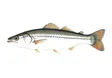
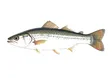
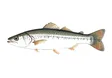
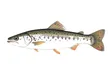
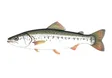
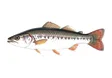
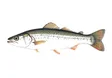
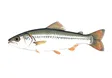
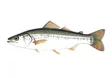
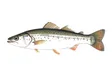
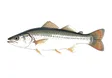
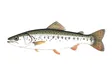
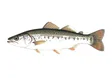
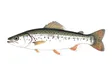
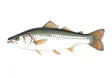
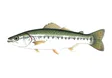
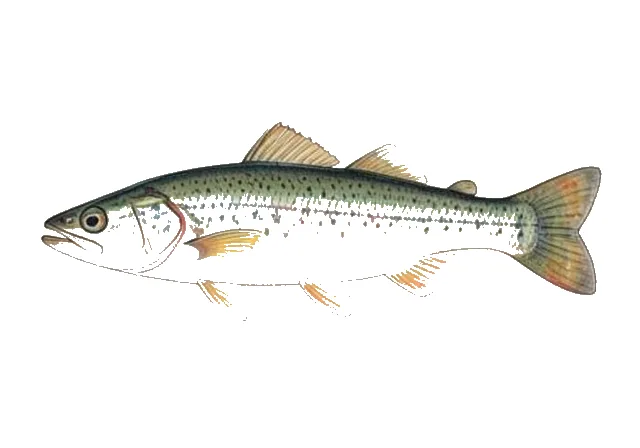
Emerald Shiner field guide illustration

About Emerald Shiner

The emerald shiner (Notropis atherinoides) is a species of freshwater ray-finned fish belonging to the family Leuciscidae, the shiners, daces and minnows. The identifying characteristic of the emerald shiner is the silvery emerald color on its sides. It is found across North America from Canada to the Gulf of Mexico, commonly in large, deep lakes and rivers, though sometimes in smaller bodies of water as well. It feeds on small organisms such as zooplankton and insects, congregating in large groups near the surface of the water. It is a quite common fish and is often used as a bait fish.

Distribution

Emerald shiners are native to North America; they are widely distributed throughout Canada, and south to Virginia and Texas. They range to the gulf coast from Texas to Alabama, and are especially prevalent in the Mississippi Basin. Emerald shiners are most likely the most abundant fish in the Mississippi.

Length

Maximum size is 89–127 millimetres (3.5–5.0 in). Females are larger than males.

Coloration

Live emerald shiners are a bright, iridescent, silvery green with a silver mid-lateral band. The back and upper sides are emerald greenish to straw colored, and the ventral side of the fish is a silvery white color. The dorsal scales have pigmented margins and clear centers. The area between the nostril and the eye lacks pigment, and the lips are pigmented medially and continues to halfway down the midline of the lower jaw. The dorsal, caudal, and leading rays of the pectoral fins are lined with pigment, but the remaining fin rays and membranes are clear. The underside of the opercle are gray. There are no nuptial colors exhibited by either sex.

Body morphology

Shiners have a slender, laterally flattened, and compressed body type. The dorsal fin is transparent, with eight rays located right behind the insertion of the pelvic fins. They have 9 to 12 anal fin rays, 35 to 43 lateral line scales, 19 to 20 pre-dorsal scale rows, 14 to 16 pectoral fin rays, and 8 or 9 pelvic fin rays. The mouth is large and in the terminal and oblique position, and does not have a barbel. The pharyngeal teeth are hooked, and are in a 2, 4–4, 2 or 1, 4–4, 1 pattern. Shiners have a short and blunt snout, and the upper lip is separated from the skin of the snout by a deep groove that is continuous across the midline. The cartilaginous ridge of the lower jaw is not very evident.

Habitat

Living in freshwater, emerald shiners are benthopelagic. They live in large open rivers, lakes, and reservoirs. In medium-sized habitats the temperature preference for the shiner is 25 °C (77 °F), and they are tolerant of low oxygen levels. It is a midwater or near-surface species that usually lives in large or moderately sized schools. Some shiners are tolerant of turbidity in streams, but others avoid turbid streams. They are most commonly seen in clear water over sand or gravel.

Diet habits

Shiners are planktivores, feeding on a variety of zooplankton, protozoans and diatoms. They move with a planktonic food source up toward the surface at dusk, and move back down at dawn. Both aquatic and terrestrial insects obtained at the surface of the water are a small portion of their diet. Algae and plants are also eaten, during spring especially.

Importance to humans

Emerald shiners are used for fishing bait, especially for winter fishing because of the shiner's hardiness in cold weather. They are also an important resource for other animals to forage. The glistening sides of the shiner, along with its graceful movements make it a good aquarium fish.

Conservation status

Currently, this species is of relatively low conservation concern and does not require significant additional protection or major management, monitoring, or research action. The IUCN Red List status of the emerald shiner is of least concern. Other than being caught for use in fish bait, emerald shiners are preyed upon by birds (gulls, terns, mergansers, cormorants) and fishes.

Life span

The maximum reported age of emerald shiners is four to five years. Females live longer than males, and all older fish that have been found were female.

Reproduction

Emerald shiners are oviparous. Females have been known to spawn anywhere from late spring (mid-May) to late summer (mid-August). Spawning is temperature dependent, and begins around 22.2 °C (72.0 °F). This is known as the threshold temperature. In Canada, females have been found to spawn in temperatures ranging from 20.1 to 23.2 °C (68.2 to 73.8 °F). Emerald shiners tend to spawn near the surface in open water near boulders and gravel shoals. Eggs usually hatch between 24 and 32 hours. They are pelagic spawners with numerous buoyant eggs that have none or poorly-developed respiratory organs, and little pigment.

Spawning occurs at night, about 1 to 2 feet below the surface, milling and darting in a circular path. Smaller males tend to pursue larger females, and the pairs swim together in a circle. The male presses closely on one side of the female, interlocking pectoral fins and gyrating. The female then rolls over and eggs are released for the male to fertilize. Males are mature at 55–60 mm, and females at 65 mm.

Etymology of name

Notropis, comes from the Greek noton, meaning "back keel". The species name atherinoides comes from the Greek atherina, meaning silverside; and from the Greek suffix oides, meaning resemblance.

Trivia

Emerald shiners resemble members of the silverside family, hence the species name atherinoides, silverside-like. This is in reference to the Old World silverside family.

Other common names include: Buckery shiner, common emerald shiner, lake shiner, lake silver side, plains shiner, river emerald shiner, shiner.

Plains shiner (Notropis percobromus) was recently incorporated into the emerald shiner species designation.

Article text: Wikipedia contributors, Emerald shiner (source revision). Licensed under CC BY-SA 4.0. Retrieved 2026-10-11.


Diet and feeding

The FishTraits compilation records these diet categories for this species: algae or phytoplankton; aquatic or other vascular plants; detritus or unidentified plant material; invertebrates or larval fish. These are broad categories, not a claim that every individual consumes every example in a category.

Reported feeding positions include surface or water-column feeding. The compilation combines published observations; diets can vary with age, locality, and available food.

Habitat preferences

Reported habitat associations include medium to large rivers, streams and small rivers, still-water habitats.

The source records associations with sand, gravel, cobble. An association indicates reported use, rather than an exclusive requirement.

Reproduction and parental care

The compilation reports a representative maturity age of 1 years. Its maturity field summarizes mean, median, or modal estimates, usually for females; male estimates can be used when female data are unavailable. It is not a fixed age at which every fish first breeds.

Recorded spawning months are May, Jun, Jul for the source’s reporting region (NC). This is a regional calendar, not a range-wide schedule.

The reproductive-guild classification includes spawning on open substrates without guarding the brood.

Size and recorded longevity

FishTraits reports a maximum total length of 13 centimetres. Some entries use an estimated asymptotic length; this value should not be treated as a certified record catch.

Recorded longevity in the compilation is 3 years. Wild observations were preferred, but captive records were accepted where wild records were unavailable, and unspecified records were assumed wild. The value is not a guaranteed wild lifespan or an aquarium life expectancy.

Native range

St. Lawrence drainage, Quebec; Hudson River drainage, New York to Mackenzie River drainage (Arctic basin), Northwest Territories, and south through Great Lakes and Mississippi River basins to Gulf; Gulf Slope drainages from Mobile Bay, Alabama, to Galveston Bay, Texas (Page and Burr 1991).

Habitat and ecology

In its native range in the Upper Niagra River, Notropis atherinoides juveniles are more often found in natural habitat (e.g. marshes) than developed habitat (e.g. seawalls; Cochran 2017). Cochran (2017) also found that larvae recruited to sampling gear in July and August. This species is a key forage species in its native range (Cochran 2017).

Introduction history

This species was stocked as forage in Jennings Randolph Reservoir, Maryland (Christmas, personal communicaton), Lake McConaughy, Nebraska (Bouc 1987), and in certain Wyoming reservoirs (Hubert 1994). Its presence in two reservoirs in New York may be due either to bait bucket releases or to movement through the Old Chenango Canal (Snelson 1968; Smith 1985). Snelson (1968) also hypothesized that the widespread occurrence of this species in the Mohawk-Hudson system of New York may have been a result of dispersal through the Erie Canal system. If records from West Virginia represent introductions, the method of entry was likely by way of bait bucket releases. The species probably was brought to Maine illegally as a baitfish; however, information on the location and exact date of its first occurrence in the state has been lost (Kircheis 1994). It was introduced into Willard Bay Reservoir in Utah in 1983 (Sigler and Sigler 1987). The Emerald Shiner has been stocked for forage in many Colorado reservoirs (Colorado Division of Wildlife).

Record fish

The Montana state record

  • Montana0.01 lbs.

    Park Grove Bridge · 6/9/06 · Ike Braaten

Each figure is the state agency’s own certified record. The site holds record tables for 11 states so far, so a state missing here has not been read yet. It is not a state where this fish holds no record.

Range

Where it lives

Share of 13,775 GBIF observation records with a state location, across 35 states. The orange dots are USGS stream-survey sites where this species was caught.
0%
24.4%
Share of 13,775 GBIF observation records with a state location, across 35 states. The orange dots are USGS stream-survey sites where this species was caught.

A blank area on the dot layer usually means nobody sampled there, not that the fish is absent. Turn on “every survey site” to see where the survey looked.

The USGS stream survey caught it at 1,716 of its sites, in 27 states. That survey and the GBIF records are two different counts of two different things, so the site keeps them apart.

Habitat

Water and movement

Water
WoRMS records this species in fresh water.
USGS NAS habitat
Freshwater
US status
Native transplant — native to part of the United States, moved to other waters inside it.
Migration
Undetermined
Pattern
Disagreement
4 published references do not agree on the pattern: Non-migratory, Potamodromous. The site shows every assignment rather than picking one.

Classification

Taxonomy

Kingdom
Animalia
Phylum
Chordata
Superclass
Actinopterygii
Class
Teleostei
Order
Cypriniformes
Genus
Notropis
Species
Notropis atherinoides
ITIS TSN
163412
WoRMS AphiaID
567536
GBIF key
2362170
Outside the US
ITIS also files it in Canada.

Common questions about Emerald Shiner

What is the scientific name of Emerald Shiner?
The scientific name is Notropis atherinoides, in the family Leuciscidae. Classification follows ITIS.
Does Emerald Shiner live in fresh water or salt water?
WoRMS records this species in fresh water.
Where has Emerald Shiner been recorded in the United States?
GBIF has observations in 35 states, with the most records in Oklahoma, Illinois, Ohio. The map shows observation records, which do not establish the complete natural range.

Closest relatives

Other Notropis species

Arkansas River Shiner5 states
Notropis girardiLeuciscidaeNative and introducedFresh
Bedrock Shiner3 states
Notropis rupestrisLeuciscidaeNativeFresh
Bigeye Shiner17 states
Notropis boopsLeuciscidaeNative and introducedFresh
Bigmouth Shiner21 states
Notropis dorsalisLeuciscidaeNative and introducedFresh
Blackchin Shiner13 states
Notropis heterodonLeuciscidaeNativeFresh
Blackmouth Shiner3 states
Notropis melanostomusLeuciscidaeNativeFresh
Blacknose Shiner21 states
Notropis heterolepisLeuciscidaeNative and introducedFresh
Blackspot Shiner5 states
Notropis atrocaudalisLeuciscidaeNativeFresh
Bluntnose Shiner3 states
Notropis simusLeuciscidaeNativeFresh
Bridle Shiner22 states
Notropis bifrenatusLeuciscidaeNativeFresh
Burrhead Shiner3 states
Notropis asperifronsLeuciscidaeNativeFresh
Cahaba Shiner1 states
Notropis cahabaeLeuciscidaeNativeFresh
Cape Fear Shiner1 states
Notropis mekistocholasLeuciscidaeNativeFresh
Carmine Shiner16 states
Notropis percobromusLeuciscidaeNativeFresh
Channel Shiner15 states
Notropis wickliffiLeuciscidaeNativeFresh
Chihuahua Shiner1 states
Notropis chihuahuaLeuciscidaeNative and introducedFresh
Chub Shiner4 states
Notropis potteriLeuciscidaeNative and introducedFresh
Coastal Shiner8 states
Notropis petersoniLeuciscidaeNativeFresh
Comely Shiner11 states
Notropis amoenusLeuciscidaeNative and introducedFresh
Coosa Shiner9 states
Notropis xaenocephalusLeuciscidaeNative and introducedFresh
Dusky Shiner6 states
Notropis cummingsaeLeuciscidaeNativeFresh
Fluvial Shiner3 states
Notropis edwardraneyiLeuciscidaeNativeFresh
Ghost Shiner16 states
Notropis buchananiLeuciscidaeNative and introducedFresh
Greenhead Shiner6 states
Notropis chlorocephalusLeuciscidaeNativeFresh

Same family

More Leuciscidae

Alabama Shiner4 states
Cyprinella callistiaLeuciscidaeNativeFresh
Allegheny Pearl Dace19 states
Margariscus margaritaLeuciscidaeNative and introducedFresh
Altamaha Shiner1 states
Cyprinella xaenuraLeuciscidaeNativeFresh
Alvord Chub2 states
Siphateles alvordensisLeuciscidaeNativeFresh
Apalachee Shiner3 states
Pteronotropis grandipinnisLeuciscidaeNativeFresh
Arkansas River Shiner5 states
Notropis girardiLeuciscidaeNative and introducedFresh
Arroyo Chub1 states
Gila orcuttiiLeuciscidaeNative and introducedFresh
Bandfin Shiner5 states
Luxilus zonistiusLeuciscidaeNative and introducedFresh
Bannerfin Shiner5 states
Cyprinella leedsiLeuciscidaeNativeFresh
Beautiful Shiner3 states
Cyprinella formosaLeuciscidaeNativeFresh
Bedrock Shiner3 states
Notropis rupestrisLeuciscidaeNativeFresh
Bigeye Chub25 states
Hybopsis amblopsLeuciscidaeNative and introducedFresh
Bigeye Shiner17 states
Notropis boopsLeuciscidaeNative and introducedFresh
Bigmouth Chub3 states
Nocomis platyrhynchusLeuciscidaeNativeFresh
Bigmouth Shiner21 states
Notropis dorsalisLeuciscidaeNative and introducedFresh
Blackchin Shiner13 states
Notropis heterodonLeuciscidaeNativeFresh
Blackmouth Shiner3 states
Notropis melanostomusLeuciscidaeNativeFresh
Blacknose Shiner21 states
Notropis heterolepisLeuciscidaeNative and introducedFresh
Blackside Dace2 states
Chrosomus cumberlandensisLeuciscidaeNativeFresh
Blackspot Shiner5 states
Notropis atrocaudalisLeuciscidaeNativeFresh
Blacktail Shiner14 states
Cyprinella venustaLeuciscidaeNative and introducedFresh
Blacktip Shiner4 states
Lythrurus atrapiculusLeuciscidaeNative and introducedFresh
Bleeding Shiner8 states
Luxilus zonatusLeuciscidaeNativeFresh
Blotched Chub6 states
Erimystax insignisLeuciscidaeNativeFresh

All 267 species in Leuciscidae