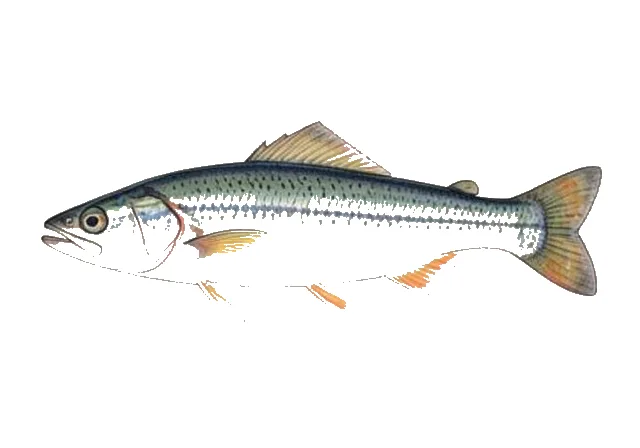
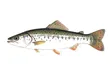
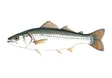
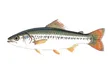
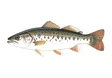
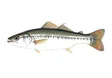
It is found in Pearl River, Apalachicola River and St. Johns River, but it is apparently not found in the Escatawpa River or Perdido River. It is known to have a fragmented population, and so has a spotty distribution in the Chipola River, Choctawhatchee River, Yellow River, Conecuh River, Alabama River and Tombigbee River. The population is very poorly known, with it being rare in the western panhandle of Florida, declining from the past 10 years in Mississippi and "ever decreasing" in Alabama.
In 2013, its conservation status was changed from Data Deficient to Vulnerable. It is threatened by streamside vegetation removal for agricultural and urban development and overcollection for the aquarium trade.
Additional field notes
Bluenose shiner form schools in quiet, vegetated freshwater habitats.
Sources: Pteronotropis welaka species summary
Depth and bottom setting
FishBase places schools in water about 1–2 metres deep, including backwaters and quiet pools over mud and sand. These are sheltered creek and river habitats, rather than swift exposed riffles. The depth observation gives a more specific search image than vegetation alone, which may also occur in much shallower water.
Sources: Pteronotropis welaka species summary
Guide sources
Research reviewed 2026-10-19.
Article text: Wikipedia contributors, Bluenose shiner (source revision). Licensed under CC BY-SA 4.0. Retrieved 2026-10-11.
Diet and feeding
The FishTraits compilation records these diet categories for this species: algae or phytoplankton. These are broad categories, not a claim that every individual consumes every example in a category.
Habitat preferences
Reported habitat associations include medium to large rivers, streams and small rivers.
The source records associations with muck, clay or silt, sand, vegetation. An association indicates reported use, rather than an exclusive requirement.
Reproduction and parental care
The compilation reports a representative maturity age of 1 years. Its maturity field summarizes mean, median, or modal estimates, usually for females; male estimates can be used when female data are unavailable. It is not a fixed age at which every fish first breeds.
Recorded spawning months are May, Jun, Jul, Aug for the source’s reporting region (MS). This is a regional calendar, not a range-wide schedule.
Size and recorded longevity
FishTraits reports a maximum total length of 5 centimetres. Some entries use an estimated asymptotic length; this value should not be treated as a certified record catch.
Recorded longevity in the compilation is 2 years. Wild observations were preferred, but captive records were accepted where wild records were unavailable, and unspecified records were assumed wild. The value is not a guaranteed wild lifespan or an aquarium life expectancy.