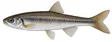
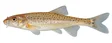
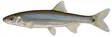
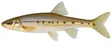
About chub
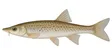
Chub is a common fish name. It pertains to any one of a number of ray-finned fish in several families and general. In the UK, the term chub usually refers to the species Squalius cephalus. In addition, see sea chub.
Common names
60 species carry chub in an English common name. They sit in 1 family, so the group is a name, not a scientific rank.
Chub is a common fish name. It pertains to any one of a number of ray-finned fish in several families and general. In the UK, the term chub usually refers to the species Squalius cephalus. In addition, see sea chub.
These species profiles show how members of the group differ. Their biology describes each named species, rather than every fish in the group.
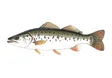 Creek Chub
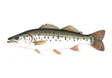
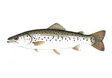
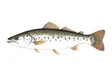
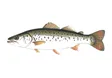
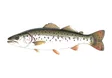
Semotilus atromaculatus, the creek chub or the common creek chub, is a species of freshwater ray-finned fish belonging to the family Leuciscidae. This species is found in the eastern US and Canada. Differing in size and color depending on origin of development, the creek chub can usually be defined by a dark brown body with a black lateral line spanning horizontally across the body. It lives primarily within streams and rivers. Creek chubs attain lengths of 2–6 inches (5.1–15.2 cm) with larger specimens of up to 12 inches (30 cm) long.
A fish which can withstand many different environments, the creek chub's current range is the eastern two-thirds of the US and southeastern Canada. It can quickly adapt to different extreme environments, and can live on many different foods. Documented to span throughout the Great Lakes surrounding Wisconsin, and into Minnesota, this species has been described as plentiful. However, reports of this species have fallen throughout Wisconsin and the Great Lakes, suggesting a decline in its population in these regions.
Though populations have been declining within the Great Lakes, they have been continually documented throughout small and medium rivers and streams. Thriving in small stream environments, the creek chub gravitates toward areas of weeds to appear secure and avoid predation. Varying in environments containing a multitude of substrates, they have been documented over gravel, sand, silt, rubble, mud, boulders, clay, bedrock and detritus bottoms. This fish actually prefers the stream or river environment compared to that of a lake, as they have been recorded in streams far more than lakes. Of over 440 individuals caught, only 9 were from lakes, and when limiting the locations to solely lakes, only six individuals were caught.
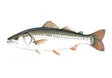
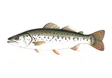
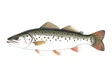
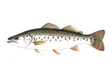
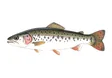
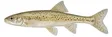
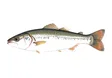
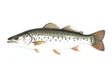
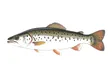
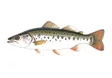
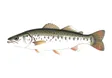
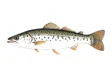
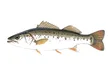
The creek chub is a small chub with a greenish-brown back, cream-colored sides interrupted by horizontal black stripes running from the nose to the tail, and a white belly. Having a round, cylindrical body with a compressed posterior, males average 125 mm (4.9 in) in length, while females average 105 mm (4.1 in). As the specimen eats what is directly in front of it, the mouth is terminal, large and under the anterior of the eye.
The creek chub has been known to slightly differ in coloration, containing black backs with a brown or yellowish middle lines. The average chub ranges in size from 127–178 mm (5.0–7.0 in) in length, with the largest chub documented to be 197 mm (7.8 in) long. They can be identified from other common minnow species by the black "moustache" on their upper lips, along with a black dot on their dorsal fins. Additionally, juvenile males develop a rosy band on their sides, along with glossy, dark dorsal fin spots.
The scales of this species are quite unique to the needs of the creek chub, ultimately helping to protect and maneuver. Scales do not appear until the fish is 26 mm (1 in) long, leaving 30 mm (1.2 in) -long individuals having small scales with few circuli. Major growth occurs during the first year, often jumping by over 50–70 mm (2.0–2.8 in) in one year. Males grow far more quickly than females, allowing maturity to occur at one to one and a half years of age.
The main scales covering the creek chub are bony-ridge scales; they are thin and flexible to aid movement. Cycloid scales are also found, allowing for smooth transport within the water with little disturbance from the scales themselves. They also have leptoid scales, which are flexible plates of bone which help to protect the fish from predators and act as armor.
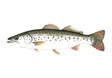 Sandhills Chub
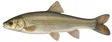
The Sandhills chub (Semotilus lumbee) is a species of freshwater ray-finned fish belonging to the family Leuciscidae. There are 4 species of Semotilus, 2 of which occur in South Carolina (Creek Chub and Sandhills Chub). This fish is found only in North Carolina and South Carolina. The Sandhills chub is predominately found in the Carolina Sandhills and some areas of Cape Fear, Pee Dee and Santee river drainages. It is characterized by its robust body, large head and lack of a dark blotch or smudge on their dorsal fin which is present on the closely related Creek Chub. The Sandhills chub has fine scales, a pinkish body and can be up to 9.4 inches.
The Sandhills Chub is mostly found in the headwaters of streams in the Carolina Sandhills area and the populations are pretty stable in the small range of streams they live in. They are a vulnerable species due to their limited habitat and occurrences are mostly in the upper Lumber River system (Pee Dee drainage) and also in adjacent tributaries of the Cape Fear drainage. The total adult population size is unknown but is estimated to exceed over 10,000.
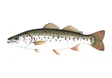
The Sandhills chub is a minnow that has a large mouth in a terminal position with a small flap-like barbel located on the corners of their mouths. It has nine dorsal fin rays and either has a light black spot or does not at the base of the dorsal fin. Their dorsal fin is located behind the pelvic fins. It has a slightly lunate caudal fin giving it a more curved fin. Its body is usually more than one color and they tend to have 46 lateral line scales, they also have cycloid scales which males them seem smooth when touched. Breeding male Sandhills chubs have a pinkish hue and orange fins, the adult fish tend to get up to 3.1–9.4 cm (1.2–3.7 in). They are bottom-fishes as they live in small streams and are more adapted for living on the bottom of the body of water they live in.
Reproduction usually happens between April and May, the best time is when temperatures are around the mid 50s (°F). The male will develop breeding tubercles on his head and the females are usually pinned down with their caudal peduncle under the males. The male mostly protects the nest during reproduction, and there aren't many predatory threats to Sandhills chub eggs.
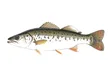 Dixie Chub
The Dixie chub (Semotilus thoreauianus) is a species of freshwater ray-finned fish belonging to the family Leuciscidae. It is endemic to southeastern United States.
The Dixie chub is similar in shape to the creek chub, (Semotilus atromaculatus) although it is typically a more robust and shorter than the creek chub. It also has larger and fewer lateral line scales, the origin of the dorsal fin is to the rear of that of the pelvic fin whereas in S. atromaculatus it sits directly over the pelvic fin origin, and the spots on the dorsal fin and caudal fin are less distinct. In the breeding season the males develop four large, hooked tubercles on either side of the head, with those nearest the nares frequently becoming fused.
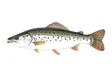
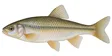
They are generally dark on the back, with the underside being colored from orange to pink on the underside while its fins are yellow-orange. Compared to S. atromaculatus the Dixie chub has a smaller number of head tubercles on its gill covers and caudal fin. The spot on the caudal peduncle is more diffuse than in S. atromaculatus which is normally wedge-shaped and distinct from the lateral stripe, while the equivalent spot in S. atromaculatus is quadrilateral and is joined to the lateral stripe. The lateral strip is dark and rather wide but not very distinct. It grows to a length of 65–150 millimetres (2.6–5.9 in).
The Dixie chub is endemic to rivers that flow into the Gulf of Mexico in the south-eastern United States from the Tombigbee River in Alabama to the Ochlockonee River drainage in Georgia and Florida. It has also been recorded from three tributaries of Bear Creek in Colbert County, Alabama, the first records from the drainage of the Tennessee River. The Dixie chub is sympatric with S. atromaculatus in the rivers draining into Mobile Bay where it is found in the coastal reaches up to the Fall Line but replaces it eastwards from the Conecuh River.
The Dixie chub is found in small, clear headwater streams in the pools of creeks and small rivers with sand or gravel substrates.
The fish aggregate to spawn in April. As in S. atromaculatus and S. lumbee this species creates breeding structures known as pit/ridge nests. These are constructed in the flowing stretches near pools which have a suitable refuge for the male to escape to, e.g. an undercut bank. The nests starts out as a pit excavated by a dominant male, the male mates with a female and then begins to cover the eggs with small pebbles taken from the substrate starting from the upstream end of the pit. Subsequent matings lead to the eggs being laid down stream of each previous batch of eggs and these are in turn covered by more pebbles and a new pit is excavated downstream, lengthening the ridge. The males guard the nests and display at other similar sized males, by swimming parallel to them. It will also aggressively lunge at other species which approach the nest. The saffron shiner (Notropis rubricroceus) has been recorded associating with nesting Dixie chubs.
Range
Species