Yaqui Chub

Gila purpurea

Leuciscidae · freshwater water fish

5 minute read · Species guide

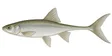
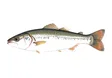
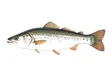
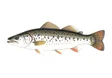
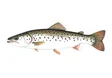
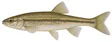
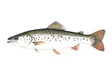
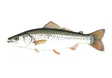
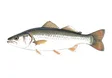
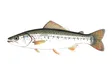
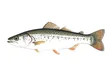
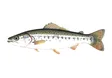
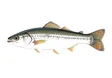
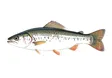
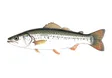
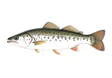
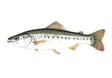
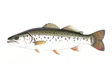
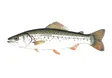
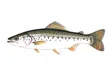
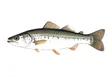
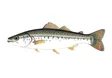
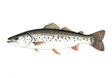
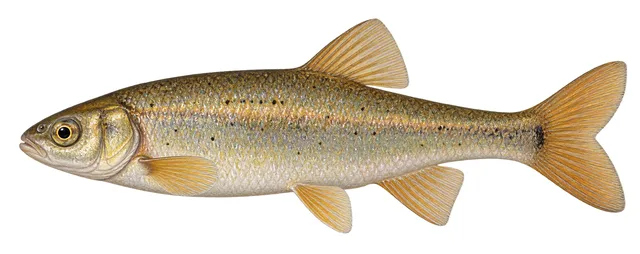
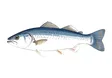
Yaqui Chub field guide illustration

About Yaqui Chub

The Yaqui chub (Gila purpurea) is a species of freshwater ray-finned fish belonging to the family Leuciscidae, which includes the daces, chubs, Eurasian minnows, and related species. It is found in northern Mexico and the United States. The Yaqui chub is a medium-sized minnow fish that historically occurred in streams of Rios Matape, Sonora, and Yaqui systems of Sonora, Mexico. It is one of the five species of the genus Gila in Arizona. The Yaqui chub is closely related to G. ditaenia (of Sonora, Mexico) and G. orcutti (of the Los Angeles Plain in California), and shares several physical characteristics with G. orcutti (Arroyo chub), but proves different by having a black wedge near the base of the caudal fin.

Description

The Yaqui chub has a short and rounded snout, which causes the mouth to be small and slightly subterminal. It has large eyes placed on a thick head, placed on a deep body. This is different from the posterior portion of the body, which is much thinner. The Yaqui chub has enlarged scales that are roughly imbricated. Coloration is usually dark overall, but sometimes has a lighter underside. The Yaqui chub's lateral bands are underdeveloped, making them quite difficult to observe. However, a vertically placed, triangle-shaped spot is usually present on the caudal fin. Very few Yaqui chubs can grow to about 17.8 cm (7 in) long, while the average length of this fish is less than 13 cm (5.1 in) long. Juveniles are usually 40–50 mm (1.6–2 in).

Range

Although the current distribution of the Yaqui chub in Mexico is unknown, some records show that this species has been introduced and established in Leslie Creek, in the Swisshelm Mountains of Arizona in 1969. This fish can also be found in the San Bernardino National Wildlife Refuge (SBNWR) and Leslie Canyon National Wildlife Refuges of Cochise County in Arizona. Specifically in the SBNWR, the current distribution of the Yaqui chub ranges from Leslie Creek to the House, Twin, North, and Mesquite Ponds, and the El Coronado Ranch (Turkey Creek). The Yaqui chub heavily relies on the artesian wells and springs of the SBNWR.

Habitat

Yaqui chubs prefer living in deep pools of smaller streams with dense vegetation in the water, but some individuals inhabit cleaner, open areas near the gravel bottoms that are covered with large amounts of algae. Their habitat includes deep, vegetated pools of creeks and spring runs.

Diet

When available, Yaqui chubs are known to eat aquatic insects and small fish, but they consume algae, terrestrial insects, and arachnids more often.

Reproduction

Although Yaqui chubs breed sporadically in the summer, young usually spawn around March. Fish have a distinct coloration during the breeding season; males turn into a "steely-blue" color, while the females become a drearier, yellowish-brown color.

Conservation

The U.S. population of the Yaqui chub is low but stable. Several threats are still present, though, including increased aquifer pumping, reduction of flows in streams, predation of nonnative fishes, overgrazing, and successive erosion. Protection of the San Bernardino aquifers and observation of nonnative fishes near the chub stream must be taken into account for this species to continue to exist. Some protective measures have been taken in an attempt for Yaqui chub conservation. In 1980, the Nature Conservancy purchased the San Bernardino Ranch, and eight years later, bought Leslie Canyon, both of which harbor strong Yaqui chub populations. These places bought by the conservancy were then sold to the U.S. Fish and Wildlife service to be established as national wildlife refuges. Soon after, a "Recovery Plan for the Endangered and Threatened fishes of the Rio Yaqui " was organized, but is still under review. The plan's main goal was to keep stable the habitats that the Yaqui chubs are currently occupying in Mexico and Arizona. The plan also involved conducting extensive research on the biology and habitat requirements for the Yaqui chub.

Article text: Wikipedia contributors, Yaqui chub (source revision). Licensed under CC BY-SA 4.0. Retrieved 2026-10-11.
Diet and feeding

The FishTraits compilation records these diet categories for this species: algae or phytoplankton; invertebrates or larval fish; larger animal prey (a source category covering fish, crayfish, crabs, or frogs). These are broad categories, not a claim that every individual consumes every example in a category.

Reported feeding positions include bottom feeding and surface or water-column feeding. The compilation combines published observations; diets can vary with age, locality, and available food.

Habitat preferences

Reported habitat associations include streams and small rivers, creeks.

The source records associations with sand, gravel, vegetation. An association indicates reported use, rather than an exclusive requirement.

Reproduction and parental care

The compilation reports a representative maturity age of 1 years. Its maturity field summarizes mean, median, or modal estimates, usually for females; male estimates can be used when female data are unavailable. It is not a fixed age at which every fish first breeds.

Recorded spawning months are Mar for the source’s reporting region (AZ). This is a regional calendar, not a range-wide schedule.

The reproductive-guild classification includes spawning on open substrates without guarding the brood.

Size and recorded longevity

FishTraits reports a maximum total length of 14 centimetres. Some entries use an estimated asymptotic length; this value should not be treated as a certified record catch.

Recorded longevity in the compilation is 3 years. Wild observations were preferred, but captive records were accepted where wild records were unavailable, and unspecified records were assumed wild. The value is not a guaranteed wild lifespan or an aquarium life expectancy.

Range

Where it lives

Share of 53 GBIF observation records with a state location, across 2 states.
0%
71.7%
Share of 53 GBIF observation records with a state location, across 2 states.

Share of records by state

Habitat

Water and movement

Water
WoRMS records this species in fresh water.
Migration
Undetermined

Classification

Taxonomy

Kingdom
Animalia
Phylum
Chordata
Superclass
Actinopterygii
Class
Teleostei
Order
Cypriniformes
Genus
Gila
Species
Gila purpurea
ITIS TSN
163557
WoRMS AphiaID
1419430
GBIF key
2360079
Outside the US
ITIS also files it in Mexico.

Common questions about Yaqui Chub

What is the scientific name of Yaqui Chub?
The scientific name is Gila purpurea, in the family Leuciscidae. Classification follows ITIS.
Does Yaqui Chub live in fresh water or salt water?
WoRMS records this species in fresh water.
Where has Yaqui Chub been recorded in the United States?
GBIF has observations in 2 states, with the most records in Arizona, New Mexico. The map shows observation records, which do not establish the complete natural range.

Closest relatives

Other Gila species

Same family

More Leuciscidae

Alabama Shiner4 states
Cyprinella callistiaLeuciscidaeNativeFresh
Allegheny Pearl Dace19 states
Margariscus margaritaLeuciscidaeNative and introducedFresh
Altamaha Shiner1 states
Cyprinella xaenuraLeuciscidaeNativeFresh
Alvord Chub2 states
Siphateles alvordensisLeuciscidaeNativeFresh
Apalachee Shiner3 states
Pteronotropis grandipinnisLeuciscidaeNativeFresh
Arkansas River Shiner5 states
Notropis girardiLeuciscidaeNative and introducedFresh
Arroyo Chub1 states
Gila orcuttiiLeuciscidaeNative and introducedFresh
Bandfin Shiner5 states
Luxilus zonistiusLeuciscidaeNative and introducedFresh
Bannerfin Shiner5 states
Cyprinella leedsiLeuciscidaeNativeFresh
Beautiful Shiner3 states
Cyprinella formosaLeuciscidaeNativeFresh
Bedrock Shiner3 states
Notropis rupestrisLeuciscidaeNativeFresh
Bigeye Chub25 states
Hybopsis amblopsLeuciscidaeNative and introducedFresh
Bigeye Shiner17 states
Notropis boopsLeuciscidaeNative and introducedFresh
Bigmouth Chub3 states
Nocomis platyrhynchusLeuciscidaeNativeFresh
Bigmouth Shiner21 states
Notropis dorsalisLeuciscidaeNative and introducedFresh
Blackchin Shiner13 states
Notropis heterodonLeuciscidaeNativeFresh
Blackmouth Shiner3 states
Notropis melanostomusLeuciscidaeNativeFresh
Blacknose Shiner21 states
Notropis heterolepisLeuciscidaeNative and introducedFresh
Blackside Dace2 states
Chrosomus cumberlandensisLeuciscidaeNativeFresh
Blackspot Shiner5 states
Notropis atrocaudalisLeuciscidaeNativeFresh
Blacktail Shiner14 states
Cyprinella venustaLeuciscidaeNative and introducedFresh
Blacktip Shiner4 states
Lythrurus atrapiculusLeuciscidaeNative and introducedFresh
Bleeding Shiner8 states
Luxilus zonatusLeuciscidaeNativeFresh
Blotched Chub6 states
Erimystax insignisLeuciscidaeNativeFresh

All 267 species in Leuciscidae