Lake Chub

Couesius plumbeus

Leuciscidae · freshwater water fish

6 minute read · Species guide

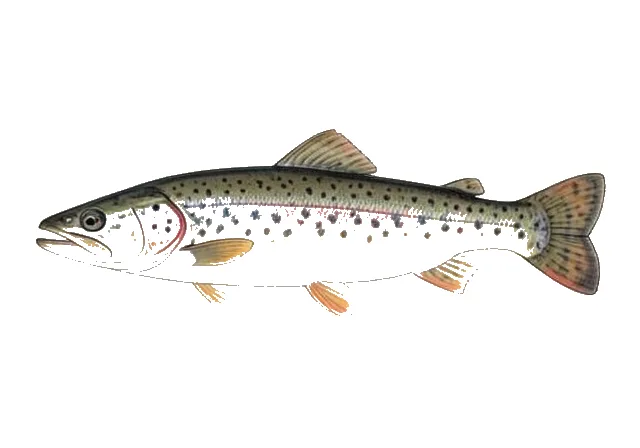
Lake Chub field guide illustration

About Lake Chub

The lake chub (Couesius plumbeus) is a species of freshwater ray-finned fish belonging to the family Leuciscidae, which includes the daces, Eurasian minnows and related species. This fish is found in Canada and in parts of the United States. Of all North American minnows, it is the one with the northernmost distribution. Its genus, Couesius, is considered monotypic today. The genus was named after Elliott Coues, who collected the holotype specimen.

Description

The body is fusiform and somewhat elongate. It is usually 100 to 175 mm (4 to 7 in) long, where the maximum length is approximately 225 mm (9 in). The back is olive-brown or dark brown, and the sides are leaden silver, hence the word plumbeus, referring to lead, in the scientific name of this fish. The snout is blunt and projects slightly beyond the upper lip. The corners of the mouth each bear a small barbel. The scales are small but well visible, and some may be black and form isolated dark spots on the lower sides. The dorsal, pelvic, and anal fins each have 8 rays. The pectoral fins are broad and have 13–18, but more usually 15–16, rays. The fish has no teeth, adipose fin, or spines. The mouth is relatively small, and the tail is forked. Breeding males can develop patches of bright orange or red at the base of the pectoral fins and sometimes near the mouth, and small nuptial tubercles on the top of the head, dorsal surface of pectoral rays, and on the belly near the base of the pectorals. The juveniles are similar to the adults, but have less obvious mottling or stripes. The females are typically larger than the males.

Distribution

The lake chub is generally found throughout Canada up to the Arctic Circle. Some scattered populations are also present in the northern United States, more precisely in New England, Michigan, Iowa, Wisconsin, Minnesota, the Dakotas, Montana, Wyoming, Colorado, Washington, Idaho and Utah. The lake chub is also the only minnow known to live in Alaska. Its range also includes Lake Michigan in Illinois and the Platte River system in Wyoming. There are relict populations of the lake chub in the upper Missouri River drainage.

Habitat

As its common name implies, the lake chub is most commonly found in cold-water lakes with clean gravel, and it can also live in cold-water rivers and streams. It often lives in shallows, but during mid- summer, it may move to the deeper parts of a lake to avoid the warmer waters of the lake shore.

Diet

The diet of the lake chub is varied: zooplankton, insects, aquatic insect larvae, and algae. The largest individuals can capture small fishes. The lake chub itself can be eaten by large predatory fishes and is therefore suitable as bait for fishing.

Growth

In and around Catamaran Brook, New Brunswick, Canada, lake chubs over 5 cm (2.0 in) long were found to grow by about 0.8 cm (0.31 in) a month in summer.

Reproduction

During spawning, male lake chub will pursue females. Spawning-ready males will charge a female which causes her to swim upward, sometimes breaking the water surface. The male swims next to the female, and if multiple males are present, they swim next to one another in order to compete for the female. During this process, the male's mouth will open and close rapidly until the female swims to a rock and the remaining male moves against her until her eggs are released.

Lake chubs normally undergo spawning migrations in early summer. Temperature plays a role in triggering migration onset, as migrations are delayed on colder years. Migrating chubs leave their lakes and rivers to ascend tributary streams, in which they mate (by day or night) and release their eggs over gravel or rocks. There is no parental care. During migration the fish move mostly during dusk and at night.

Behavior

In the laboratory, lake chubs have expressed free-running circadian rhythms that are among the most precise of the few fish species studied to date. These fish are usually diurnal in the laboratory, but in the wild they can be diurnal, crepuscular, or nocturnal.

The lake chub has large optic lobes in its brain and is therefore presumed to be a good sight feeder. It can, however, feed at night also. Comparisons with other freshwater fishes such as stickleback, northern pike, sculpin, and burbot have revealed that it has a superior hearing capacity.

Common name

The lake chub is sometimes called by other names such as northern chub, lake northern chub, chub minnow, plumbeus minnow, or bottlefish. The species is also found in Quebec and its French name is "mené de lac". The lake chub must not be confused with various cisco species of the genus Coregonus living in Lake Michigan, which are often called Michigan Lake chubs.

Subspecies

Three distinct subspecies of lake chub have been identified: C. p. plumbeus, C. p. greeni, and one formerly known as C. p. dissimilis. A name is no longer available for C. p. dissimilis.

Article text: Wikipedia contributors, Lake chub (source revision). Licensed under CC BY-SA 4.0. Retrieved 2026-10-11.


Diet and feeding

The FishTraits compilation records these diet categories for this species: algae or phytoplankton; invertebrates or larval fish; larger animal prey (a source category covering fish, crayfish, crabs, or frogs). These are broad categories, not a claim that every individual consumes every example in a category.

Reported feeding positions include bottom feeding and surface or water-column feeding. The compilation combines published observations; diets can vary with age, locality, and available food.

Habitat preferences

Reported habitat associations include streams and small rivers, creeks, still-water habitats.

The source records associations with sand, gravel, boulders. An association indicates reported use, rather than an exclusive requirement.

Reproduction and parental care

The compilation reports a representative maturity age of 3 years. Its maturity field summarizes mean, median, or modal estimates, usually for females; male estimates can be used when female data are unavailable. It is not a fixed age at which every fish first breeds.

Recorded spawning months are Apr, May for the source’s reporting region (WI). This is a regional calendar, not a range-wide schedule.

The reproductive-guild classification includes spawning on open substrates without guarding the brood.

Size and recorded longevity

FishTraits reports a maximum total length of 23 centimetres. Some entries use an estimated asymptotic length; this value should not be treated as a certified record catch.

Recorded longevity in the compilation is 5 years. Wild observations were preferred, but captive records were accepted where wild records were unavailable, and unspecified records were assumed wild. The value is not a guaranteed wild lifespan or an aquarium life expectancy.

Spawning movements

The compilation records significant spawning-related movement. Its combined migration flag covers movements within fresh water as well as between rivers and the sea; this flag alone does not establish which migration pattern applies.

Native range

Throughout much of Canada and northern United States; south to Delaware River, New York; southern end of Lake Michigan, Illinois; Platte River system, Colorado; and Columbia River drainage, Washington. Relict populations in Mississippi River basin, Iowa (Page and Burr 1991).

Introduction history

Probably introduced by bait bucket release (Baxter and Simon 1970).

Record fish

The Montana state record

  • Montana0.075 lbs.

    Corner Lake · 7/23/10 · James Cashell

Each figure is the state agency’s own certified record. The site holds record tables for 11 states so far, so a state missing here has not been read yet. It is not a state where this fish holds no record.

Range

Where it lives

Share of 990 GBIF observation records with a state location, across 21 states. The orange dots are USGS stream-survey sites where this species was caught.
0%
23.1%
Share of 990 GBIF observation records with a state location, across 21 states. The orange dots are USGS stream-survey sites where this species was caught.

A blank area on the dot layer usually means nobody sampled there, not that the fish is absent. Turn on “every survey site” to see where the survey looked.

The USGS stream survey caught it at 199 of its sites, in 7 states. That survey and the GBIF records are two different counts of two different things, so the site keeps them apart.

Habitat

Water and movement

Water
WoRMS records this species in fresh water.
USGS NAS habitat
Freshwater
US status
Native transplant — native to part of the United States, moved to other waters inside it.
Migration
Undetermined
Pattern
Disagreement
6 published references do not agree on the pattern: Non-migratory, Potamodromous. The site shows every assignment rather than picking one.

Classification

Taxonomy

Kingdom
Animalia
Phylum
Chordata
Superclass
Actinopterygii
Class
Teleostei
Order
Cypriniformes
Genus
Couesius
Species
Couesius plumbeus
ITIS TSN
163535
WoRMS AphiaID
567529
GBIF key
2360898
Outside the US
ITIS also files it in Canada.

Common questions about Lake Chub

What is the scientific name of Lake Chub?
The scientific name is Couesius plumbeus, in the family Leuciscidae. Classification follows ITIS.
Does Lake Chub live in fresh water or salt water?
WoRMS records this species in fresh water.
Where has Lake Chub been recorded in the United States?
GBIF has observations in 21 states, with the most records in Wyoming, Michigan, Maine. The map shows observation records, which do not establish the complete natural range.

Same family

More Leuciscidae

Alabama Shiner4 states
Cyprinella callistiaLeuciscidaeNativeFresh
Allegheny Pearl Dace19 states
Margariscus margaritaLeuciscidaeNative and introducedFresh
Altamaha Shiner1 states
Cyprinella xaenuraLeuciscidaeNativeFresh
Alvord Chub2 states
Siphateles alvordensisLeuciscidaeNativeFresh
Apalachee Shiner3 states
Pteronotropis grandipinnisLeuciscidaeNativeFresh
Arkansas River Shiner5 states
Notropis girardiLeuciscidaeNative and introducedFresh
Arroyo Chub1 states
Gila orcuttiiLeuciscidaeNative and introducedFresh
Bandfin Shiner5 states
Luxilus zonistiusLeuciscidaeNative and introducedFresh
Bannerfin Shiner5 states
Cyprinella leedsiLeuciscidaeNativeFresh
Beautiful Shiner3 states
Cyprinella formosaLeuciscidaeNativeFresh
Bedrock Shiner3 states
Notropis rupestrisLeuciscidaeNativeFresh
Bigeye Chub25 states
Hybopsis amblopsLeuciscidaeNative and introducedFresh
Bigeye Shiner17 states
Notropis boopsLeuciscidaeNative and introducedFresh
Bigmouth Chub3 states
Nocomis platyrhynchusLeuciscidaeNativeFresh
Bigmouth Shiner21 states
Notropis dorsalisLeuciscidaeNative and introducedFresh
Blackchin Shiner13 states
Notropis heterodonLeuciscidaeNativeFresh
Blackmouth Shiner3 states
Notropis melanostomusLeuciscidaeNativeFresh
Blacknose Shiner21 states
Notropis heterolepisLeuciscidaeNative and introducedFresh
Blackside Dace2 states
Chrosomus cumberlandensisLeuciscidaeNativeFresh
Blackspot Shiner5 states
Notropis atrocaudalisLeuciscidaeNativeFresh
Blacktail Shiner14 states
Cyprinella venustaLeuciscidaeNative and introducedFresh
Blacktip Shiner4 states
Lythrurus atrapiculusLeuciscidaeNative and introducedFresh
Bleeding Shiner8 states
Luxilus zonatusLeuciscidaeNativeFresh
Blotched Chub6 states
Erimystax insignisLeuciscidaeNativeFresh

All 267 species in Leuciscidae





















