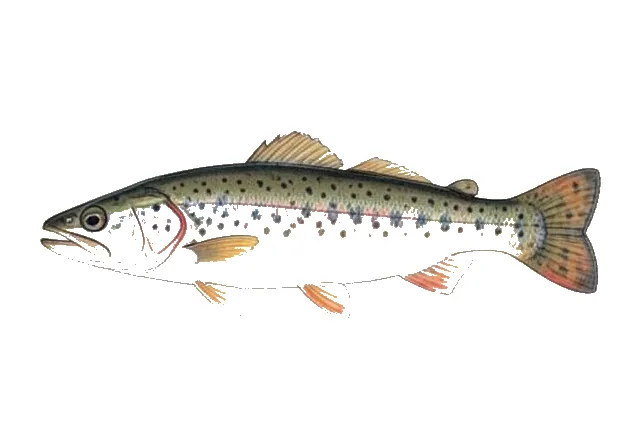
Borax Lake Chub

Siphateles boraxobius

Leuciscidae · freshwater water fish

2 minute read · Species guide

Borax Lake Chub field guide illustration

About Borax Lake Chub

The Borax Lake chub (Epizon boraxobius) is a species of freshwater ray-finned fish belonging to the family Leuciscidae, which includes the daces, chubs, Eurasian minnows and related fishes. This is a rare species which is found only in outflows and pools around Borax Lake, a small lake of the Alvord basin, Harney County, Oregon.

This species typically reaches only 2.0 inches (5 cm) in length, although some are as long as 4.3 inches (11 cm). The back is generally a dark olive green, while the sides are silvery, with a dark line extending from gill cover to tail, and a scattering of dark melanophores. The fins are colorless, with more melanophores on the rays of the dorsal fin and tail, as well as on the first four rays of the pectoral fins. Similar in many ways to the Alvord chub, the Borax Lake species has a longer, wider, and deeper head, and larger eyes, and the caudal peduncle is more slender.

The Borax Lake chub eats a variety of foods, including midge larvae, diatoms, copepods, ostracods, and terrestrial insects. Its preferred mode of feeding is to root around in the bottom, but it will go after floating material or feed from the surface if necessary.

This species is the sole fish inhabiting the Borax Lake waters. While parts of the lake itself can, at times, rise to about 100 °F (38 °C) fed from thermal springs, the average temperature ranges between 61–95 °F (16–35 °C). The fish avoid the warmest water, favoring lake's outflows. Its continued existence was threatened by geothermal energy development near the lake, which dried up part of the chub's habitat. However, in 2000 the Steens Mountain Cooperative Management and Protection Act put the area around the lake off-limits to geothermal exploration and mining.

It was listed as an endangered species by the U.S. Fish and Wildlife Department from 1980, when it was listed under an emergency rule that was made permanent in 1982, until July 2020, when it was delisted due to recovery. The Nature Conservancy had bought Borax Lake and surrounding land for conservation management in the interim.

Additional field notes

Borax Lake chub can be separated from the nearby Alvord chub by several structural details.

Sources: Siphateles boraxobius species summary

Comparison with Alvord chub

FishBase describes a larger head, a depression between the eyes, an incomplete lateral line, and a more slender tail stalk than in Alvord chub. The pectoral fin usually has 13 rays. Considering these characters together is more useful than relying on the fact that both are small chubs from the same regional basin.

Sources: Siphateles boraxobius species summary

Guide sources

Research reviewed 2026-10-19.

Article text: Wikipedia contributors, Borax Lake chub (source revision). Licensed under CC BY-SA 4.0. Retrieved 2026-10-12.

Range

Where it lives

Share of 42 GBIF observation records with a state location, across 1 states.
0%
100%
Share of 42 GBIF observation records with a state location, across 1 states.

Share of records by state

Habitat

Water and movement

Water
WoRMS records this species in fresh water.
Migration
Undetermined

Classification

Taxonomy

Kingdom
Animalia
Phylum
Chordata
Superclass
Actinopterygii
Class
Teleostei
Order
Cypriniformes
Genus
Siphateles
Species
Siphateles boraxobius
ITIS TSN
913990
WoRMS AphiaID
1012465
GBIF key
7193679

Common questions about Borax Lake Chub

What is the scientific name of Borax Lake Chub?
The scientific name is Siphateles boraxobius, in the family Leuciscidae. Classification follows ITIS.
Does Borax Lake Chub live in fresh water or salt water?
WoRMS records this species in fresh water.
Where has Borax Lake Chub been recorded in the United States?
GBIF has observations in 1 states, with the most records in Oregon. The map shows observation records, which do not establish the complete natural range.

Closest relatives

Other Siphateles species

Same family

More Leuciscidae

Alabama Shiner4 states
Cyprinella callistiaLeuciscidaeNativeFresh
Allegheny Pearl Dace19 states
Margariscus margaritaLeuciscidaeNative and introducedFresh
Altamaha Shiner1 states
Cyprinella xaenuraLeuciscidaeNativeFresh
Alvord Chub2 states
Siphateles alvordensisLeuciscidaeNativeFresh
Apalachee Shiner3 states
Pteronotropis grandipinnisLeuciscidaeNativeFresh
Arkansas River Shiner5 states
Notropis girardiLeuciscidaeNative and introducedFresh
Arroyo Chub1 states
Gila orcuttiiLeuciscidaeNative and introducedFresh
Bandfin Shiner5 states
Luxilus zonistiusLeuciscidaeNative and introducedFresh
Bannerfin Shiner5 states
Cyprinella leedsiLeuciscidaeNativeFresh
Beautiful Shiner3 states
Cyprinella formosaLeuciscidaeNativeFresh
Bedrock Shiner3 states
Notropis rupestrisLeuciscidaeNativeFresh
Bigeye Chub25 states
Hybopsis amblopsLeuciscidaeNative and introducedFresh
Bigeye Shiner17 states
Notropis boopsLeuciscidaeNative and introducedFresh
Bigmouth Chub3 states
Nocomis platyrhynchusLeuciscidaeNativeFresh
Bigmouth Shiner21 states
Notropis dorsalisLeuciscidaeNative and introducedFresh
Blackchin Shiner13 states
Notropis heterodonLeuciscidaeNativeFresh
Blackmouth Shiner3 states
Notropis melanostomusLeuciscidaeNativeFresh
Blacknose Shiner21 states
Notropis heterolepisLeuciscidaeNative and introducedFresh
Blackside Dace2 states
Chrosomus cumberlandensisLeuciscidaeNativeFresh
Blackspot Shiner5 states
Notropis atrocaudalisLeuciscidaeNativeFresh
Blacktail Shiner14 states
Cyprinella venustaLeuciscidaeNative and introducedFresh
Blacktip Shiner4 states
Lythrurus atrapiculusLeuciscidaeNative and introducedFresh
Bleeding Shiner8 states
Luxilus zonatusLeuciscidaeNativeFresh
Blotched Chub6 states
Erimystax insignisLeuciscidaeNativeFresh

All 267 species in Leuciscidae






















