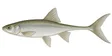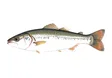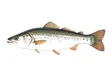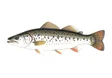
Roundtail Chub

Gila robusta

Leuciscidae · freshwater water fish

4 minute read · Species guide

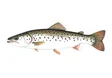
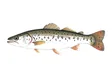
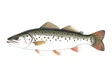
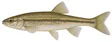
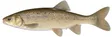
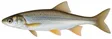
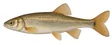
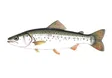
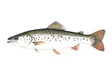
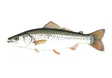
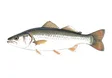
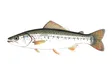
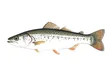
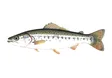
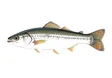
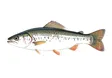
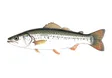
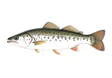
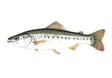
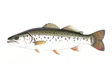
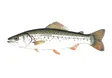
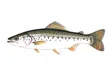
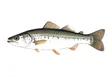
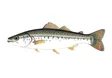
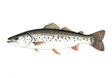
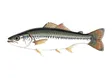
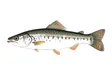
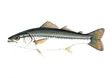
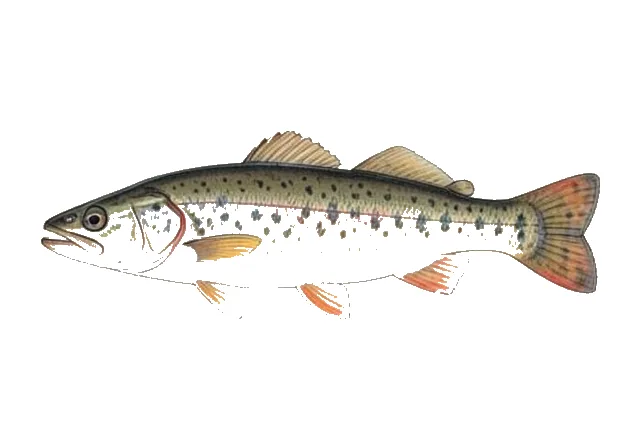
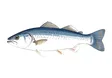
Roundtail Chub field guide illustration

About Roundtail Chub

The roundtail chub (Gila robusta) is a species of freshwater ray-finned fish belonging to the family Leuciscidae, which includes the daces, chubs, Eurasian minnows and related species. This species is found in southwestern North America. It is native to the Colorado River drainage basin, including the Gila River and other tributaries, and in several other rivers. It is part of the " robusta complex", which includes the Gila robusta robusta, G.r. grahami, and G.r. seminuda.

Evolution

A partial articulated fossil skeleton of a Gila chub, tentatively assigned to Gila robusta, has been recovered from the middle Pliocene -aged Bidahochi Formation of Arizona. This suggests that the Colorado River had already developed its iconic swift-river habitat by this point in time.

Description

The body of the roundtail chub is significantly larger forward of the dorsal fin, and posteriorly it is tapered towards the tail. The forehead area is concave. The mouth is largish, but does not reach as far as the pupil of the eye, and is overhung by the snout. The tail is deeply forked. Color is a grayish brown above, and a lighter shade below. Mature males sometimes acquire red-orange lower cheeks and paired fins during breeding season. Roundtail chub can reach almost 49 cm (19.5 in), but usually only grow to about 25–30 cm (10–12 in). Recently, it has been recorded at up to 43 cm (17 in) in length. Roundtail chub are also described to be "trout-like" because they possess a large mouth with the lower lip outlined in black. However, they lack the adipose fins found on trout species.

Range

Its range of is within the Colorado River drainage basin, found from the headwaters down to the mouth, in Utah, Colorado, Arizona, Nevada, and California, and northwest Mexico; as well as in other rivers of northwestern Mexico.

This species is rather variable, and formerly accounted as several species, until intermediate forms were discovered. Recognized subspecies include:

The roundtail chub has been extirpated from the Zuni and San Francisco Rivers of New Mexico.

In Arizona, specifically in Gila, Mohave, and Yavapai Counties, the roundtail chub occupies several tributaries: Fossil Creek, Oak Creek, Burro Creek, Francis Creek, Big Sandy River, Santa Maria River, Boulder Creek, Trout Creek, Sycamore Creek, Beaverhead Springs, and throughout the Verde River. It is also found in the Gila River and the Rio Yaqui.

Diet

Roundtail chub is a voracious predator, consuming large amounts of fish, crayfish, frogs, and insects. Roundtail chub adults primarily consume aquatic and terrestrial insects, other fishes, and sometimes algae. Roundtail chub juveniles eat smaller insects, crustaceans, and algae.

Conservation

The decreasing population of the roundtail chub is primarily the result of habitat loss as well as predation and competition by non-native fish. Although the populations in the Salt and Verde Rivers were stable ten years ago, they have been exponentially decreasing. Recent conservation efforts include more research to determine the mechanisms of their sudden disappearance, and population surveys conducted by the Arizona Game and Fish and US Forest Service (in progress).

Arizona Game and Fish Department considers roundtail chub a sport fish. They put up a strong fight for anglers, and the meat is described as "firm, white and very mild tasting." Intermuscular bones or floating bones are present, which can be cut out prior to cooking.

It is a candidate endangered species of the United States Fish and Wildlife Service, under the Endangered Species Act criteria. Gila robusta jordani and Gila seminuda are recognized as endangered species under the Endangered Species Act.

Article text: Wikipedia contributors, Roundtail chub (source revision). Licensed under CC BY-SA 4.0. Retrieved 2026-10-11.
Diet and feeding

The FishTraits compilation records these diet categories for this species: algae or phytoplankton; invertebrates or larval fish; larger animal prey (a source category covering fish, crayfish, crabs, or frogs). These are broad categories, not a claim that every individual consumes every example in a category.

Reported feeding positions include bottom feeding and surface or water-column feeding. The compilation combines published observations; diets can vary with age, locality, and available food.

Habitat preferences

Reported habitat associations include medium to large rivers, streams and small rivers, creeks.

The source records associations with gravel, cobble, boulders, bedrock. An association indicates reported use, rather than an exclusive requirement.

Reproduction and parental care

The compilation reports a representative maturity age of 2 years. Its maturity field summarizes mean, median, or modal estimates, usually for females; male estimates can be used when female data are unavailable. It is not a fixed age at which every fish first breeds.

Recorded spawning months are Feb, Mar for the source’s reporting region (NM). This is a regional calendar, not a range-wide schedule.

The reproductive-guild classification includes spawning on open substrates without guarding the brood.

Size and recorded longevity

FishTraits reports a maximum total length of 43 centimetres. Some entries use an estimated asymptotic length; this value should not be treated as a certified record catch.

Recorded longevity in the compilation is 9 years. Wild observations were preferred, but captive records were accepted where wild records were unavailable, and unspecified records were assumed wild. The value is not a guaranteed wild lifespan or an aquarium life expectancy.

Range

Where it lives

Share of 1,868 GBIF observation records with a state location, across 9 states. The orange dots are USGS stream-survey sites where this species was caught.
0%
37.8%
Share of 1,868 GBIF observation records with a state location, across 9 states. The orange dots are USGS stream-survey sites where this species was caught.

A blank area on the dot layer usually means nobody sampled there, not that the fish is absent. Turn on “every survey site” to see where the survey looked.

The USGS stream survey caught it at 55 of its sites, in 4 states. That survey and the GBIF records are two different counts of two different things, so the site keeps them apart.

Habitat

Water and movement

Water
WoRMS records this species in fresh water.
USGS NAS habitat
Freshwater
US status
Native transplant — native to part of the United States, moved to other waters inside it.
Migration
Migratory
Pattern

Classification

Taxonomy

Kingdom
Animalia
Phylum
Chordata
Superclass
Actinopterygii
Class
Teleostei
Order
Cypriniformes
Genus
Gila
Species
Gila robusta
ITIS TSN
163558
WoRMS AphiaID
1014229
GBIF key
2360128
Outside the US
ITIS also files it in Mexico.

Common questions about Roundtail Chub

What is the scientific name of Roundtail Chub?
The scientific name is Gila robusta, in the family Leuciscidae. Classification follows ITIS.
Does Roundtail Chub live in fresh water or salt water?
WoRMS records this species in fresh water.
Where has Roundtail Chub been recorded in the United States?
GBIF has observations in 9 states, with the most records in Arizona, Colorado, New Mexico. The map shows observation records, which do not establish the complete natural range.

Closest relatives

Other Gila species

Same family

More Leuciscidae

Alabama Shiner4 states
Cyprinella callistiaLeuciscidaeNativeFresh
Allegheny Pearl Dace19 states
Margariscus margaritaLeuciscidaeNative and introducedFresh
Altamaha Shiner1 states
Cyprinella xaenuraLeuciscidaeNativeFresh
Alvord Chub2 states
Siphateles alvordensisLeuciscidaeNativeFresh
Apalachee Shiner3 states
Pteronotropis grandipinnisLeuciscidaeNativeFresh
Arkansas River Shiner5 states
Notropis girardiLeuciscidaeNative and introducedFresh
Arroyo Chub1 states
Gila orcuttiiLeuciscidaeNative and introducedFresh
Bandfin Shiner5 states
Luxilus zonistiusLeuciscidaeNative and introducedFresh
Bannerfin Shiner5 states
Cyprinella leedsiLeuciscidaeNativeFresh
Beautiful Shiner3 states
Cyprinella formosaLeuciscidaeNativeFresh
Bedrock Shiner3 states
Notropis rupestrisLeuciscidaeNativeFresh
Bigeye Chub25 states
Hybopsis amblopsLeuciscidaeNative and introducedFresh
Bigeye Shiner17 states
Notropis boopsLeuciscidaeNative and introducedFresh
Bigmouth Chub3 states
Nocomis platyrhynchusLeuciscidaeNativeFresh
Bigmouth Shiner21 states
Notropis dorsalisLeuciscidaeNative and introducedFresh
Blackchin Shiner13 states
Notropis heterodonLeuciscidaeNativeFresh
Blackmouth Shiner3 states
Notropis melanostomusLeuciscidaeNativeFresh
Blacknose Shiner21 states
Notropis heterolepisLeuciscidaeNative and introducedFresh
Blackside Dace2 states
Chrosomus cumberlandensisLeuciscidaeNativeFresh
Blackspot Shiner5 states
Notropis atrocaudalisLeuciscidaeNativeFresh
Blacktail Shiner14 states
Cyprinella venustaLeuciscidaeNative and introducedFresh
Blacktip Shiner4 states
Lythrurus atrapiculusLeuciscidaeNative and introducedFresh
Bleeding Shiner8 states
Luxilus zonatusLeuciscidaeNativeFresh
Blotched Chub6 states
Erimystax insignisLeuciscidaeNativeFresh

All 267 species in Leuciscidae