Sturgeon Chub

Macrhybopsis gelida

Leuciscidae · freshwater water fish

4 minute read · Species guide

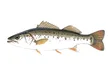
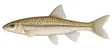
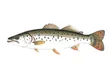
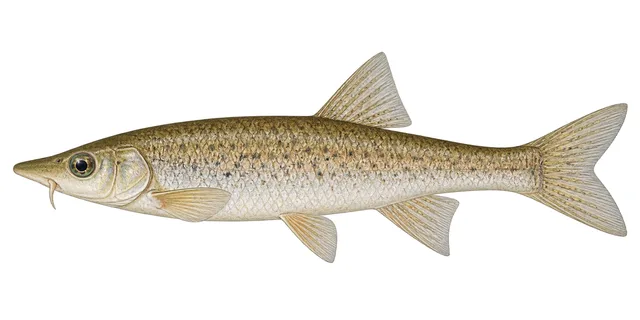
Sturgeon Chub field guide illustration

About Sturgeon Chub

The sturgeon chub (Macrhybopsis gelida) is a species of freshwater ray-finned fish belonging to the family Leuciscidae, the shiners, daces and minnows. It is found only in the United States. It is a species of concern in the Charles M. Russell National Wildlife Refuge in Montana.

Names and documentation

The type species was collected in the Milk River in Montana, and described by Charles Frédéric Girard in 1856. Girard named it Gobio gelidus, but it was reclassified as Hybopsis gelidus in 1900 and Macrhybopsis gelidus in 1935. A new classification of Hybopsis gelida was suggested in 1965.

Description and habitat

The sturgeon chub is slender, streamlined fish with a long, flat snout. The snout resembles that of a sturgeon, which gives the fish its name. Adults grow to be about 3 inches (7.6 cm) in length. There is a small barbel near the corner of the mouth, and small pustules on the throat. The scales on the sturgeon chub's back and sides have a small ridge-like projection known as a "keel". The purpose of the keel is not established, but may help the fish stabilize and orient itself in fast currents or as a means of detecting currents. The eyes are small and it does not see well. The fish's color ranges from silvery-white on the belly to silvery sides, with a light-brown back. The tail is deeply forked, with the lower lobe darker than the upper lobe. The body fins are triangular, slightly rounded, and straight-edged (unlike the sicklefin chub). The last dorsal fin ray extends beyond the first ray of the depressed fin.

Little is known about its feeding habits, although it does have teeth in its throat. The body is covered with taste buds which help it locate food. It lives in waters which are little populated by other small fish, but can be found associating with the flathead chub, sicklefin chub, and speckled chub.

Sturgeon chub exhibits little sexual dimorphism, and neither sex exhibits color changes during breeding. However, the male does develop small tubercles behind the gills during breeding. It lays eggs on gravel or clean sand to reproduce. Breeding probably occurs in June.

The habitat of the sturgeon chub is murky river bottoms in fast-flowing streams with gravel bottoms. Its habitat extends over the Missouri River and its primary tributaries, the lower Mississippi River in the states of Mississippi and Louisiana, and some streams in northeastern Wyoming. Increased silt and the construction of dams (which cause silt to settle and slow river currents) have destroyed extensive portions of its habitat. It remains common in the middle Missouri River, but rare elsewhere. The United States Fish and Wildlife Service (FWS) estimated in 2001 that it only inhabited about 59 percent of its former range.

Article text: Wikipedia contributors, Sturgeon chub (source revision). Licensed under CC BY-SA 4.0. Retrieved 2026-10-11.
Diet and feeding

The FishTraits compilation records these diet categories for this species: invertebrates or larval fish. These are broad categories, not a claim that every individual consumes every example in a category.

Reported feeding positions include bottom feeding and surface or water-column feeding. The compilation combines published observations; diets can vary with age, locality, and available food.

Habitat preferences

Reported habitat associations include medium to large rivers, streams and small rivers.

The source records associations with sand, gravel. An association indicates reported use, rather than an exclusive requirement.

Reproduction and parental care

The compilation reports a representative maturity age of 2 years. Its maturity field summarizes mean, median, or modal estimates, usually for females; male estimates can be used when female data are unavailable. It is not a fixed age at which every fish first breeds.

Recorded spawning months are May, Jun for the source’s reporting region (KS). This is a regional calendar, not a range-wide schedule.

The reproductive-guild classification includes spawning on open substrates without guarding the brood.

Size and recorded longevity

FishTraits reports a maximum total length of 9 centimetres. Some entries use an estimated asymptotic length; this value should not be treated as a certified record catch.

Recorded longevity in the compilation is 3.5 years. Wild observations were preferred, but captive records were accepted where wild records were unavailable, and unspecified records were assumed wild. The value is not a guaranteed wild lifespan or an aquarium life expectancy.

Range

Where it lives

Share of 143 GBIF observation records with a state location, across 11 states.
0%
16.1%
Share of 143 GBIF observation records with a state location, across 11 states.

Habitat

Water and movement

Water
WoRMS records this species in fresh water.
Migration
Migratory
Pattern

Classification

Taxonomy

Kingdom
Animalia
Phylum
Chordata
Superclass
Actinopterygii
Class
Teleostei
Order
Cypriniformes
Genus
Macrhybopsis
Species
Macrhybopsis gelida
ITIS TSN
163866
WoRMS AphiaID
1021446
GBIF key
2362060

Common questions about Sturgeon Chub

What is the scientific name of Sturgeon Chub?
The scientific name is Macrhybopsis gelida, in the family Leuciscidae. Classification follows ITIS.
Does Sturgeon Chub live in fresh water or salt water?
WoRMS records this species in fresh water.
Where has Sturgeon Chub been recorded in the United States?
GBIF has observations in 11 states, with the most records in Illinois, Nebraska, Missouri. The map shows observation records, which do not establish the complete natural range.

Closest relatives

Other Macrhybopsis species

Same family

More Leuciscidae

Alabama Shiner4 states
Cyprinella callistiaLeuciscidaeNativeFresh
Allegheny Pearl Dace19 states
Margariscus margaritaLeuciscidaeNative and introducedFresh
Altamaha Shiner1 states
Cyprinella xaenuraLeuciscidaeNativeFresh
Alvord Chub2 states
Siphateles alvordensisLeuciscidaeNativeFresh
Apalachee Shiner3 states
Pteronotropis grandipinnisLeuciscidaeNativeFresh
Arkansas River Shiner5 states
Notropis girardiLeuciscidaeNative and introducedFresh
Arroyo Chub1 states
Gila orcuttiiLeuciscidaeNative and introducedFresh
Bandfin Shiner5 states
Luxilus zonistiusLeuciscidaeNative and introducedFresh
Bannerfin Shiner5 states
Cyprinella leedsiLeuciscidaeNativeFresh
Beautiful Shiner3 states
Cyprinella formosaLeuciscidaeNativeFresh
Bedrock Shiner3 states
Notropis rupestrisLeuciscidaeNativeFresh
Bigeye Chub25 states
Hybopsis amblopsLeuciscidaeNative and introducedFresh
Bigeye Shiner17 states
Notropis boopsLeuciscidaeNative and introducedFresh
Bigmouth Chub3 states
Nocomis platyrhynchusLeuciscidaeNativeFresh
Bigmouth Shiner21 states
Notropis dorsalisLeuciscidaeNative and introducedFresh
Blackchin Shiner13 states
Notropis heterodonLeuciscidaeNativeFresh
Blackmouth Shiner3 states
Notropis melanostomusLeuciscidaeNativeFresh
Blacknose Shiner21 states
Notropis heterolepisLeuciscidaeNative and introducedFresh
Blackside Dace2 states
Chrosomus cumberlandensisLeuciscidaeNativeFresh
Blackspot Shiner5 states
Notropis atrocaudalisLeuciscidaeNativeFresh
Blacktail Shiner14 states
Cyprinella venustaLeuciscidaeNative and introducedFresh
Blacktip Shiner4 states
Lythrurus atrapiculusLeuciscidaeNative and introducedFresh
Bleeding Shiner8 states
Luxilus zonatusLeuciscidaeNativeFresh
Blotched Chub6 states
Erimystax insignisLeuciscidaeNativeFresh

All 267 species in Leuciscidae