Creek Chub

Semotilus atromaculatus

Leuciscidae · freshwater water fish

9 minute read · Species guide

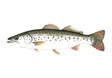
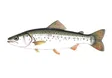
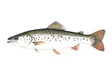
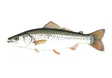
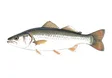
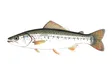
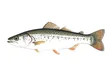
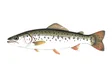
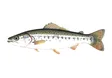
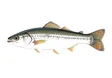
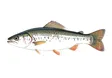
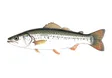
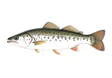
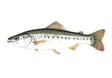
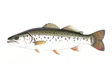
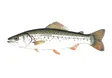
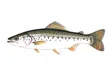
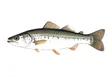
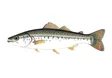
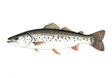
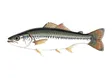
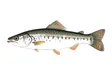
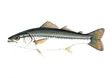
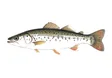
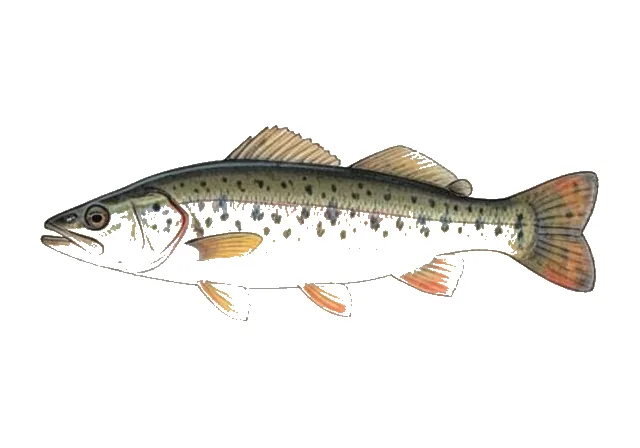
Creek Chub field guide illustration

About Creek Chub

Semotilus atromaculatus, the creek chub or the common creek chub, is a species of freshwater ray-finned fish belonging to the family Leuciscidae. This species is found in the eastern US and Canada. Differing in size and color depending on origin of development, the creek chub can usually be defined by a dark brown body with a black lateral line spanning horizontally across the body. It lives primarily within streams and rivers. Creek chubs attain lengths of 2–6 inches (5.1–15.2 cm) with larger specimens of up to 12 inches (30 cm) long.

Distribution and habitat

A fish which can withstand many different environments, the creek chub's current range is the eastern two-thirds of the US and southeastern Canada. It can quickly adapt to different extreme environments, and can live on many different foods. Documented to span throughout the Great Lakes surrounding Wisconsin, and into Minnesota, this species has been described as plentiful. However, reports of this species have fallen throughout Wisconsin and the Great Lakes, suggesting a decline in its population in these regions.

Though populations have been declining within the Great Lakes, they have been continually documented throughout small and medium rivers and streams. Thriving in small stream environments, the creek chub gravitates toward areas of weeds to appear secure and avoid predation. Varying in environments containing a multitude of substrates, they have been documented over gravel, sand, silt, rubble, mud, boulders, clay, bedrock and detritus bottoms. This fish actually prefers the stream or river environment compared to that of a lake, as they have been recorded in streams far more than lakes. Of over 440 individuals caught, only 9 were from lakes, and when limiting the locations to solely lakes, only six individuals were caught.

Description

The creek chub is a small chub with a greenish-brown back, cream-colored sides interrupted by horizontal black stripes running from the nose to the tail, and a white belly. Having a round, cylindrical body with a compressed posterior, males average 125 mm (4.9 in) in length, while females average 105 mm (4.1 in). As the specimen eats what is directly in front of it, the mouth is terminal, large and under the anterior of the eye.

The creek chub has been known to slightly differ in coloration, containing black backs with a brown or yellowish middle lines. The average chub ranges in size from 127–178 mm (5.0–7.0 in) in length, with the largest chub documented to be 197 mm (7.8 in) long. They can be identified from other common minnow species by the black "moustache" on their upper lips, along with a black dot on their dorsal fins. Additionally, juvenile males develop a rosy band on their sides, along with glossy, dark dorsal fin spots.

Biology

The scales of this species are quite unique to the needs of the creek chub, ultimately helping to protect and maneuver. Scales do not appear until the fish is 26 mm (1 in) long, leaving 30 mm (1.2 in) -long individuals having small scales with few circuli. Major growth occurs during the first year, often jumping by over 50–70 mm (2.0–2.8 in) in one year. Males grow far more quickly than females, allowing maturity to occur at one to one and a half years of age.

The main scales covering the creek chub are bony-ridge scales; they are thin and flexible to aid movement. Cycloid scales are also found, allowing for smooth transport within the water with little disturbance from the scales themselves. They also have leptoid scales, which are flexible plates of bone which help to protect the fish from predators and act as armor.

Behavior

The creek chub has specific behaviors at different ages. Commonly a school fish, they have been documented to school from birth to late adult, occupying the edges of pools. Their upper lethal temperature is 32 °C (90 °F), while the lower lethal temperature is 1.7 °C (35.1 °F). Initially, the creek chub is quite hesitant to venture from its known territory. For instance, while developing and growing, a school of creek chub travels together within the same 50-metre (160 ft) radius. Ensuring safety from unknown predators and environment, this increases their potential for survival.

As the creek chub develops, traveling outside its radius, it engages in aggressive behavior with other members of the species. The creek chub engages in ritualized aggression when others of the species invade its territory. Engaging in parallel swim, the fish widens its fins and mouth and swims at a caudal beat. Intimidating opponent fish throughout these rituals, the forward fish stops and directs blows to the head of the other fish. This ensures territory dominance, forcing intruders out of its area.

In central Ohio, creek chubs tend to dominate small creeks, where predators such as smallmouth, largemouth, and spotted bass are unable to thrive. They will be present in larger creeks and rivers, but they will no longer be a dominant species, and their population numbers will suffer from predation. Creek chubs can be caught on small hooks with small sections of nightcrawlers. They feed in schools during daylight, and aggressively compete for the bait at first. After several of their comrades are pulled from the water, creek chubs become wary, and they will no longer aggressively take the bait. At this point, they may nibble at the bait, or look at the bait and avoid striking at it. Creek chubs can be effectively caught in minnow traps with dry dog food. More information is needed about effective daytime angling hours. Creek chubs are a hardy minnow that can easily be caught in small creeks, stored in aquariums, and used as bait to catch larger fish such as bass and catfish. Since creek chubs do not have sharp spines that make up their dorsal fins, like a bluegill or largemouth bass does, they may be a preferred food source for fish that prey on smaller fish.

Diet

The creek chub is described as an opportunist and a carnivore, and consumes many different foods to survive, including fish, insect remains and vegetation, amphipods, adult Coleoptera, Ephemeroptera nymphs, Odonata larvae and Diptera adults and larvae.

Feeding habits are specific to the creeks and rivers where in the chub exists. As a juvenile, it actively feeds throughout the early morning on organisms within the water. Fish often do not leave their shelter until temperatures have increased to a daily maximum. Large chubs actively forage for 1–2 hr, then wait in their environment to feed on drift items.

Reproduction

Males increase reproductive success by migrating to a spawning area. The male then initiates building a spawning site to draw in females in the surrounding area. This most likely occurs in small pits with small pebbles to protect the area where eggs are laid. Once females enter, the male wraps around her pectoral fin and body, fertilization occurs, and the female leaves. Around 25–30 eggs are released each fertilization cycle. Often, these reproductive cycles occur in communal nesting sites, where the male controls the territory and protects it from intruders.

During the breeding season, males grow small, keratin-based bumps, called nuptial tubercles, on their head, which are used in ritualized combat. This hardly ever gets dangerous or destructive, but it is used to ward off intruding males on communal nesting sites.

Predation and management

The creek chub is often preyed on by species ranging from birds to fish, such as loons, kingfishers, brown trout, northern pike and smallmouth bass. Viruses infecting the creek chub have been documented to decrease this species' population. Additionally, the food supply of the creek chub is limited by other animals, such as trout and other chubs.

Managing creek chub has been recorded to work in small growing ponds. Providing the right conditions, with flowing water through the pond, gives the chub the necessary environment to survive.

Article text: Wikipedia contributors, Semotilus atromaculatus (source revision). Licensed under CC BY-SA 4.0. Retrieved 2026-10-11.
Diet and feeding

The FishTraits compilation records these diet categories for this species: algae or phytoplankton; aquatic or other vascular plants; invertebrates or larval fish; larger animal prey (a source category covering fish, crayfish, crabs, or frogs); fish or frog eggs. These are broad categories, not a claim that every individual consumes every example in a category.

Reported feeding positions include bottom feeding and surface or water-column feeding. The compilation combines published observations; diets can vary with age, locality, and available food.

Habitat preferences

Reported habitat associations include streams and small rivers, creeks.

The source records associations with muck, clay or silt, sand, gravel, organic debris. An association indicates reported use, rather than an exclusive requirement.

Reproduction and parental care

The compilation reports a representative maturity age of 2 years. Its maturity field summarizes mean, median, or modal estimates, usually for females; male estimates can be used when female data are unavailable. It is not a fixed age at which every fish first breeds.

Recorded spawning months are Apr, May for the source’s reporting region (NC). This is a regional calendar, not a range-wide schedule.

The reproductive-guild classification includes hiding a brood without subsequent guarding.

Size and recorded longevity

FishTraits reports a maximum total length of 30 centimetres. Some entries use an estimated asymptotic length; this value should not be treated as a certified record catch.

Recorded longevity in the compilation is 5 years. Wild observations were preferred, but captive records were accepted where wild records were unavailable, and unspecified records were assumed wild. The value is not a guaranteed wild lifespan or an aquarium life expectancy.

Native range

Most of eastern United States and southeastern Canada in Atlantic, Great Lakes, Hudson Bay, Mississippi, and Gulf basins as far west as Manitoba, eastern Montana, Wyoming, Colorado, eastern Oklahoma, and eastern Texas, but absent from southern Georgia and peninsular Florida; isolated population in upper Pecos and Canadian River systems, New Mexico (Page and Burr 1991).

Introduction history

Most introductions probably via bait bucket release. Woodling (1985) stated that the Colorado West Slope populations are the result of accidental introduction by man. Hubbs (1957) stated that western records in Texas, and a report from Lake Texoma "have undoubtedly resulted from bait release."

Ecological impacts

According to Baxter and Simon (1970), in some situations populations of this species may compete with trout, but the authors did not give details. Beckman (1974) reported that Creek Chub prey on trout. Magnan and Fitzgerald (1984) provided evidence that introduced Creek Chub are a potential competitor with brook charr Salvelinus fontinalis. In their study of a Quebec stream, they found that charr changed their diet from benthic invertebrates to zooplankton in the presence of chub. Subsequent laboratory experiments suggested that higher relative abundance of Creek Chub was one of several important factors in the observed niche shift of brook charr in nature (Magnan and Fitzgerald 1984). Competition with and predation by nonnative species (i.e., Catostomus sp., Creek Chub Semotilus atromaculatus, redside shiner Richardsonius balteatus, burbot Lota lota, brown trout Salmo trutta, and lake trout Salvelinus namaycush) limit populations of the rare bluehead sucker Catostomus discobolus (Wyoming Game and Fish Department 2010).

Record fish

State records in 2 states

  • Wisconsin0 lbs.12.0 oz.

    Amnicon Lake · Douglas · 01/07/2018

  • Montana0.52 lbs.

    Harbaugh Bass Pond · 5/12/13 · William Bibeau

Each figure is the state agency’s own certified record. The site holds record tables for 11 states so far, so a state missing here has not been read yet. It is not a state where this fish holds no record.

Range

Where it lives

Share of 41,255 GBIF observation records with a state location, across 43 states. The orange dots are USGS stream-survey sites where this species was caught.
0%
11.1%
Share of 41,255 GBIF observation records with a state location, across 43 states. The orange dots are USGS stream-survey sites where this species was caught.

A blank area on the dot layer usually means nobody sampled there, not that the fish is absent. Turn on “every survey site” to see where the survey looked.

The USGS stream survey caught it at 13,729 of its sites, in 38 states. That survey and the GBIF records are two different counts of two different things, so the site keeps them apart.

Habitat

Water and movement

Water
WoRMS records this species in fresh water.
USGS NAS habitat
Freshwater
US status
Native transplant — native to part of the United States, moved to other waters inside it.
Migration
Migratory
Pattern

Classification

Taxonomy

Kingdom
Animalia
Phylum
Chordata
Superclass
Actinopterygii
Class
Teleostei
Order
Cypriniformes
Genus
Semotilus
Species
Semotilus atromaculatus
ITIS TSN
163376
WoRMS AphiaID
590495
GBIF key
2360481
Outside the US
ITIS also files it in Canada.

Common questions about Creek Chub

What is the scientific name of Creek Chub?
The scientific name is Semotilus atromaculatus, in the family Leuciscidae. Classification follows ITIS.
Does Creek Chub live in fresh water or salt water?
WoRMS records this species in fresh water.
Where has Creek Chub been recorded in the United States?
GBIF has observations in 43 states, with the most records in New York, Ohio, Illinois. The map shows observation records, which do not establish the complete natural range.

Closest relatives

Other Semotilus species

Same family

More Leuciscidae

Alabama Shiner4 states
Cyprinella callistiaLeuciscidaeNativeFresh
Allegheny Pearl Dace19 states
Margariscus margaritaLeuciscidaeNative and introducedFresh
Altamaha Shiner1 states
Cyprinella xaenuraLeuciscidaeNativeFresh
Alvord Chub2 states
Siphateles alvordensisLeuciscidaeNativeFresh
Apalachee Shiner3 states
Pteronotropis grandipinnisLeuciscidaeNativeFresh
Arkansas River Shiner5 states
Notropis girardiLeuciscidaeNative and introducedFresh
Arroyo Chub1 states
Gila orcuttiiLeuciscidaeNative and introducedFresh
Bandfin Shiner5 states
Luxilus zonistiusLeuciscidaeNative and introducedFresh
Bannerfin Shiner5 states
Cyprinella leedsiLeuciscidaeNativeFresh
Beautiful Shiner3 states
Cyprinella formosaLeuciscidaeNativeFresh
Bedrock Shiner3 states
Notropis rupestrisLeuciscidaeNativeFresh
Bigeye Chub25 states
Hybopsis amblopsLeuciscidaeNative and introducedFresh
Bigeye Shiner17 states
Notropis boopsLeuciscidaeNative and introducedFresh
Bigmouth Chub3 states
Nocomis platyrhynchusLeuciscidaeNativeFresh
Bigmouth Shiner21 states
Notropis dorsalisLeuciscidaeNative and introducedFresh
Blackchin Shiner13 states
Notropis heterodonLeuciscidaeNativeFresh
Blackmouth Shiner3 states
Notropis melanostomusLeuciscidaeNativeFresh
Blacknose Shiner21 states
Notropis heterolepisLeuciscidaeNative and introducedFresh
Blackside Dace2 states
Chrosomus cumberlandensisLeuciscidaeNativeFresh
Blackspot Shiner5 states
Notropis atrocaudalisLeuciscidaeNativeFresh
Blacktail Shiner14 states
Cyprinella venustaLeuciscidaeNative and introducedFresh
Blacktip Shiner4 states
Lythrurus atrapiculusLeuciscidaeNative and introducedFresh
Bleeding Shiner8 states
Luxilus zonatusLeuciscidaeNativeFresh
Blotched Chub6 states
Erimystax insignisLeuciscidaeNativeFresh

All 267 species in Leuciscidae