Sicklefin Chub

Macrhybopsis meeki

Leuciscidae · freshwater water fish

5 minute read · Species guide

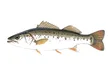
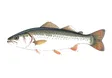
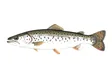
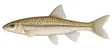
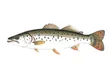
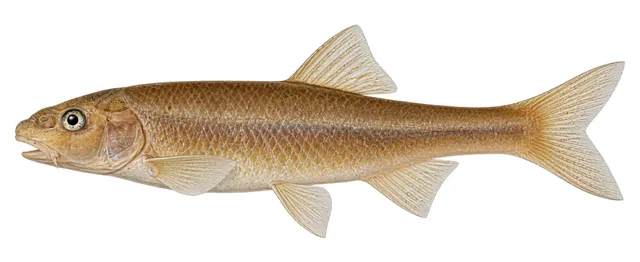
Sicklefin Chub field guide illustration

About Sicklefin Chub

The sicklefin chub (Macrhybopsis meeki) is a species of freshwater ray-finned fish belonging to the family Leuciscidae, the shiners, daces and minnows. It is found only in the United States. It is one of the 324 fish species found in Tennessee, and is a species of concern in the Charles M. Russell National Wildlife Refuge in Montana.

Names and documentation

The type species was collected in the Missouri River near St. Louis, Missouri, and described by David Starr Jordan and Barton Warren Evermann in 1896. They named it Hybopsis meeki. The name meeki is in honor of Seth Eugene Meek, a noted American fish biologist. In 1908, Stephen Alfred Forbes and Robert Earl Richardson suggested the binomial name Platygobio gracilis based on a specimen collected in Illinois, but this is clearly the same species described by Jordan and Evermann.

Description and habitat

The sicklefin chub is a small fish which can reach 4.25 inches (10.8 cm) in adulthood. The snout is round and bulbous, and overhangs the lower jaw slightly. It is fairly round and thickest around the nape (the area just in back of the head), and the body tapers significantly until it reaches the tail. Its head is wide and deep, flat on top, with eyes set high on the head. The eyes are not as high on the head as in similar species, and are sometimes covered with a flap of skin. There is a small barbel near the corner of the mouth, and small pustules on the throat. Unlike the sturgeon chub, which it closely resembles, the sicklefin chub has no "keels" (small ridge-like protrusions on its scales). This fish has silvery sides, and is light green or brown on top. The fish often exhibits dark brown or silver specks. In larger individuals, the lower lobe of the caudal fin is often black with a white edge. This fish has large, pointed, sickle-shaped fins, which gives the minnow its name. The dorsal fin originates just over or behind where the pelvic fin originates. When depressed, the first dorsal fin extends beyond the last ray. The tip of the pelvic fin can reach beyond the origin of the pelvic fin. There are eight rays in the anal fin. The chest and belly of the fish lack scales, but not the sides or tail.

Little is known about its feeding habits, although it does have teeth in its throat. Black fly pupae and other insects have been found in the stomachs of some specimens. There is some evidence that it is a bottom feeder. The eyes are weak and it does not see well. Its body, however, is covered with taste buds which help it locate food. There are also taste buds in the mouth, which has led to speculation that the fish sorts food orally and spits out what is not edible.

Almost nothing is known about its breeding habits, but it is an egg layer. The sicklefin chub exhibits little sexual dimorphism, and neither sex exhibits color changes during breeding. However, the male develops small tubercles on the fin rays during breeding. Breeding probably occurs in the spring, and the fish is thought to be quite short-lived.

The sicklefin chub lives in fast-moving rivers with sandy or fine gravel beds, but is more commonly found on sandy beds. Its range covers the entire Missouri River; the Mississippi River from the mouth of the Missouri River down to the Ohio River; and the Mississippi River in southern Mississippi and northern Louisiana. It is fairly common in the Missouri River, but rare elsewhere. It has also been reported in the lower Kansas River.

Dams have destroyed much of the sicklefin chub's habitat by slowing currents and allowing silt to precipitate from the water and cover the sand and gravel beds the fish prefers. The United States Fish and Wildlife Service (FWS) estimated in 2001 that it only inhabited about 54 percent of its former range. In 1993, the FWS considered listing the sicklefin chub as a threatened species, but declined to do so.

Article text: Wikipedia contributors, Sicklefin chub (source revision). Licensed under CC BY-SA 4.0. Retrieved 2026-10-11.
Diet and feeding

The FishTraits compilation records these diet categories for this species: invertebrates or larval fish. These are broad categories, not a claim that every individual consumes every example in a category.

Reported feeding positions include bottom feeding. The compilation combines published observations; diets can vary with age, locality, and available food.

Habitat preferences

Reported habitat associations include medium to large rivers.

The source records associations with sand, gravel. An association indicates reported use, rather than an exclusive requirement.

Reproduction and parental care

The compilation reports a representative maturity age of 2 years. Its maturity field summarizes mean, median, or modal estimates, usually for females; male estimates can be used when female data are unavailable. It is not a fixed age at which every fish first breeds.

Batch or serial spawning has been reported somewhere in the species’ range. This does not establish the same spawning pattern for every population.

Recorded spawning months are Mar, Apr, May for the source’s reporting region (TN). This is a regional calendar, not a range-wide schedule.

Size and recorded longevity

FishTraits reports a maximum total length of 10 centimetres. Some entries use an estimated asymptotic length; this value should not be treated as a certified record catch.

Recorded longevity in the compilation is 4 years. Wild observations were preferred, but captive records were accepted where wild records were unavailable, and unspecified records were assumed wild. The value is not a guaranteed wild lifespan or an aquarium life expectancy.

Native range

The native range of the Sicklefin Chub includes the Missouri River, from Montana to the mouth. It also includes the lower Kansas River in eastern Kansas,and the Mississippi River from the mouth of the Missouri River to the mouth of the Ohio River. The fish is also found in the Mississippi River in southern Mississippi and northern Louisiana. The Sicklefin Chub is thought to be common in the middle Missouri River but rare everywhere else (Page and Burr 1991).

Habitat and ecology

Macrhybopsis meeki inhabits large rivers. Fast moving waters with sand and gravel substrate are ideal (Page and Burr 1991).

Range

Where it lives

Share of 120 GBIF observation records with a state location, across 10 states.
0%
36.7%
Share of 120 GBIF observation records with a state location, across 10 states.

Habitat

Water and movement

Water
WoRMS records this species in fresh water.
USGS NAS habitat
Freshwater
US status
Native transplant — native to part of the United States, moved to other waters inside it.
Migration
Migratory
Pattern

Classification

Taxonomy

Kingdom
Animalia
Phylum
Chordata
Superclass
Actinopterygii
Class
Teleostei
Order
Cypriniformes
Genus
Macrhybopsis
Species
Macrhybopsis meeki
ITIS TSN
163868
WoRMS AphiaID
1019282
GBIF key
2362056

Common questions about Sicklefin Chub

What is the scientific name of Sicklefin Chub?
The scientific name is Macrhybopsis meeki, in the family Leuciscidae. Classification follows ITIS.
Does Sicklefin Chub live in fresh water or salt water?
WoRMS records this species in fresh water.
Where has Sicklefin Chub been recorded in the United States?
GBIF has observations in 10 states, with the most records in Missouri, Illinois, Kansas. The map shows observation records, which do not establish the complete natural range.

Closest relatives

Other Macrhybopsis species

Same family

More Leuciscidae

Alabama Shiner4 states
Cyprinella callistiaLeuciscidaeNativeFresh
Allegheny Pearl Dace19 states
Margariscus margaritaLeuciscidaeNative and introducedFresh
Altamaha Shiner1 states
Cyprinella xaenuraLeuciscidaeNativeFresh
Alvord Chub2 states
Siphateles alvordensisLeuciscidaeNativeFresh
Apalachee Shiner3 states
Pteronotropis grandipinnisLeuciscidaeNativeFresh
Arkansas River Shiner5 states
Notropis girardiLeuciscidaeNative and introducedFresh
Arroyo Chub1 states
Gila orcuttiiLeuciscidaeNative and introducedFresh
Bandfin Shiner5 states
Luxilus zonistiusLeuciscidaeNative and introducedFresh
Bannerfin Shiner5 states
Cyprinella leedsiLeuciscidaeNativeFresh
Beautiful Shiner3 states
Cyprinella formosaLeuciscidaeNativeFresh
Bedrock Shiner3 states
Notropis rupestrisLeuciscidaeNativeFresh
Bigeye Chub25 states
Hybopsis amblopsLeuciscidaeNative and introducedFresh
Bigeye Shiner17 states
Notropis boopsLeuciscidaeNative and introducedFresh
Bigmouth Chub3 states
Nocomis platyrhynchusLeuciscidaeNativeFresh
Bigmouth Shiner21 states
Notropis dorsalisLeuciscidaeNative and introducedFresh
Blackchin Shiner13 states
Notropis heterodonLeuciscidaeNativeFresh
Blackmouth Shiner3 states
Notropis melanostomusLeuciscidaeNativeFresh
Blacknose Shiner21 states
Notropis heterolepisLeuciscidaeNative and introducedFresh
Blackside Dace2 states
Chrosomus cumberlandensisLeuciscidaeNativeFresh
Blackspot Shiner5 states
Notropis atrocaudalisLeuciscidaeNativeFresh
Blacktail Shiner14 states
Cyprinella venustaLeuciscidaeNative and introducedFresh
Blacktip Shiner4 states
Lythrurus atrapiculusLeuciscidaeNative and introducedFresh
Bleeding Shiner8 states
Luxilus zonatusLeuciscidaeNativeFresh
Blotched Chub6 states
Erimystax insignisLeuciscidaeNativeFresh

All 267 species in Leuciscidae