Hornyhead Chub

Nocomis biguttatus

Leuciscidae · freshwater water fish

7 minute read · Species guide

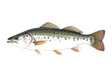
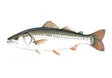
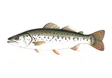
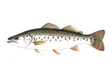
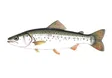
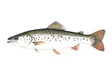
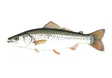
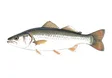
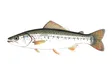
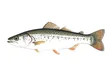
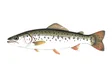
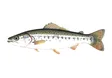
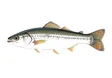
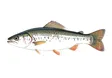
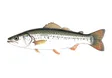
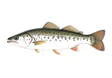
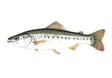
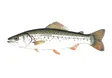
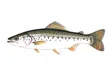
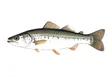
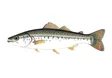
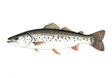
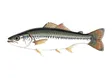
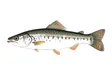
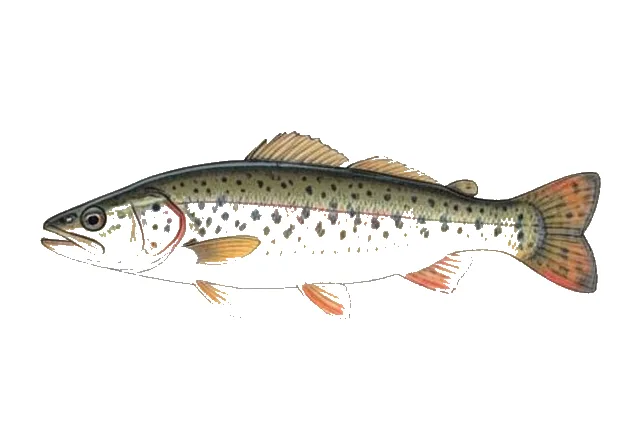
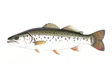
Hornyhead Chub field guide illustration

About Hornyhead Chub

The hornyhead chub (Nocomis biguttatus) is a species of freshwater fish belonging to the family Leuciscidae, the shiners, daces and minnows. It mainly inhabits small rivers and streams of the northern central USA, up into Canada. The adults inhabit faster, rocky pools of rivers.

Range

The hornyhead chub ranges from Wyoming, North Dakota, and South Dakota, east to the Hudson River drainage and south to Oklahoma. In South Dakota, the hornyhead chub is at the western edge of its range. Hornyhead chubs have been found in several water bodies in the Minnesota River Basin including the north and south forks of the Yellowbank River, Monigan Creek, Cobb Creek, Whetstone Creek, the North Fork of Whetstone Creek and Gary Creek in Roberts, Grant and Deuel Counties, as well as in Big Stone Lake in Grant County. In 1952, hornyhead chubs were documented to occur in the Big Sioux River drainage, but the exact location is unknown. The hornyhead chub has not been documented in the Big Sioux River drainage since the finding in 1952, and is likely extirpated from this watershed. They are also found in the Mississippi River basin, Red River drainage, Ohio River and lower Kentucky River systems. They can be found from New York west into the Dakotas with isolated populations in the Platte and Colorado River Systems, and north from Manitoba and south into Kentucky. There are hornyhead chubs in Georgia below Chattahoochee Forest National Fish Hatchery on Rock Creek and Toccoa River in Suches, GA.

Description

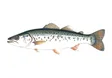
The Hornyhead chub is moderate in size and slightly subterminal with an inconspicuous barbel in corner of mouth. This fish has no teeth. A body pattern of a back olive brown in color, with its sides having silvery color, and a belly of white. It also has a dark lateral stripe and a spot at the base of the tail, which is faint or absent in some adults. Fins contain decorative markings. Its body shape is fusiform and robust, round in cross-section. Typical adult size is 100–150 mm (3.9–5.9 in) TL, with a maximum of about 225 mm (8.9 in). It has a forked tail and a single relatively short dorsal fin with 8 rays and without spines. Its pelvic fins are abdominal and has no adipose fin. Lastly, its anal fin with 7 rays has no spines. Its distinguishing characteristics are its moderately slightly subterminal mouth, and its defining inconspicuous barbel in the corner of its mouth. It also uniquely has 38–48 lateral line scales and a dark lateral stripe and caudal spot. Breeding adults have numerous large pointed tubercles on the top of their heads, smaller tubercles on their pectoral fins and a red or orange spot on the upper opercle behind their eyes. Juveniles look similar to adults, but have more obvious lateral stripes and caudal spots, and their tails are typically more reddish than the adult's tail.

Habitat

The hornyhead chub is found in rocky pools and runs of creeks and small to medium-sized rivers. The hornyhead chub inhabits riffle/pool sections of small streams to medium-sized rivers. Although they are occasionally found in dark-water streams, they are more commonly found in clear-water streams. Presence is inversely related to turbidity. Vegetation does not necessarily have an effect on abundance of adults, however, the young use vegetation extensively for cover and are found in higher concentrations in these areas, at least for the first several weeks to one month of life. This species is commonly found in water depths of 2–6 ft (61–183 cm).

Life history and reproduction

Hornyhead chubs spawn from May through June. They become sexually mature at 2 to 3 years of age. Males build a cup shaped depression that they build up with pebbles that can be as large as 1–3 feet (0.30–0.91 m) across and 6–8 inches (150–200 mm) high. Eggs and sperm are deposited in depressions in the nests and covered with gravel. Males defend the nest mounds from other N. biguttatus males but not other species. Other species take advantage of this defense and spawn in the nest mounds. The result of this is sometimes accidental hybridization. The same male may spawn with several females.

Diet

The hornyhead chub is a visual feeder that is active primarily during daylight. A variety of plant and animal food items are commonly reported for hornyhead chubs. Animal food items for the young include: rotifers, cladocerans, copepods, chironomids, and aquatic insect larvae. Older hornyhead chubs are known to consume: clams, snails, crayfish, worms, aquatic insect larvae, and fish.

Importance to humans

Due to the fact that smallmouth bass, northern pike, and rock bass are thought to prey on the hornyhead chub, this type of minnow is often used as bait during fishing expeditions.

Conservation status

Globally, the status of the hornyhead chub is secure, but it is considered Critically Imperiled in Wyoming, Kansas, and Pennsylvania, and Possibly or Presumed Extirpated in Colorado and Nebraska. Currently, The Nature Conservancy has assigned the hornyhead chub a national ranking of G5 suggesting that the species' existence is globally secure and of least concern (LC).

Etymology of name

Etymology: Nocomis: An indigenous (North America) name used by Charles Girard; ojibwe, nokomis = grandmother. Actinopterygii (ray-finned fishes) > Cypriniformes (Carps) > Cyprinidae (Minnows or carps) > Leuciscinae.

Article text: Wikipedia contributors, Hornyhead chub (source revision). Licensed under CC BY-SA 4.0. Retrieved 2026-10-11.
Diet and feeding

The FishTraits compilation records these diet categories for this species: algae or phytoplankton; aquatic or other vascular plants; detritus or unidentified plant material; invertebrates or larval fish; larger animal prey (a source category covering fish, crayfish, crabs, or frogs). These are broad categories, not a claim that every individual consumes every example in a category.

Reported feeding positions include bottom feeding and surface or water-column feeding. The compilation combines published observations; diets can vary with age, locality, and available food.

Habitat preferences

Reported habitat associations include streams and small rivers, creeks.

The source records associations with muck, clay or silt, sand, gravel, cobble, boulders. An association indicates reported use, rather than an exclusive requirement.

The species is classified as tolerant of a broad range of salinities. This flag does not specify a salinity range for aquarium care.

Reproduction and parental care

The compilation reports a representative maturity age of 2 years. Its maturity field summarizes mean, median, or modal estimates, usually for females; male estimates can be used when female data are unavailable. It is not a fixed age at which every fish first breeds.

Batch or serial spawning has been reported somewhere in the species’ range. This does not establish the same spawning pattern for every population.

Recorded spawning months are May, Jun, Jul for the source’s reporting region (WI). This is a regional calendar, not a range-wide schedule.

The reproductive-guild classification includes guarding eggs or young at a spawning substrate or nest.

Size and recorded longevity

FishTraits reports a maximum total length of 26 centimetres. Some entries use an estimated asymptotic length; this value should not be treated as a certified record catch.

Recorded longevity in the compilation is 4 years. Wild observations were preferred, but captive records were accepted where wild records were unavailable, and unspecified records were assumed wild. The value is not a guaranteed wild lifespan or an aquarium life expectancy.

Native range

Mohawk River system, New York, west through Great Lakes and Mississippi River basin to Red River drainage (Hudson Bay basin), Manitoba and North Dakota, south to Ohio River and lower Kentucky River system, Kentucky, but rare in unglaciated areas; south into Ozarks. Isolated populations in Platte and Cheyenne River systems, New Brunswick, Wyoming, and Colorado (Page and Burr 1991).

Introduction history

Lachner and Jenkins (1971) stated that collections from Elkhorn Creek of the lower Kentucky River system may represent introduction via bait fishermen or transport through stocking programs and farm pond culture. Smith (1985) suggested that its presence in the Susquehanna and Mohawk rivers of New York may be the result of dispersal through artificial canal systems (Chenango Canal). There are no historical records of Nocomis biguttatus from the Susquehanna drainage (Lee et al. 1980 et seq.). Consequently, Gilbert (personal communication) agrees that the species has been introduced there. However, since it has only appeared in that drainage very recently, Gilbert concluded that its presence is more likely the result of a bait bucket transfer rather than migration through the canal system.

Record fish

The Wisconsin state record

  • Wisconsin0 lbs. 7.3 oz.

    Little Platte River · Grant · 04/11/2024

Each figure is the state agency’s own certified record. The site holds record tables for 11 states so far, so a state missing here has not been read yet. It is not a state where this fish holds no record.

Range

Where it lives

Share of 6,548 GBIF observation records with a state location, across 27 states. The orange dots are USGS stream-survey sites where this species was caught.
0%
29.9%
Share of 6,548 GBIF observation records with a state location, across 27 states. The orange dots are USGS stream-survey sites where this species was caught.

A blank area on the dot layer usually means nobody sampled there, not that the fish is absent. Turn on “every survey site” to see where the survey looked.

The USGS stream survey caught it at 1,446 of its sites, in 15 states. That survey and the GBIF records are two different counts of two different things, so the site keeps them apart.

Habitat

Water and movement

Water
WoRMS records this species in fresh water.
USGS NAS habitat
Freshwater
US status
Native transplant — native to part of the United States, moved to other waters inside it.
Migration
Undetermined

Classification

Taxonomy

Kingdom
Animalia
Phylum
Chordata
Superclass
Actinopterygii
Class
Teleostei
Order
Cypriniformes
Genus
Nocomis
Species
Nocomis biguttatus
ITIS TSN
163395
WoRMS AphiaID
1021410
GBIF key
2365443
Outside the US
ITIS also files it in Canada.

Common questions about Hornyhead Chub

What is the scientific name of Hornyhead Chub?
The scientific name is Nocomis biguttatus, in the family Leuciscidae. Classification follows ITIS.
Does Hornyhead Chub live in fresh water or salt water?
WoRMS records this species in fresh water.
Where has Hornyhead Chub been recorded in the United States?
GBIF has observations in 27 states, with the most records in Illinois, Missouri, Michigan. The map shows observation records, which do not establish the complete natural range.

Closest relatives

Other Nocomis species

Same family

More Leuciscidae

Alabama Shiner4 states
Cyprinella callistiaLeuciscidaeNativeFresh
Allegheny Pearl Dace19 states
Margariscus margaritaLeuciscidaeNative and introducedFresh
Altamaha Shiner1 states
Cyprinella xaenuraLeuciscidaeNativeFresh
Alvord Chub2 states
Siphateles alvordensisLeuciscidaeNativeFresh
Apalachee Shiner3 states
Pteronotropis grandipinnisLeuciscidaeNativeFresh
Arkansas River Shiner5 states
Notropis girardiLeuciscidaeNative and introducedFresh
Arroyo Chub1 states
Gila orcuttiiLeuciscidaeNative and introducedFresh
Bandfin Shiner5 states
Luxilus zonistiusLeuciscidaeNative and introducedFresh
Bannerfin Shiner5 states
Cyprinella leedsiLeuciscidaeNativeFresh
Beautiful Shiner3 states
Cyprinella formosaLeuciscidaeNativeFresh
Bedrock Shiner3 states
Notropis rupestrisLeuciscidaeNativeFresh
Bigeye Chub25 states
Hybopsis amblopsLeuciscidaeNative and introducedFresh
Bigeye Shiner17 states
Notropis boopsLeuciscidaeNative and introducedFresh
Bigmouth Chub3 states
Nocomis platyrhynchusLeuciscidaeNativeFresh
Bigmouth Shiner21 states
Notropis dorsalisLeuciscidaeNative and introducedFresh
Blackchin Shiner13 states
Notropis heterodonLeuciscidaeNativeFresh
Blackmouth Shiner3 states
Notropis melanostomusLeuciscidaeNativeFresh
Blacknose Shiner21 states
Notropis heterolepisLeuciscidaeNative and introducedFresh
Blackside Dace2 states
Chrosomus cumberlandensisLeuciscidaeNativeFresh
Blackspot Shiner5 states
Notropis atrocaudalisLeuciscidaeNativeFresh
Blacktail Shiner14 states
Cyprinella venustaLeuciscidaeNative and introducedFresh
Blacktip Shiner4 states
Lythrurus atrapiculusLeuciscidaeNative and introducedFresh
Bleeding Shiner8 states
Luxilus zonatusLeuciscidaeNativeFresh
Blotched Chub6 states
Erimystax insignisLeuciscidaeNativeFresh

All 267 species in Leuciscidae