Spotfin Chub

Erimonax monachus

Leuciscidae · freshwater water fish

5 minute read · Species guide

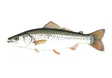
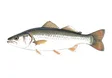
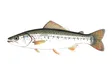
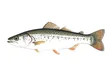
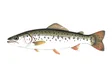
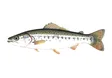
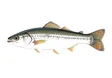
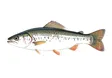
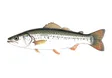
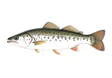
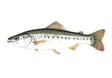
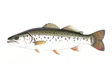
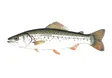
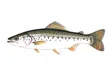
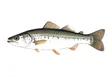
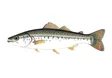
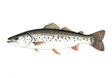
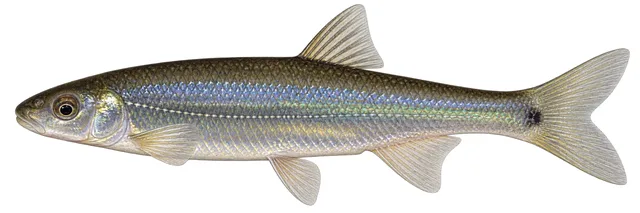
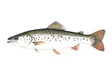
Spotfin Chub field guide illustration

About Spotfin Chub

Spotfin chub (Erimonax monachus) is a species of freshwater ray-finned fish belonging to the family Leuciscidae, the shiners, daces and minnows. It is the only species in the monospecific genus Erimonax. This fish is endemic to the Tennessee River watershed. Its other common names include turquoise shiner and chromium shiner.

Appearance and anatomy

Spotfin chub have an average length of 55 to 90 millimetres (2.2 to 3.5 in).

Geographic distribution

The spotfin chub has a native range endemic to the Tennessee River drainage. This range includes five states: Alabama, Georgia, North Carolina, Virginia, and Tennessee. Current surveys show that spotfin chub has been extirpated from Alabama and Georgia. The only remaining populations are confined to four tributaries along the Tennessee River: the Little Tennessee, Emory, Buffalo, and Holston rivers.

Many anthropogenic changes are the cause for such a large population decline. Major disturbances include dams, sedimentation, introduction of invasive species, and wide-ranging fish kills. In 1957, a project aiming to enhance habitats for trout used ichthyocides to kill fish. By eliminating the competition, it was believed that trout would thrive.

Ecology

Spotfins are born predominately benthic insectivores and become more open water as they mature. According to a study done with adult specimens from the Emory River, they prefer midge, black fly, and caddisfly larvae. Spotfins rely heavily on sight feeding.

Food is a leading factor for microhabitat preferences, and microhabitats differ seasonally. Spotfins streamlined body and eurythermal characteristics allows them to tolerate a wide range of habitats. During the summer and fall months, spotfins are most likely found in clear, warm water stretches of rivers that resemble run habitats. These runs consist of boulder/bedrock substrates with medium to moderate depth and velocity. However, during the winter they are most commonly found in pool habitats with a sandy substrate. Due to similar habitat requirements and desired prey they tend to compete with other minnow species. Their most common competitors of the genus Cyprinella, primarily whitetail shiners (Cyprinella galactura), and the genus Luxilus, such as the warpaint shiner (Luxilus coccogenis). Humans are also competing for habitat. Flooding and sedimentation are both results of impounding water and harvesting riparian vegetation.

Life history

They spawn in areas with clean running water between May and August. The timing of spawning varies based on temperature and photoperiod. Breeding males' bodies will turn a metallic blue with their fins forming a white margin. Males will then select the site and deposit milt along the length of the crevice to attract the female. Spotfins spawn on stream bottoms where boulders create crevices. Females deposit their eggs in the crevice which is then fertilized by the male. Clutch size has been difficult to determine, but studies have shown the number to be in the low to mid hundreds per breeding pair. Any eggs not concealed by the crevice are quickly cannibalized by either of the parents. Eggs have an incubation period of about six days. They grow rapidly as embryos while remaining benthic for approximately 30 days. Juveniles will then enter the water column and begin feeding on macroinvertebrates. After two years, most spotfin chub have reached sexual maturity. Spotfin chub have a lifespan of three years.

Current management

In 1977, spotfin chub became federally listed as threatened under the Endangered Species Act. Habitat loss, sedimentation, and dams have severely damaged the sustainability of its population. Sedimentation is detrimental to spotfin chub: a 2006 laboratory test done at the University of Georgia showed that densely suspended sediment levels in the water can result in a 15-fold decrease in growth rates of juveniles. Suspended sediment also damages gill tissues which impairs respiration and osmoregulatory patterns.

Organized efforts by many state, federal, and non-profit organizations have helped to sustain spotfin populations for many years. Non-invasive capture and relocation from species abundant locations to low species abundance has helped to redistribute them to their once native ranges. Also, captive breeding efforts by Conservation Fisheries, Inc. and other organizations have increased knowledge of breeding patterns, life history, and microhabitat requirements.

Article text: Wikipedia contributors, Spotfin chub (source revision). Licensed under CC BY-SA 4.0. Retrieved 2026-10-11.
Diet and feeding

The FishTraits compilation records these diet categories for this species: invertebrates or larval fish. These are broad categories, not a claim that every individual consumes every example in a category.

Reported feeding positions include bottom feeding. The compilation combines published observations; diets can vary with age, locality, and available food.

Habitat preferences

Reported habitat associations include medium to large rivers, streams and small rivers.

The source records associations with gravel, cobble, boulders. An association indicates reported use, rather than an exclusive requirement.

Reproduction and parental care

The compilation reports a representative maturity age of 1.5 years. Its maturity field summarizes mean, median, or modal estimates, usually for females; male estimates can be used when female data are unavailable. It is not a fixed age at which every fish first breeds.

Batch or serial spawning has been reported somewhere in the species’ range. This does not establish the same spawning pattern for every population.

Recorded spawning months are May, Jun, Jul for the source’s reporting region (NC). This is a regional calendar, not a range-wide schedule.

The reproductive-guild classification includes hiding a brood without subsequent guarding.

Size and recorded longevity

FishTraits reports a maximum total length of 11 centimetres. Some entries use an estimated asymptotic length; this value should not be treated as a certified record catch.

Recorded longevity in the compilation is 3.5 years. Wild observations were preferred, but captive records were accepted where wild records were unavailable, and unspecified records were assumed wild. The value is not a guaranteed wild lifespan or an aquarium life expectancy.

Range

Where it lives

Share of 96 GBIF observation records with a state location, across 4 states.
0%
62.5%
Share of 96 GBIF observation records with a state location, across 4 states.

Habitat

Water and movement

Water
WoRMS records this species in fresh water.
Migration
Undetermined

Classification

Taxonomy

Kingdom
Animalia
Phylum
Chordata
Superclass
Actinopterygii
Class
Teleostei
Order
Cypriniformes
Genus
Erimonax
Species
Erimonax monachus
ITIS TSN
689041
WoRMS AphiaID
1535203
GBIF key
5207718

Common questions about Spotfin Chub

What is the scientific name of Spotfin Chub?
The scientific name is Erimonax monachus, in the family Leuciscidae. Classification follows ITIS.
Does Spotfin Chub live in fresh water or salt water?
WoRMS records this species in fresh water.
Where has Spotfin Chub been recorded in the United States?
GBIF has observations in 4 states, with the most records in Tennessee, North Carolina, Virginia. The map shows observation records, which do not establish the complete natural range.

Same family

More Leuciscidae

Alabama Shiner4 states
Cyprinella callistiaLeuciscidaeNativeFresh
Allegheny Pearl Dace19 states
Margariscus margaritaLeuciscidaeNative and introducedFresh
Altamaha Shiner1 states
Cyprinella xaenuraLeuciscidaeNativeFresh
Alvord Chub2 states
Siphateles alvordensisLeuciscidaeNativeFresh
Apalachee Shiner3 states
Pteronotropis grandipinnisLeuciscidaeNativeFresh
Arkansas River Shiner5 states
Notropis girardiLeuciscidaeNative and introducedFresh
Arroyo Chub1 states
Gila orcuttiiLeuciscidaeNative and introducedFresh
Bandfin Shiner5 states
Luxilus zonistiusLeuciscidaeNative and introducedFresh
Bannerfin Shiner5 states
Cyprinella leedsiLeuciscidaeNativeFresh
Beautiful Shiner3 states
Cyprinella formosaLeuciscidaeNativeFresh
Bedrock Shiner3 states
Notropis rupestrisLeuciscidaeNativeFresh
Bigeye Chub25 states
Hybopsis amblopsLeuciscidaeNative and introducedFresh
Bigeye Shiner17 states
Notropis boopsLeuciscidaeNative and introducedFresh
Bigmouth Chub3 states
Nocomis platyrhynchusLeuciscidaeNativeFresh
Bigmouth Shiner21 states
Notropis dorsalisLeuciscidaeNative and introducedFresh
Blackchin Shiner13 states
Notropis heterodonLeuciscidaeNativeFresh
Blackmouth Shiner3 states
Notropis melanostomusLeuciscidaeNativeFresh
Blacknose Shiner21 states
Notropis heterolepisLeuciscidaeNative and introducedFresh
Blackside Dace2 states
Chrosomus cumberlandensisLeuciscidaeNativeFresh
Blackspot Shiner5 states
Notropis atrocaudalisLeuciscidaeNativeFresh
Blacktail Shiner14 states
Cyprinella venustaLeuciscidaeNative and introducedFresh
Blacktip Shiner4 states
Lythrurus atrapiculusLeuciscidaeNative and introducedFresh
Bleeding Shiner8 states
Luxilus zonatusLeuciscidaeNativeFresh
Blotched Chub6 states
Erimystax insignisLeuciscidaeNativeFresh

All 267 species in Leuciscidae