Tadpole Madtom

Noturus gyrinus

Ictaluridae · freshwater water fish

6 minute read · Species guide

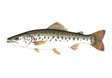
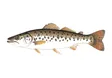
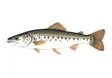
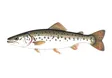
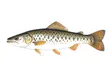
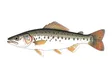
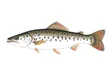
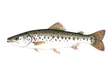
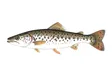
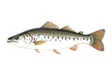
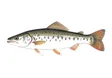
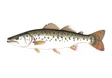
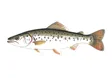
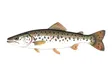
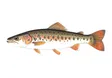
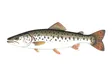
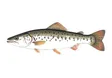
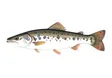
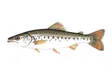
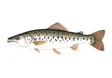
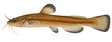
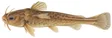
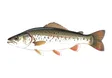
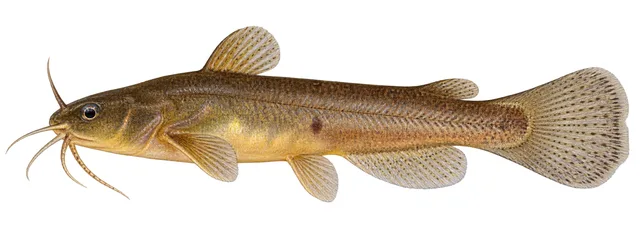
Tadpole Madtom field guide illustration

About Tadpole Madtom

The tadpole madtom (Noturus gyrinus) is a species of fish in the family Ictaluridae. It is native to Canada and the United States.

Description

An adult tadpole madtom is typically 2–3 inches (50–80 mm), however they have been recorded at a length of 5 inches (130 mm). The tadpole madtom has a dark brown back with a lighter brown color on their sides and a yellow or white stomach. The pelvic and pectoral fins of adults are heavily covered in melanophores responsible for pigmentation, and the dorsal and anal fins contain fewer melanophores. There are also bands of melanophores on both the upper and lower jaws creating a dark horizontal streak along the side. Chin barbels vary from white to being lightly covered with melanophores. The tadpole madtom possess dark nasal and maxillary barbels and white mandibular barbels. Their adipose fin is completely connected to their large and round caudal fin, and their pectoral fin is not serrated. They possess 6–7 gill rakers; 6–7 dorsal rays; 15–18 anal rays; 7–9 pectoral rays; and 8–10 pelvic rays. The anal fin is of moderate length, but decreases with increasing body length. The tadpole madtoms also possess two pectoral spines through which an anti-predatory venom is transmitted. They have a terminal mouth with numerous small and sharp cardiform teeth. The teeth exist in numerous broad bands across the upper and lower jaw.

Range and habitat

The tadpole madtom is found in parts of the U.S. and Canada. In Canada it is native to Manitoba, Ontario, Quebec, and Saskatchewan, and can be found in the Assiniboine, Saskatchewan, Souris, Red, English, Winnipeg, and Nelson rivers. The tadpole madtom's range in the United States is extensive, ranging from Texas to Florida and north along the Atlantic coast to New York. It can be found in the Mississippi River valley as well as the Great Lakes basin. In Minnesota it is present in all adjacent drainage systems to the Red River basin. In North Dakota it can be found in the Missouri river drainage. In South Dakota it is present in the eastern tributaries to the Missouri River, including the James River, as well as the Minnesota and Big Sioux river drainages. The tadpole madtom lives in areas with little to no current. They typically inhabit swamps and marshes, as well as lakes and slow moving streams and rivers 0.1–1.5 meters deep and 12–24 meters wide. They also prefer habitats with turbid water; a soft mud, sand or gravel bottom; and thick vegetation to use for crypsis.

Diet

The tadpole madtom is an invertivore, planktivore, but also feeds on particulate. A Common food source for the tadpole madtom are immature insects and small crustaceans such as cladocera, ostracods, hyalella, and chironomids. Another popular food source is small crustaceans such as amphipods and isopods. Smaller fish feed more on small crustaceans while large fish tend to consume large prey such as worms and grass shrimp. Researchers in Wisconsin recorded the stomach contents of numerous tadpole madtoms and found an average diet consisting of 44% insects, 28.3% small crustaceans, 18.3% oligochaetes, 5.9% plants, 3% silt and debris, 0.1% snails, and 0.1% algae.

Reproduction, life cycle

Due to the tadpole madtom's secretive nature, little is known of their spawning habits. In most areas the tadpole madtom spawn in June or July when the water temperature reaches 80 °F. Breeding males exhibit swelling of the lips and genital papillae as well as enlarged muscles on top of the head. Breeding tadpole madtoms do not build nests, but instead rely on any present solid substrate with which to attach their eggs. This generally includes things such as a rocks, logs, and vegetation. However, they have also been known to attach their eggs to submerged garbage such as pop cans. They have also been known to use abandoned crayfish burrows as a place to house their eggs. The female produces numerous clutches of eggs throughout breeding season, however not much is known of the number of clutches that they produce. Each clutch generally contains anywhere from 75 to 200 eggs. The male then guards the eggs until they hatch to ensure their safety.

Conservation status

Tadpole madtom populations are secure in most areas. However, they are critically endangered in Pennsylvania, and they are on Kansas's list of species in need of conservation. Populations in Saskatchewan, New York, South Dakota, Oklahoma, Iowa, and Nebraska are considered vulnerable as well.

Etymology

The tom segment of the name is used as another word for cat. There are two explanations proposed for the reasoning behind the mad segment of the name. One is that it refers to the venomous spines that it possesses; which maddens predators that get stuck by them. The alternative is that it refers to their habit of darting every which way when startled by predators. The tadpole segment of the name exists, because of their rounded caudal fin which gives them the appearance of a tadpole. Noturus (no-tour´-us) means "back tail" in Greek, which refers to the strip of skin which connects the tail and adipose fins. Gyrinus (jie-wren´-us) is Greek for tadpole.

Article text: Wikipedia contributors, Tadpole madtom (source revision). Licensed under CC BY-SA 4.0. Retrieved 2026-10-11.
Diet and feeding

The FishTraits compilation records these diet categories for this species: aquatic or other vascular plants; invertebrates or larval fish; larger animal prey (a source category covering fish, crayfish, crabs, or frogs). These are broad categories, not a claim that every individual consumes every example in a category.

Reported feeding positions include bottom feeding. The compilation combines published observations; diets can vary with age, locality, and available food.

Habitat preferences

Reported habitat associations include medium to large rivers, streams and small rivers, creeks, still-water habitats.

The source records associations with vegetation, organic debris, large woody material. An association indicates reported use, rather than an exclusive requirement.

Reproduction and parental care

The compilation reports a representative maturity age of 1.5 years. Its maturity field summarizes mean, median, or modal estimates, usually for females; male estimates can be used when female data are unavailable. It is not a fixed age at which every fish first breeds.

Batch or serial spawning has been reported somewhere in the species’ range. This does not establish the same spawning pattern for every population.

Recorded spawning months are May, Jun, Jul, Aug, Sep for the source’s reporting region (NC). This is a regional calendar, not a range-wide schedule.

The reproductive-guild classification includes guarding eggs or young at a spawning substrate or nest.

Size and recorded longevity

FishTraits reports a maximum total length of 13 centimetres. Some entries use an estimated asymptotic length; this value should not be treated as a certified record catch.

Recorded longevity in the compilation is 4 years. Wild observations were preferred, but captive records were accepted where wild records were unavailable, and unspecified records were assumed wild. The value is not a guaranteed wild lifespan or an aquarium life expectancy.

Native range

Atlantic and Gulf Slope drainages from New Hampshire to Nueces River, Texas; St. Lawrence-Great Lakes, Hudson Bay (Red River), and Mississippi River basins from southern Quebec to southern Saskatchewan, and south to Gulf. Absent from Appalachian and Ozark Highlands (Page and Burr 1991).

Introduction history

Unintentional in most locations. It is believed that introduced channel catfish and bullhead stock was contaminated with Tadpole Madtoms (Linder 1963; Taylor 1969; Simpson and Wallace 1978; Wydoski and Whitney 1979; Hartel 1992).

Range

Where it lives

Share of 8,371 GBIF observation records with a state location, across 38 states. The orange dots are USGS stream-survey sites where this species was caught.
0%
14.9%
Share of 8,371 GBIF observation records with a state location, across 38 states. The orange dots are USGS stream-survey sites where this species was caught.

A blank area on the dot layer usually means nobody sampled there, not that the fish is absent. Turn on “every survey site” to see where the survey looked.

The USGS stream survey caught it at 1,003 of its sites, in 31 states. That survey and the GBIF records are two different counts of two different things, so the site keeps them apart.

Habitat

Water and movement

Water
WoRMS records this species in fresh water.
USGS NAS habitat
Freshwater
US status
Native transplant — native to part of the United States, moved to other waters inside it.
Migration
Not migratory

Classification

Taxonomy

Kingdom
Animalia
Phylum
Chordata
Superclass
Actinopterygii
Class
Teleostei
Order
Siluriformes
Genus
Noturus
Species
Noturus gyrinus
ITIS TSN
164003
WoRMS AphiaID
1022873
GBIF key
2341016
Outside the US
ITIS also files it in Canada.

Common questions about Tadpole Madtom

What is the scientific name of Tadpole Madtom?
The scientific name is Noturus gyrinus, in the family Ictaluridae. Classification follows ITIS.
Does Tadpole Madtom live in fresh water or salt water?
WoRMS records this species in fresh water.
Where has Tadpole Madtom been recorded in the United States?
GBIF has observations in 38 states, with the most records in Texas, Minnesota, Florida. The map shows observation records, which do not establish the complete natural range.

Closest relatives

Other Noturus species

Same family

More Ictaluridae

Black Bullhead46 states
Ameiurus melasIctaluridaeNative and introducedFresh
Black Madtom5 states
Noturus funebrisIctaluridaeNativeFresh
Black River Madtom2 states
Noturus maydeniIctaluridaeNativeFresh
Blue Catfish31 states
Ictalurus furcatusIctaluridaeNative and introducedFreshBrackish
Brindled Madtom16 states
Noturus miurusIctaluridaeNativeFresh
Brown Bullhead44 states
Ameiurus nebulosusIctaluridaeNative and introducedFresh
Brown Madtom6 states
Noturus phaeusIctaluridaeNativeFresh
Caddo Madtom1 states
Noturus tayloriIctaluridaeNativeFresh
Carolina Madtom2 states
Noturus furiosusIctaluridaeNativeFresh
Channel Catfish47 states
Ictalurus punctatusIctaluridaeNative and introducedFresh
Checkered Madtom3 states
Noturus flavaterIctaluridaeNativeFresh
Chucky Madtom1 states
Noturus crypticusIctaluridaeNativeFresh
Elegant Madtom4 states
Noturus elegansIctaluridaeNativeFresh
Flat Bullhead7 states
Ameiurus platycephalusIctaluridaeNative and introducedFresh
Flathead Catfish34 states
Pylodictis olivarisIctaluridaeNative and introducedFresh
Frecklebelly Madtom5 states
Noturus munitusIctaluridaeNativeFresh
Freckled Madtom15 states
Noturus nocturnusIctaluridaeNativeFresh
Headwater Catfish2 states
Ictalurus lupusIctaluridaeNativeFresh
Least Madtom4 states
Noturus hildebrandiIctaluridaeNativeFresh
Margined Madtom21 states
Noturus insignisIctaluridaeNative and introducedFresh
Mountain Madtom15 states
Noturus eleutherusIctaluridaeNativeFresh
Neosho Madtom3 states
Noturus placidusIctaluridaeNativeFresh
Northern Madtom9 states
Noturus stigmosusIctaluridaeNativeFresh
Orangefin Madtom3 states
Noturus gilbertiIctaluridaeNative and introducedFresh

All 42 species in Ictaluridae