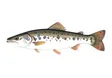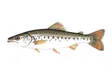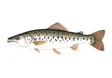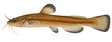
Freckled Madtom

Noturus nocturnus

Ictaluridae · freshwater water fish

4 minute read · Species guide

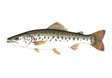
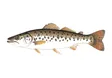
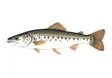
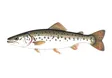
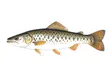
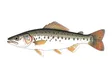
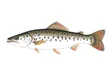
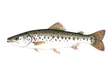
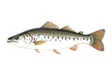
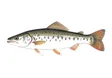
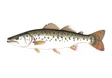
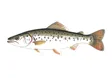
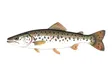
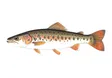
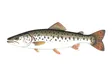
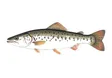
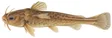
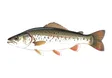
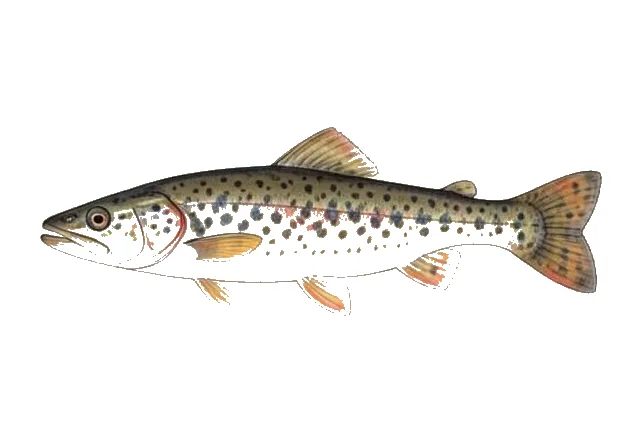
Freckled Madtom field guide illustration

About Freckled Madtom

The freckled madtom (Noturus nocturnus) a species of freshwater madtom (catfish) found in the eastern United States. The freckled madtom is a benthic feeder mostly of invertebrates and usually inhabits waters that are medium to large in size, living mostly in riffle areas that have mostly clear waters and rocky bottoms. Its spawning season occurs from spring to early summer in riffle areas, and sexual maturation occurs after two years.

Geographic distribution

The freckled madtom is a freshwater species found across the eastern United States; it is common across most of its range. This range includes the Mississippi River basin and tributaries of the Gulf of Mexico in Alabama, Mississippi, Louisiana, and Texas. This species is also found in the lower Ohio River basin in Kentucky, Indiana, and Illinois. Other areas it is found include Oklahoma, southeastern Iowa, central Kansas, Arkansas, Georgia, and western Tennessee. Latitudinally it is found mostly between 41 and 30°N. This range has been identified since at least 1980; the current distribution is similar to the historical one, though some small extensions have been driven north, possibly as a result of global warming. This species is not known to travel often, especially over long distances. Further, its distribution is not entirely known due to its small population sizes and tendency to be easily misidentified. Freckled madtoms are often misidentified as bullheads or other catfish.

Further, the freckled madtom is said to be an intolerant species that sometimes disappears after a disturbance. These individuals are fluvial specialists, meaning they are specialized to a particular habitat, theirs being fast-moving riffle habitats. Human litter may be a potential disturbance to the species; young and breeding adult male individuals have often been found in beverage cans and other human-created debris. It may be difficult to determine range expansion, though, because of its small population sizes in certain areas, including central Oklahoma. However, freckled madtom distributions may have extended slightly as water quality in certain regions has improved.

Ecology

The freckled madtom is known to inhabit fast-moving and permanently moving streams that are medium to large in size. The streams usually contain rocky bottoms. Further, this species is sometimes found in the vicinity of undercut banks near masses of sticks and roots.

The freckled madtom is primarily an invertivore (feeding on invertebrates). It uses ambush tactics in benthic regions largely at night to feed. It notably consumes insect larvae, including mayfly, black fly, caddisfly, and midge larvae. It also occasionally eats crustaceans. Though it is largely an invertivore, it has also been known to occasionally eat other fish. In southern Mississippi, evidence was found of freckled madtoms feeding on the smaller speckled madtom (N. leptacanthus). To aid in devouring victims, this catfish has venom glands along smooth spines on the pectoral and dorsal fins.

Life history

The maximum reported size of the freckled madtom is 15 cm (5.9 in). One source lists the average size as 4.6 cm (1.8 in), and another source lists an average size range between 5 and 13.5 cm (2.0 and 5.3 in) long.

The maximum age reported is 4.0 to 4.5 years. Males become sexually mature by 2 years, most females by their second summer if not sooner, and polygamy is common among this species, as well as other Noturus species. Females produce an average of around 100 eggs per summer. The oocytes mature by late May to early July, and males guard the nests usually by late June. Optimal water temperature surrounding the nests is 25 °C (77 °F). Nests have been found under flat rocks, though still in the same fast-moving riffle areas this species inhabits.

Conservation and management

The freckled madtom is not considered an endangered species at the federal level, and it is not found on the International Union for Conservation of Nature's endangered species lists. However, it has been listed as an endangered species in Iowa since 1984.

Article text: Wikipedia contributors, Freckled madtom (source revision). Licensed under CC BY-SA 4.0. Retrieved 2026-10-11.
Diet and feeding

The FishTraits compilation records these diet categories for this species: invertebrates or larval fish. These are broad categories, not a claim that every individual consumes every example in a category.

Reported feeding positions include bottom feeding. The compilation combines published observations; diets can vary with age, locality, and available food.

Habitat preferences

Reported habitat associations include streams and small rivers, creeks.

The source records associations with muck, clay or silt, vegetation, organic debris, large woody material. An association indicates reported use, rather than an exclusive requirement.

Reproduction and parental care

The compilation reports a representative maturity age of 1.5 years. Its maturity field summarizes mean, median, or modal estimates, usually for females; male estimates can be used when female data are unavailable. It is not a fixed age at which every fish first breeds.

Recorded spawning months are May, Jun, Jul for the source’s reporting region (IL). This is a regional calendar, not a range-wide schedule.

The reproductive-guild classification includes guarding eggs or young at a spawning substrate or nest.

Size and recorded longevity

FishTraits reports a maximum total length of 15 centimetres. Some entries use an estimated asymptotic length; this value should not be treated as a certified record catch.

Recorded longevity in the compilation is 4.5 years. Wild observations were preferred, but captive records were accepted where wild records were unavailable, and unspecified records were assumed wild. The value is not a guaranteed wild lifespan or an aquarium life expectancy.

Range

Where it lives

Share of 3,081 GBIF observation records with a state location, across 15 states. The orange dots are USGS stream-survey sites where this species was caught.
0%
30.2%
Share of 3,081 GBIF observation records with a state location, across 15 states. The orange dots are USGS stream-survey sites where this species was caught.

A blank area on the dot layer usually means nobody sampled there, not that the fish is absent. Turn on “every survey site” to see where the survey looked.

The USGS stream survey caught it at 342 of its sites, in 12 states. That survey and the GBIF records are two different counts of two different things, so the site keeps them apart.

Habitat

Water and movement

Water
WoRMS records this species in fresh water.
USGS NAS habitat
Freshwater
US status
Native transplant — native to part of the United States, moved to other waters inside it.
Migration
Not migratory

Classification

Taxonomy

Kingdom
Animalia
Phylum
Chordata
Superclass
Actinopterygii
Class
Teleostei
Order
Siluriformes
Genus
Noturus
Species
Noturus nocturnus
ITIS TSN
164005
WoRMS AphiaID
1019808
GBIF key
2341036

Common questions about Freckled Madtom

What is the scientific name of Freckled Madtom?
The scientific name is Noturus nocturnus, in the family Ictaluridae. Classification follows ITIS.
Does Freckled Madtom live in fresh water or salt water?
WoRMS records this species in fresh water.
Where has Freckled Madtom been recorded in the United States?
GBIF has observations in 15 states, with the most records in Texas, Oklahoma, Illinois. The map shows observation records, which do not establish the complete natural range.

Closest relatives

Other Noturus species

Same family

More Ictaluridae

Black Bullhead46 states
Ameiurus melasIctaluridaeNative and introducedFresh
Black Madtom5 states
Noturus funebrisIctaluridaeNativeFresh
Black River Madtom2 states
Noturus maydeniIctaluridaeNativeFresh
Blue Catfish31 states
Ictalurus furcatusIctaluridaeNative and introducedFreshBrackish
Brindled Madtom16 states
Noturus miurusIctaluridaeNativeFresh
Brown Bullhead44 states
Ameiurus nebulosusIctaluridaeNative and introducedFresh
Brown Madtom6 states
Noturus phaeusIctaluridaeNativeFresh
Caddo Madtom1 states
Noturus tayloriIctaluridaeNativeFresh
Carolina Madtom2 states
Noturus furiosusIctaluridaeNativeFresh
Channel Catfish47 states
Ictalurus punctatusIctaluridaeNative and introducedFresh
Checkered Madtom3 states
Noturus flavaterIctaluridaeNativeFresh
Chucky Madtom1 states
Noturus crypticusIctaluridaeNativeFresh
Elegant Madtom4 states
Noturus elegansIctaluridaeNativeFresh
Flat Bullhead7 states
Ameiurus platycephalusIctaluridaeNative and introducedFresh
Flathead Catfish34 states
Pylodictis olivarisIctaluridaeNative and introducedFresh
Frecklebelly Madtom5 states
Noturus munitusIctaluridaeNativeFresh
Headwater Catfish2 states
Ictalurus lupusIctaluridaeNativeFresh
Least Madtom4 states
Noturus hildebrandiIctaluridaeNativeFresh
Margined Madtom21 states
Noturus insignisIctaluridaeNative and introducedFresh
Mountain Madtom15 states
Noturus eleutherusIctaluridaeNativeFresh
Neosho Madtom3 states
Noturus placidusIctaluridaeNativeFresh
Northern Madtom9 states
Noturus stigmosusIctaluridaeNativeFresh
Orangefin Madtom3 states
Noturus gilbertiIctaluridaeNative and introducedFresh
Ouachita Madtom1 states
Noturus lachneriIctaluridaeNativeFresh

All 42 species in Ictaluridae