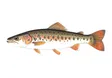
An omnivorous predator, it has been introduced in a number of reservoirs and rivers, notably the Santee Cooper lakes of Lake Marion and Lake Moultrie in South Carolina, the James River in Virginia, Powerton Lake in Pekin, Illinois, and Lake Springfield in Springfield, Illinois. It is also found in some lakes in Florida.
The blue catfish can tolerate brackish water, and thus can colonize along inland waterways of coastal regions. It is considered invasive in some areas, particularly the Albemarle Sound and Chesapeake Bay.
Evolution
The blue catfish is likely a direct descendant of Ictalurus lambda, a prehistoric catfish that inhabited the central and southern United States during the Pliocene. The bones of I. lambda very closely resemble those of I. furcatus aside from a few minor differences.
Identification
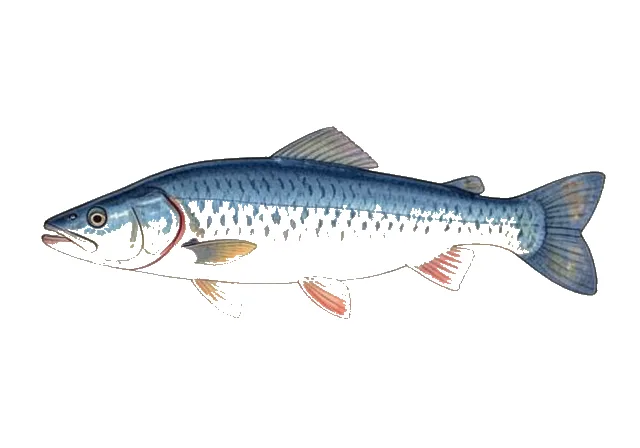
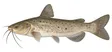
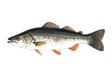
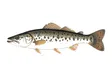
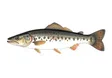
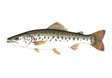
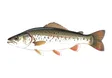
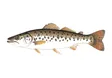
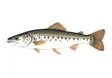
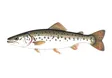
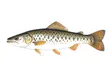
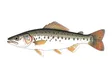
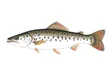
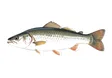
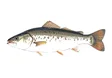
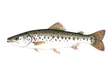
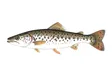
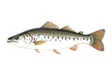
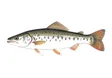
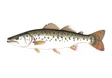
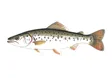
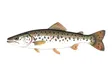
Blue catfish are often misidentified as channel catfish. Blue catfish are heavy bodied, blueish gray in color, and have a dorsal hump. The best way to tell the difference between a channel catfish and a blue catfish is to count the number of rays on the anal fin. A blue catfish has 30–36 rays, whereas a channel catfish has 25–29. Blue catfish also have barbels, a deeply forked tail, and a protruding upper jaw.
While adult blue catfish usually only grow to around two feet (0.61 m) they have been seen to grow up to at least five feet (1.5 m) in length and even weigh more than 100 pounds (45 kg).
Diet
The blue catfish is an opportunistic predator, eating any species of fish it can take (including cannibalism), along with insects, crawfish, crabs, freshwater mussels, clams, worms, frogs, and other readily available aquatic food sources.
The species is noted for taking injured fish beneath marauding schools of striped bass in open water in reservoirs, and feeding on wounded baitfish that have been washed through dam spillways or power-generation turbines. It is one of the few species of fish in the Mississippi River basin able to eat adult Asian carp.
Population
The blue catfish are a highly productive species, spawning once a year from May to June. Females can produce 2,000 to 4,000 eggs per pound (0.45 kg) of body weight, meaning a 20-pound (9.1 kg) blue catfish can produce upwards of 40,000 eggs.
As an invasive
The ability of the blue catfish to tolerate a wide range of climates and brackish water has allowed it to thrive in Virginia's rivers, lakes, tributaries, and the Chesapeake Bay. Unfortunately, the relatively low mortality rate, large body size, wide range of species preyed upon, and success as a predator has resulted in the blue catfish being considered a problematic invasive species in Virginia. Since their introduction in Virginia waters in the 1970s, blue catfish populations have exploded. Recent electrofishing studies have documented capture rates in excess of 6,000 fish/hr, whereas studies from the native range show peak electrofishing capture rates of 700 fish/hr. Clearly, blue catfish are a dominant species within the freshwater and oligohaline portions of Virginia's tidal rivers. The introduction of blue catfish in Virginia's tidal rivers was thought to have negative impacts on anadromous American shad, blueback herring, and alewife; however, predation of these species by blue catfish has been demonstrated to be minimal. Researchers from Virginia Tech have found the species to be mostly herbivorous and omnivorous, with diets consisting largely of Hydrilla and Asian clams, both of which are invasive to the Chesapeake Bay. Blue crab, the most valuable species in the Chesapeake Bay, was also found in the diet with some regularity, with blue catfish consuming an estimated 400.7 metric tonnes in the Chesapeake alone.
Record-setting fish
An angling world record was set on May 22, 2005 with a 124-pound (56.2 kg) blue catfish caught in the Mississippi River, surpassing a 121.5-pound (55.1 kg) specimen from Lake Texoma in Texas.
On June 18, 2011, a 143-pound (64.9 kg) blue catfish was landed from Kerr Lake on the Virginia- North Carolina border. On June 22, 2011, the Virginia Department of Game and Inland Fisheries certified it as the new state record. The fish had a length of 57 in (145 cm) and a girth of 47 in (120 cm).
The hand-line record is a 107-pound (48.5 kg) blue catfish on 15-pound (6.8 kg) -test braided line caught June 5, 2015 on the Potomac River using a sausage with a circle hook.
Article text: Wikipedia contributors, Blue catfish (source revision). Licensed under CC BY-SA 4.0. Retrieved 2026-10-11.
Diet and feeding
The FishTraits compilation records these diet categories for this species: invertebrates or larval fish; larger animal prey (a source category covering fish, crayfish, crabs, or frogs). These are broad categories, not a claim that every individual consumes every example in a category.
Reported feeding positions include bottom feeding and surface or water-column feeding. The compilation combines published observations; diets can vary with age, locality, and available food.
Habitat preferences
Reported habitat associations include medium to large rivers.
The source records associations with muck, vegetation, organic debris. An association indicates reported use, rather than an exclusive requirement.
Reproduction and parental care
The compilation reports a representative maturity age of 5 years. Its maturity field summarizes mean, median, or modal estimates, usually for females; male estimates can be used when female data are unavailable. It is not a fixed age at which every fish first breeds.
Recorded spawning months are Apr, May for the source’s reporting region (NC). This is a regional calendar, not a range-wide schedule.
The reproductive-guild classification includes guarding eggs or young at a spawning substrate or nest.
Size and recorded longevity
FishTraits reports a maximum total length of 165 centimetres. Some entries use an estimated asymptotic length; this value should not be treated as a certified record catch.
Recorded longevity in the compilation is 20 years. Wild observations were preferred, but captive records were accepted where wild records were unavailable, and unspecified records were assumed wild. The value is not a guaranteed wild lifespan or an aquarium life expectancy.
Identification and appearance
Blue Catfish are often confused with channel catfish (I. punctatus). These two species can be distinguished by the shape of the anal fin (straight edge in I. furcatus; curved edge in I. punctatus) Smith (1979); Page and Burr (1991); Etnier and Starnes (1993); Jenkins and Burkhead (1994).
Native range
Mississippi River basin from western Pennsylvania to southern South Dakota and the Platte River, southwestern Nebraska, south to the Gulf of America; tributaries of the gulf from Mobile Bay basin, Alabama, to the Rio Grande drainage, Texas and New Mexico. Ictalurus furcatus is endemic to the Mississippi, Missouri, and Ohio River basins of the central and southern United States and inhabits Gulf Coast streams from Alabama south into Mexico. Also, native to the Atlantic Slope of Mexico (Page and Burr 1991) if not distinguished separately from I. meridionalis (Gilbert 1998). Rarely found in the Mississippi above the confluence with the Missouri River (Becker 1983). Two historic records from Wisconsin (Lake Pepin and Lansing, Iowa) are believed to be misidentifications of Channel Catfish (Becker 1983). As such, Becker does not consider the species native to Wisconsin.
Habitat and ecology
The harsh winters in their native and introduced range region make it likely Blue Catfish can survive low temperatures. They can be found in the Missouri River near Bismarck, North Dakota (Fuller and Neilson 2013). A CLIMATCH analysis included in the USFWS risk assessment for Blue Catfish found that the climate of the Great Lakes Basin closely matches the climate of their current range (Australian Bureau of Rural Sciences 2008).This species migrates toward warmer waters during winter and to cooler waters during summer (Graham 1999). Their preferred temperature is between 28 and 30°C. In fish farms in Mississippi Delta, 95% survive after winter with temperatures as low of 5.1°C (Bosworth 2012).
Blue Catfish can live in a variety of habitats. They inhabit river channels which have higher flows and harder substrates (i.e., gravel, boulders, rock rip rap), and floodplain lakes which have lower or no flows and softer substrates (i.e., silt, sand) (Eggleton and Schramm Jr 2004). Blue Catfish prefer open waters of large reservoirs and main channels, backwaters, and embayments of large, flowing rivers where water is normally turbid and substrate varies from gravel-sand to silt-mud (Burr and Warren 1986). Many rivers and reservoirs with I. furcatus populations have only mud or silt substrate. Blue Catfish prefer deep, swift channels and flowing pools (Jenkins and Burkhead 1994), and large individuals often are found in tailwaters below dams where currents are swift and substrates consist of sand, gravel, and rock (Mettee et al. 1996, Graham et al. 1999).
Blue Catfish are highly omnivorous. In the lower Mississippi River, across all habitats their diets were composed of 47% fishes (more than 15 identifiable species), 15% molluscs, 12% chironomids and oligochaetes, 7% detritus/plant matter, 6% decapods, 6% scavenging, and 1% terrestrial arthropods (Eggleton and Schramm Jr. 2004). Scavenged items were typically fishes and fish scales, but also included small mammals, birds, and turtles.
Blue Catfish spawns in late spring to early summer at water temperatures of 21 to 25°C (Sublette et al. 1990) In advance of spawning, Blue Catfish seek protected areas to deposit eggs behind rocks, root-wads, depressions, undercut stream banks, or other areas where the currents are minimal (Graham et al. 1999). Males guard eggs and fry (Graham et al. 1999) which is a strategy associated with animals that have high colonization success.
Introduction history
Intentionally stocked for food and sport. Stocked in the Cape Fear River, North Carolina, in 1966 (Guire et al. 1984). Introductions in the Choctawhatchee River, Alabama, were due to flooding of a private lake in 1993 (Mettee et al. 1996). Recent introductions into the Chattahoochee River in Alabama and Georgia were due to flooding of catfish farms in Alabama during a storm in March 1990 (Ober, personal communication). Presumably these fish moved downstream into the Apalachicola in Florida. Sources of introductions in Escambia and Yellow rivers of Florida are unknown (R. Cailteux, personal communication).
Ecological impacts
Hybridizes with threatened Yaqui catfish I. pricei in Mexico (U.S. Fish and Wildlife Service 1994).