Frecklebelly Madtom

Noturus munitus

Ictaluridae · freshwater water fish

5 minute read · Species guide

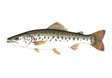
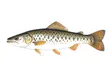
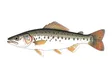
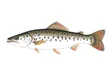
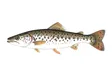
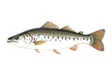
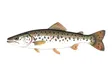
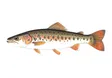
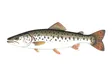
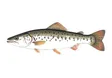
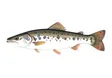
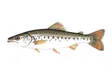
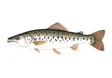
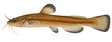
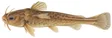
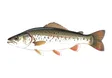
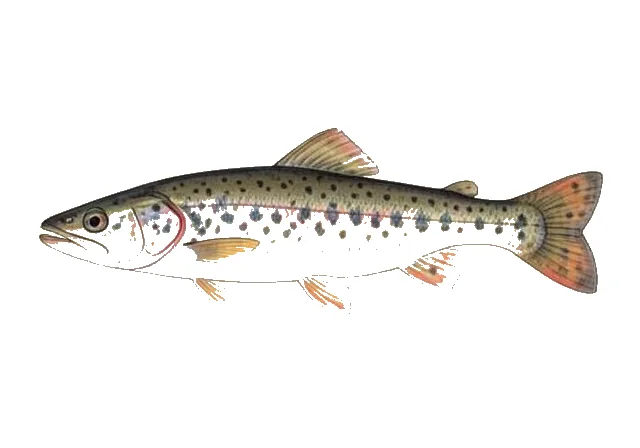
Frecklebelly Madtom field guide illustration

About Frecklebelly Madtom

The frecklebelly madtom (Noturus munitus) is a species of fish in the family Ictaluridae endemic to the United States. Madtoms are in the genus Noturus, which is a group of catfish prevalent in North America. In 2023, the Upper Coosa River distinct population segment (DPS) of N. munitus was listed as federally threatened under the Endangered Species Act of 1973.

Description

The frecklebelly madtom is a robust, boldly patterned member of the monophyletic saddled madtom subgenus Rabida. Historically, the population thrived in large rivers in the Mobile Basin and Pearl River drainages in the southeastern United States. However, it is currently limited to the Gulf Coastal Plain rivers. The species lives exclusively in medium to large rivers free of sedimentation and over gravel shoals. They spawn between June and August while producing 50 to 75 mature eggs in a single clutch.

All madtom species, including N. munitus have experienced decline since the 1950s due to channelization, gravel mining, dredging, and siltation, which reduce the ability for the species to properly breed and survive.

Distribution

N. munitus is a diminutive catfish with a disjunct distribution across the southeastern United States. It is historically known from the Pearl River drainage and the Upper Tombigbee River drainage in Mississippi and Louisiana, and the Alabama River and Cahaba River drainages in Alabama. However, it has been extirpated from the main channel of the Tombigbee and Alabama Rivers, and is currently limited to the Coastal Plain rivers. The species lives exclusively in medium to large rivers free of sedimentation and over gravel shoals. N. munitus has declined rapidly since the mid-1950s when river modification began. The loss of gravel substrates and increased levels of sedimentation due to poor agricultural practices have also affected the species. It is now reliably found in high numbers in only a few locations and is considered threatened with extinction.

Ecology

The habitats of N. munitus and other Noturus species are very specific. They must have moving, cool water, with no sedimentation. Dams interrupt the water flows, and sedimentation can cover eggs, preventing them from hatching. Several large-river specialists were frequently collected with N. munitus, including Macrhybopsis sp.cf. aestivalis (speckled chub), Macrhybopsis storeriana (silver chub), Notropis uranoscopus Suttkus (skygazing shiner), Crystallaria asprella (crystal darter), Percina lenticula (freckled darter), and P. vigil (saddleback darter).

Since N. munitus is an opportunistic insectivore, like most of these fish, competition for food may be present in the ecology of the species. A diet analysis showed Bactidae nymphs (31%), Hydropsychidae larvae (20%), and Simuliidae larvae (20%) provided most of the food for N. munitus. Consequently, in the long run, managing for N. munitus would also benefit other species. However, another reason for decline that should be assessed is predators, but predators were hard to find. Like all madtoms, they are known for their pectoral spines that contain saw-like teeth and a neurotoxin gland. These spines and toxins produce a painful sting when used, and indicate the presence of predators.

Life history

N. munitus reproduction is similar to those of other madtom species. They spawn between June and August while producing 50 to 75 mature eggs in a single clutch. They also prefer to make homes in cavities under rocks. They use these cavities for spawning. The male locates and guards a suitable site while the female deposits the eggs. The male then protects the eggs from predators and keeps them clean until they hatch; sedimentation plays a big role in the decline of the species. It can cover the eggs and cause them to die. If successful, the young reach reproductive maturity during the second summer of life, and 2–3 years.

Current management

Of the 29 Noturus species, more than 50% are considered vulnerable, imperiled, or extinct, and many are likely in need of conservation action due to small ranges and increasing anthropogenic threats, such as: water impoundment, channelization, gravel mining, dredging, and siltation. These activities reduce the ability for the species to properly breed and survive. Its habitat specificity and lack of published research are also affecting further conservation actions. They are protected in Mississippi and Alabama, but not in Louisiana. The Alabama Forever Wild Land Trust has aimed to protecting habitat sites that would be used by N. munitus.

Article text: Wikipedia contributors, Frecklebelly madtom (source revision). Licensed under CC BY-SA 4.0. Retrieved 2026-10-11.
Diet and feeding

The FishTraits compilation records these diet categories for this species: invertebrates or larval fish. These are broad categories, not a claim that every individual consumes every example in a category.

Reported feeding positions include bottom feeding. The compilation combines published observations; diets can vary with age, locality, and available food.

Habitat preferences

Reported habitat associations include medium to large rivers, streams and small rivers.

The source records associations with gravel, cobble, vegetation. An association indicates reported use, rather than an exclusive requirement.

Reproduction and parental care

The compilation reports a representative maturity age of 1.5 years. Its maturity field summarizes mean, median, or modal estimates, usually for females; male estimates can be used when female data are unavailable. It is not a fixed age at which every fish first breeds.

Recorded spawning months are May, Jun, Jul for the source’s reporting region (MS,AL). This is a regional calendar, not a range-wide schedule.

The reproductive-guild classification includes guarding eggs or young at a spawning substrate or nest.

Size and recorded longevity

FishTraits reports a maximum total length of 8.1 centimetres. Some entries use an estimated asymptotic length; this value should not be treated as a certified record catch.

Recorded longevity in the compilation is 2.5 years. Wild observations were preferred, but captive records were accepted where wild records were unavailable, and unspecified records were assumed wild. The value is not a guaranteed wild lifespan or an aquarium life expectancy.

Range

Where it lives

Share of 341 GBIF observation records with a state location, across 5 states.
0%
56.3%
Share of 341 GBIF observation records with a state location, across 5 states.

Habitat

Water and movement

Water
WoRMS records this species in fresh water.
USGS NAS habitat
Freshwater
US status
Native transplant — native to part of the United States, moved to other waters inside it.
Migration
Not migratory

Classification

Taxonomy

Kingdom
Animalia
Phylum
Chordata
Superclass
Actinopterygii
Class
Teleostei
Order
Siluriformes
Genus
Noturus
Species
Noturus munitus
ITIS TSN
164021
WoRMS AphiaID
1013471
GBIF key
2341015

Common questions about Frecklebelly Madtom

What is the scientific name of Frecklebelly Madtom?
The scientific name is Noturus munitus, in the family Ictaluridae. Classification follows ITIS.
Does Frecklebelly Madtom live in fresh water or salt water?
WoRMS records this species in fresh water.
Where has Frecklebelly Madtom been recorded in the United States?
GBIF has observations in 5 states, with the most records in Mississippi, Alabama, Georgia. The map shows observation records, which do not establish the complete natural range.

Closest relatives

Other Noturus species

Same family

More Ictaluridae

Black Bullhead46 states
Ameiurus melasIctaluridaeNative and introducedFresh
Black Madtom5 states
Noturus funebrisIctaluridaeNativeFresh
Black River Madtom2 states
Noturus maydeniIctaluridaeNativeFresh
Blue Catfish31 states
Ictalurus furcatusIctaluridaeNative and introducedFreshBrackish
Brindled Madtom16 states
Noturus miurusIctaluridaeNativeFresh
Brown Bullhead44 states
Ameiurus nebulosusIctaluridaeNative and introducedFresh
Brown Madtom6 states
Noturus phaeusIctaluridaeNativeFresh
Caddo Madtom1 states
Noturus tayloriIctaluridaeNativeFresh
Carolina Madtom2 states
Noturus furiosusIctaluridaeNativeFresh
Channel Catfish47 states
Ictalurus punctatusIctaluridaeNative and introducedFresh
Checkered Madtom3 states
Noturus flavaterIctaluridaeNativeFresh
Chucky Madtom1 states
Noturus crypticusIctaluridaeNativeFresh
Elegant Madtom4 states
Noturus elegansIctaluridaeNativeFresh
Flat Bullhead7 states
Ameiurus platycephalusIctaluridaeNative and introducedFresh
Flathead Catfish34 states
Pylodictis olivarisIctaluridaeNative and introducedFresh
Freckled Madtom15 states
Noturus nocturnusIctaluridaeNativeFresh
Headwater Catfish2 states
Ictalurus lupusIctaluridaeNativeFresh
Least Madtom4 states
Noturus hildebrandiIctaluridaeNativeFresh
Margined Madtom21 states
Noturus insignisIctaluridaeNative and introducedFresh
Mountain Madtom15 states
Noturus eleutherusIctaluridaeNativeFresh
Neosho Madtom3 states
Noturus placidusIctaluridaeNativeFresh
Northern Madtom9 states
Noturus stigmosusIctaluridaeNativeFresh
Orangefin Madtom3 states
Noturus gilbertiIctaluridaeNative and introducedFresh
Ouachita Madtom1 states
Noturus lachneriIctaluridaeNativeFresh

All 42 species in Ictaluridae