Ozark Madtom

Noturus albater

Ictaluridae · freshwater water fish

3 minute read · Species guide

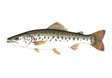
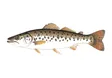
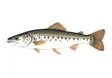
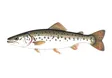
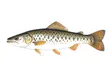
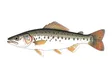
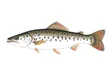
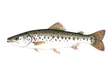
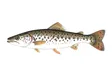
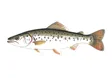
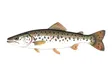
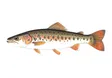
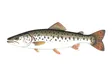
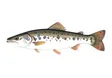
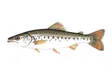
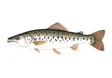
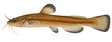
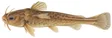
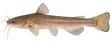
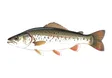
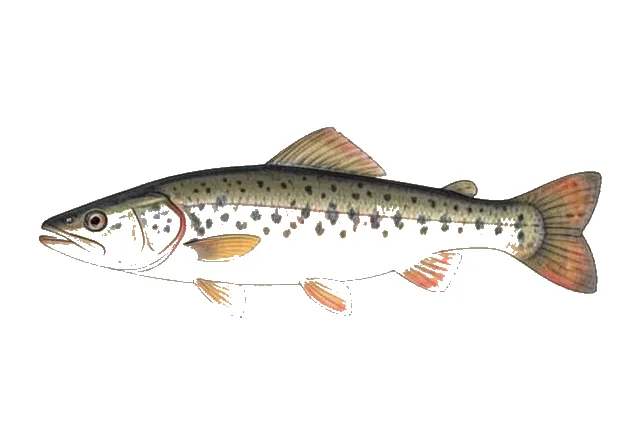
Ozark Madtom field guide illustration

About Ozark Madtom

The Ozark madtom (Noturus albater) is a freshwater fish endemic to the United States. It is one of 29 species of madtom.

Description

The Ozark madtom has a stout body and small head. A dark bar can be found at the base of the caudal fin, and the caudal fin is usually straight or slightly rounded. The pectoral fin has 9 rays, and the anal fin has 13 to 16 rays. The fish has a total length of 120 mm (4 in).

Distribution and habitat

The Ozark madtom are found around the upper White River and the Little Red River in the Ozark Uplands in Arkansas and Missouri, United States.

The Ozark madtom can by found in riffles and rocky pools, as well as cool, clear, high-gradient creeks and small to medium-sized rivers. They are found in shallow depths (usually of less than half a meter deep) and high velocity currents. During the day, they use the rocky bed bottom as cover.

Diet

Most of the Ozark madtom's diet consists of aquatic insects, with Diptera (flies) making up a majority. Ephemeroptera (mayflies) make up most of the remainder of the diet.

Behavior

Nests are found under small flat rocks in pools that are about one-third to two-thirds of a meter deep. In the moments before spawning, males have enlarged head muscles and swollen lips, similar to other madtoms. It is presumed that these enlarged heads are associated with nest construction, helping with the clearing and burrowing by males under rocks.

Life history

Ozark madtoms have yellow spherical eggs. Their eggs adhere to each other but to no other surfaces. After about 4 days after spawning, the embryos obviously show blood, myomeres are well developed, the tail is free from the yolk sac, pigment is well developed in the eye, and a couple sets of barbels are beginning to form.

At hatching, the larvae are 8 mm (0.3 in) long and mostly translucent. They gain melanophores on their head. Caudal and anal fins begin to develop and another pair of barbels appears near the nostrils. About 7 days after hatching, the larvae are 12 mm (0.5 in) long. All fins are nearly adult-like. The barred pattern found in adults does not form until later.

Predators

Luxilus zonatus (bleeding shiners) are known to prey upon the Ozark madtom's eggs, while Etheostoma caeruleum (rainbow darters) and Percina evides (gilt darters) are known to prey upon the Ozark madtom's larvae.

Article text: Wikipedia contributors, Ozark madtom (source revision). Licensed under CC BY-SA 4.0. Retrieved 2026-10-11.
Diet and feeding

The FishTraits compilation records these diet categories for this species: invertebrates or larval fish. These are broad categories, not a claim that every individual consumes every example in a category.

Reported feeding positions include bottom feeding. The compilation combines published observations; diets can vary with age, locality, and available food.

Habitat preferences

Reported habitat associations include streams and small rivers, creeks.

The source records associations with gravel, cobble, boulders, bedrock. An association indicates reported use, rather than an exclusive requirement.

Reproduction and parental care

The compilation reports a representative maturity age of 2 years. Its maturity field summarizes mean, median, or modal estimates, usually for females; male estimates can be used when female data are unavailable. It is not a fixed age at which every fish first breeds.

Recorded spawning months are Jun, Jul for the source’s reporting region (MO). This is a regional calendar, not a range-wide schedule.

The reproductive-guild classification includes guarding eggs or young at a spawning substrate or nest.

Size and recorded longevity

FishTraits reports a maximum total length of 12 centimetres. Some entries use an estimated asymptotic length; this value should not be treated as a certified record catch.

Recorded longevity in the compilation is 3.5 years. Wild observations were preferred, but captive records were accepted where wild records were unavailable, and unspecified records were assumed wild. The value is not a guaranteed wild lifespan or an aquarium life expectancy.

Range

Where it lives

Share of 554 GBIF observation records with a state location, across 2 states. The orange dots are USGS stream-survey sites where this species was caught.
0%
65.7%
Share of 554 GBIF observation records with a state location, across 2 states. The orange dots are USGS stream-survey sites where this species was caught.

A blank area on the dot layer usually means nobody sampled there, not that the fish is absent. Turn on “every survey site” to see where the survey looked.

Share of records by state

The USGS stream survey caught it at 48 of its sites, in 2 states. That survey and the GBIF records are two different counts of two different things, so the site keeps them apart.

Habitat

Water and movement

Water
WoRMS records this species in fresh water.
Migration
Not migratory

Classification

Taxonomy

Kingdom
Animalia
Phylum
Chordata
Superclass
Actinopterygii
Class
Teleostei
Order
Siluriformes
Genus
Noturus
Species
Noturus albater
ITIS TSN
164006
WoRMS AphiaID
1012746
GBIF key
2341019

Common questions about Ozark Madtom

What is the scientific name of Ozark Madtom?
The scientific name is Noturus albater, in the family Ictaluridae. Classification follows ITIS.
Does Ozark Madtom live in fresh water or salt water?
WoRMS records this species in fresh water.
Where has Ozark Madtom been recorded in the United States?
GBIF has observations in 2 states, with the most records in Arkansas, Missouri. The map shows observation records, which do not establish the complete natural range.

Closest relatives

Other Noturus species

Same family

More Ictaluridae

Black Bullhead46 states
Ameiurus melasIctaluridaeNative and introducedFresh
Black Madtom5 states
Noturus funebrisIctaluridaeNativeFresh
Black River Madtom2 states
Noturus maydeniIctaluridaeNativeFresh
Blue Catfish31 states
Ictalurus furcatusIctaluridaeNative and introducedFreshBrackish
Brindled Madtom16 states
Noturus miurusIctaluridaeNativeFresh
Brown Bullhead44 states
Ameiurus nebulosusIctaluridaeNative and introducedFresh
Brown Madtom6 states
Noturus phaeusIctaluridaeNativeFresh
Caddo Madtom1 states
Noturus tayloriIctaluridaeNativeFresh
Carolina Madtom2 states
Noturus furiosusIctaluridaeNativeFresh
Channel Catfish47 states
Ictalurus punctatusIctaluridaeNative and introducedFresh
Checkered Madtom3 states
Noturus flavaterIctaluridaeNativeFresh
Chucky Madtom1 states
Noturus crypticusIctaluridaeNativeFresh
Elegant Madtom4 states
Noturus elegansIctaluridaeNativeFresh
Flat Bullhead7 states
Ameiurus platycephalusIctaluridaeNative and introducedFresh
Flathead Catfish34 states
Pylodictis olivarisIctaluridaeNative and introducedFresh
Frecklebelly Madtom5 states
Noturus munitusIctaluridaeNativeFresh
Freckled Madtom15 states
Noturus nocturnusIctaluridaeNativeFresh
Headwater Catfish2 states
Ictalurus lupusIctaluridaeNativeFresh
Least Madtom4 states
Noturus hildebrandiIctaluridaeNativeFresh
Margined Madtom21 states
Noturus insignisIctaluridaeNative and introducedFresh
Mountain Madtom15 states
Noturus eleutherusIctaluridaeNativeFresh
Neosho Madtom3 states
Noturus placidusIctaluridaeNativeFresh
Northern Madtom9 states
Noturus stigmosusIctaluridaeNativeFresh
Orangefin Madtom3 states
Noturus gilbertiIctaluridaeNative and introducedFresh

All 42 species in Ictaluridae