Smoky Madtom

Noturus baileyi

Ictaluridae · freshwater water fish

4 minute read · Species guide

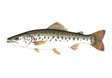
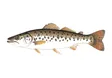
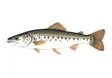
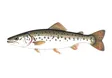
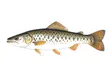
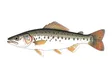
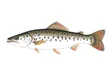
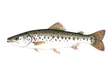
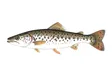
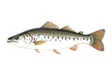
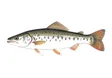
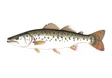
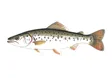
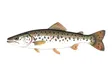
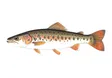
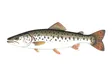
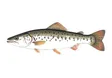
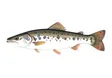
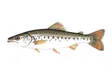
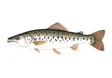
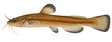
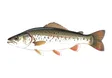
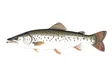
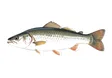
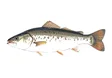
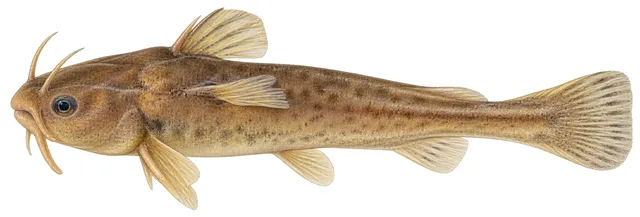
Smoky Madtom field guide illustration

About Smoky Madtom

The smoky madtom (Noturus baileyi) is a species of catfish. Little information exists about the smoky madtom, along with other members of the Noturus species, due to the high turbidity in which they spawn, preventing observation, as well as their nocturnal behaviors.

Description

The madtom is a small member of the family Ictaluridae, only reaching a maximum of 5 cm (2 in) long. It is olive brown on top with white to yellow below. Four saddles line the back of this species.

Distribution

The smoky madtom is endemic to Abrams Creek in the Great Smoky Mountains National Park, Tennessee. In 1957, Chilhowee Dam was closed and an ichthyocide was administered to Abrams Creek, in an attempt to improve trout fishery. Extirpation of the smoky madtom resulted. The smoky madtom was presumed extinct until in 1980, when another population was found in Citico Creek in the Cherokee National Forest within Monroe County, Tennessee. In 1986, a restoration project was begun to restore this native population. Efforts include collecting egg masses from Citico Creek, rearing them in the lab, and reintroducing them into Abrams Creek after a year.

Ecology

The smoky madtom is a very secretive catfish. During the day, it buries itself under gravel. It is nocturnal and feeds at night on aquatic invertebrates and small fish. It prefers areas of transition between pools and riffles and spawns in the summer under large, flat rocks. Specimens have been collected in areas of transition between pools and riffles in depths around 25 cm (10 in). In the winter and spring, it seems to prefer more gentle runs and pools. The area also includes large boulders for the madtom to hide under, which it has been documented to do when disturbed at night. The water is clear and its temperature is also intermediate between cold and cool water. Stream width is about 4–10 m (13–32 ft). Smallmouth bass have been recorded preying on the smoky madtoms. Noturus species can be used as an indicator of the environment because they are very susceptible to changes. Human disturbances such as logging, mining, and cattle grazing can cause siltation of the water and drop the populations dramatically.

The female madtom reaches maturity after two years. Spawning happens once per year, and on average 30 eggs are produced. The life expectancy is 4 years, allowing only 2 years of reproduction, with a total of 72 eggs. This low reproduction, coupled with extirpation and low tolerance, has led the smoky madtom to be federally listed as endangered. The average spawning season is between June and July. The male, like other catfish, defends its nest. The muscles of the head also swell during the breeding season. Siltation plays a vital role in whether the species will reproduce. Too much silt in the water smothers the eggs.

Management

In 1984, the population was as low as 500-1,000 fish due to a combination of building the Chilhowee Dam, poisoning the creek, and degrading the stream by livestock and tourists. The restoration project in 1986 required the help of the North Carolina Wildlife Resources Commission, the Tennessee Wildlife Resources Agency, the US Fish and Wildlife Service, the US Forest Service, the National Park Service, and the University of Tennessee. Since the population was so low, the risk of stocking live fish into Abrams Creek was too high. Egg masses were collected during the spawning season and reared in the lab. The young were released after one year. They were also released at night to minimize predation risk and help them get used to their surroundings. Since then, 10 to 20 clutches have been removed from Citico Creek and a total of 3,167 stocked in Abrams Creek. The average survival is 55%. Since 1990, observations of smoky madtom in Abrams Creek have been increasing. In 2002, 43 of 56 were young-of-year, indicating successful spawning.

Article text: Wikipedia contributors, Smoky madtom (source revision). Licensed under CC BY-SA 4.0. Retrieved 2026-10-11.
Diet and feeding

The FishTraits compilation records these diet categories for this species: invertebrates or larval fish. These are broad categories, not a claim that every individual consumes every example in a category.

Reported feeding positions include bottom feeding. The compilation combines published observations; diets can vary with age, locality, and available food.

Habitat preferences

Reported habitat associations include streams and small rivers.

The source records associations with gravel, cobble, boulders. An association indicates reported use, rather than an exclusive requirement.

Reproduction and parental care

The compilation reports a representative maturity age of 2 years. Its maturity field summarizes mean, median, or modal estimates, usually for females; male estimates can be used when female data are unavailable. It is not a fixed age at which every fish first breeds.

Recorded spawning months are Jun, Jul for the source’s reporting region (TN,NC). This is a regional calendar, not a range-wide schedule.

The reproductive-guild classification includes guarding eggs or young at a spawning substrate or nest.

Size and recorded longevity

FishTraits reports a maximum total length of 7.3 centimetres. Some entries use an estimated asymptotic length; this value should not be treated as a certified record catch.

Recorded longevity in the compilation is 4 years. Wild observations were preferred, but captive records were accepted where wild records were unavailable, and unspecified records were assumed wild. The value is not a guaranteed wild lifespan or an aquarium life expectancy.

Range

Where it lives

Share of 26 GBIF observation records with a state location, across 1 states.
0%
100%
Share of 26 GBIF observation records with a state location, across 1 states.

Share of records by state

Habitat

Water and movement

Water
WoRMS records this species in fresh water.
Migration
Not migratory

Classification

Taxonomy

Kingdom
Animalia
Phylum
Chordata
Superclass
Actinopterygii
Class
Teleostei
Order
Siluriformes
Genus
Noturus
Species
Noturus baileyi
ITIS TSN
164007
WoRMS AphiaID
1013243
GBIF key
2341038

Common questions about Smoky Madtom

What is the scientific name of Smoky Madtom?
The scientific name is Noturus baileyi, in the family Ictaluridae. Classification follows ITIS.
Does Smoky Madtom live in fresh water or salt water?
WoRMS records this species in fresh water.
Where has Smoky Madtom been recorded in the United States?
GBIF has observations in 1 states, with the most records in Tennessee. The map shows observation records, which do not establish the complete natural range.

Closest relatives

Other Noturus species

Same family

More Ictaluridae

Black Bullhead46 states
Ameiurus melasIctaluridaeNative and introducedFresh
Black Madtom5 states
Noturus funebrisIctaluridaeNativeFresh
Black River Madtom2 states
Noturus maydeniIctaluridaeNativeFresh
Blue Catfish31 states
Ictalurus furcatusIctaluridaeNative and introducedFreshBrackish
Brindled Madtom16 states
Noturus miurusIctaluridaeNativeFresh
Brown Bullhead44 states
Ameiurus nebulosusIctaluridaeNative and introducedFresh
Brown Madtom6 states
Noturus phaeusIctaluridaeNativeFresh
Caddo Madtom1 states
Noturus tayloriIctaluridaeNativeFresh
Carolina Madtom2 states
Noturus furiosusIctaluridaeNativeFresh
Channel Catfish47 states
Ictalurus punctatusIctaluridaeNative and introducedFresh
Checkered Madtom3 states
Noturus flavaterIctaluridaeNativeFresh
Chucky Madtom1 states
Noturus crypticusIctaluridaeNativeFresh
Elegant Madtom4 states
Noturus elegansIctaluridaeNativeFresh
Flat Bullhead7 states
Ameiurus platycephalusIctaluridaeNative and introducedFresh
Flathead Catfish34 states
Pylodictis olivarisIctaluridaeNative and introducedFresh
Frecklebelly Madtom5 states
Noturus munitusIctaluridaeNativeFresh
Freckled Madtom15 states
Noturus nocturnusIctaluridaeNativeFresh
Headwater Catfish2 states
Ictalurus lupusIctaluridaeNativeFresh
Least Madtom4 states
Noturus hildebrandiIctaluridaeNativeFresh
Margined Madtom21 states
Noturus insignisIctaluridaeNative and introducedFresh
Mountain Madtom15 states
Noturus eleutherusIctaluridaeNativeFresh
Neosho Madtom3 states
Noturus placidusIctaluridaeNativeFresh
Northern Madtom9 states
Noturus stigmosusIctaluridaeNativeFresh
Orangefin Madtom3 states
Noturus gilbertiIctaluridaeNative and introducedFresh

All 42 species in Ictaluridae