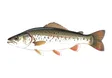
Brindled Madtom

Noturus miurus

Ictaluridae · freshwater water fish

5 minute read · Species guide

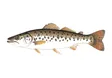
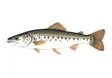
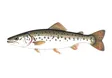
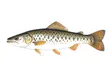
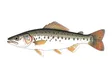
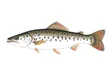
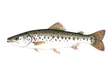
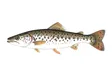
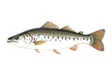
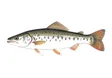
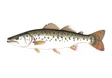
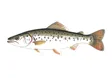
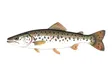
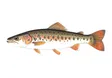
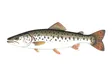
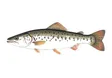
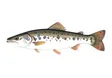
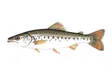
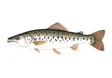
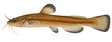
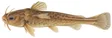
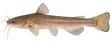
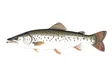
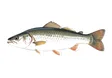
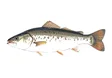
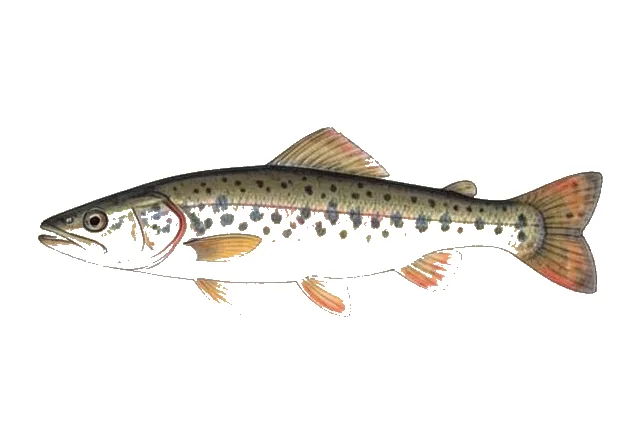
Brindled Madtom field guide illustration

About Brindled Madtom

The brindled madtom (Noturus miurus) is a small catfish of the family Ictaluridae that is native to the eastern United States.

Description

Brindled madtoms are approximately 10.1 to 12.6 centimeters (4.0 to 5.0 in) long. The brindled madtom, like other Noturus species, has a caudally-fused adipose fin which extends from the caudal fin and runs nearly to the dorsal fin. The caudal fin spreads around the caudal peduncle, terminating just prior to the anal fin. The species has smooth skin without scales and possesses four pairs of barbels along the premaxilla and dentary. The brindled madtom is laterally compressed along the caudal peduncle and has a dorsally compressed anterior from the pelvic fins to the jaw. The brindled madtom is light brown, with dark dorsal splotches along the tip and two conspicuous saddle marks just behind the dorsal fin. The dorsal fin has a dark, spotted blotch on the tip and is located between the pectoral and pelvic fins.

Geographic distribution

The habitat range is in the eastern United States, west of the Appalachian / Blue Ridge Mountains and from the lower Great Lakes drainage, southwest to Louisiana. River systems included are the Cache (Illinois), Huron, Mississippi and Ohio river basins, Pearl River, Wabash River, and Lake Pontchartrain drainage into the Gulf of Mexico. This species is endangered in Missouri, Kansas, Pennsylvania, and Michigan.

Ecology

In a 1982 study by Burr and Mayden, the quantitative diet of the brindled madtom was determined via dissection of stomach contents which

Predation upon adult brindled madtoms is primarily from upper trophic level aquatic predators such as the longnose gar. Brindled madtom egg clutches are a viable food source for multiple opportunistic species including crustaceans, insects, and other fishes. Although most other Noturus species occur primarily in riffles, the brindled madtom occurs primarily in moderately silted pools with heavy texture and mild currents. The brindled madtom thrives in clean, benthic regions of pools in swift streams and rivers that have moderate siltation over a cobble or heavily textured bottom. The species thrives in water with consistent temperatures around 25 to 27 °C (77 to 81 °F). Temperatures above 30 °C (86 °F) are not well tolerated, and mass mortalities observed at temperatures above 33 °C (91 °F).

Life history

It takes one year for females and two years for males to mature sexually and nesting/reproduction extends from May to July, with regional variance according to water temperature. When reproduction begins, the mating pair guards their clutch of 50-100 eggs, which is usually deposited in a protective shelter with a very small opening such as under rocks or in bottles/cans that litter the waterways; and these shelters are layered with mud or silt by the parents. The brindled madtom can produce multiple clutches per year and the average lifespan of the species is about 3 years, with most specimens being found in the 2 year old range. The selective nature of this species as it relates to reproduction habitat puts the reproductive fitness of the species as a whole, in jeopardy. Since this species prefers a substrate which has equal stone, cobble, sediment and texture which provides shelter and preferred nesting opportunities, even the slightest disturbance can drastically alter and distort the balance needed for fitness. The decrease in preferred habitat has contributed to the decline of various species of madtoms, leading to an inter-species breeding, specifically between the brindled madtom and the tadpole madtom, which may lead to further chromosomal evolution within this species as identified by LeGrand's study.

Article text: Wikipedia contributors, Brindled madtom (source revision). Licensed under CC BY-SA 4.0. Retrieved 2026-10-11.
Diet and feeding

The FishTraits compilation records these diet categories for this species: aquatic or other vascular plants; invertebrates or larval fish. These are broad categories, not a claim that every individual consumes every example in a category.

Reported feeding positions include bottom feeding. The compilation combines published observations; diets can vary with age, locality, and available food.

Habitat preferences

Reported habitat associations include streams and small rivers, creeks.

The source records associations with muck, clay or silt, sand, gravel, vegetation, organic debris, large woody material. An association indicates reported use, rather than an exclusive requirement.

Reproduction and parental care

The compilation reports a representative maturity age of 1.5 years. Its maturity field summarizes mean, median, or modal estimates, usually for females; male estimates can be used when female data are unavailable. It is not a fixed age at which every fish first breeds.

Recorded spawning months are Jun, Jul, Aug for the source’s reporting region (IL). This is a regional calendar, not a range-wide schedule.

The reproductive-guild classification includes guarding eggs or young at a spawning substrate or nest.

Size and recorded longevity

FishTraits reports a maximum total length of 13 centimetres. Some entries use an estimated asymptotic length; this value should not be treated as a certified record catch.

Recorded longevity in the compilation is 3 years. Wild observations were preferred, but captive records were accepted where wild records were unavailable, and unspecified records were assumed wild. The value is not a guaranteed wild lifespan or an aquarium life expectancy.

Native range

Lower Great Lakes drainages in Ontario and New York, southwest through most of the Ohio River basin and lower Mississippi River basin (west to eastern Kansas and Oklahoma; Pearl River and Lake Pontchartrain drainages on central Gulf Slope in Mississippi and Louisiana (Page and Burr 1991).

Introduction history

Canal connection. Probably gained access from Lake America systems in western New York to the Mohawk River via the Erie Canal (Smith 1985; Mills et al. 1997).

Range

Where it lives

Share of 2,692 GBIF observation records with a state location, across 16 states. The orange dots are USGS stream-survey sites where this species was caught.
0%
22.9%
Share of 2,692 GBIF observation records with a state location, across 16 states. The orange dots are USGS stream-survey sites where this species was caught.

A blank area on the dot layer usually means nobody sampled there, not that the fish is absent. Turn on “every survey site” to see where the survey looked.

The USGS stream survey caught it at 323 of its sites, in 15 states. That survey and the GBIF records are two different counts of two different things, so the site keeps them apart.

Habitat

Water and movement

Water
WoRMS records this species in fresh water.
USGS NAS habitat
Freshwater
US status
Native transplant — native to part of the United States, moved to other waters inside it.
Migration
Not migratory

Classification

Taxonomy

Kingdom
Animalia
Phylum
Chordata
Superclass
Actinopterygii
Class
Teleostei
Order
Siluriformes
Genus
Noturus
Species
Noturus miurus
ITIS TSN
164020
WoRMS AphiaID
1020187
GBIF key
2341024
Outside the US
ITIS also files it in Canada.

Common questions about Brindled Madtom

What is the scientific name of Brindled Madtom?
The scientific name is Noturus miurus, in the family Ictaluridae. Classification follows ITIS.
Does Brindled Madtom live in fresh water or salt water?
WoRMS records this species in fresh water.
Where has Brindled Madtom been recorded in the United States?
GBIF has observations in 16 states, with the most records in Ohio, Mississippi, Kentucky. The map shows observation records, which do not establish the complete natural range.

Closest relatives

Other Noturus species

Same family

More Ictaluridae

Black Bullhead46 states
Ameiurus melasIctaluridaeNative and introducedFresh
Black Madtom5 states
Noturus funebrisIctaluridaeNativeFresh
Black River Madtom2 states
Noturus maydeniIctaluridaeNativeFresh
Blue Catfish31 states
Ictalurus furcatusIctaluridaeNative and introducedFreshBrackish
Brown Bullhead44 states
Ameiurus nebulosusIctaluridaeNative and introducedFresh
Brown Madtom6 states
Noturus phaeusIctaluridaeNativeFresh
Caddo Madtom1 states
Noturus tayloriIctaluridaeNativeFresh
Carolina Madtom2 states
Noturus furiosusIctaluridaeNativeFresh
Channel Catfish47 states
Ictalurus punctatusIctaluridaeNative and introducedFresh
Checkered Madtom3 states
Noturus flavaterIctaluridaeNativeFresh
Chucky Madtom1 states
Noturus crypticusIctaluridaeNativeFresh
Elegant Madtom4 states
Noturus elegansIctaluridaeNativeFresh
Flat Bullhead7 states
Ameiurus platycephalusIctaluridaeNative and introducedFresh
Flathead Catfish34 states
Pylodictis olivarisIctaluridaeNative and introducedFresh
Frecklebelly Madtom5 states
Noturus munitusIctaluridaeNativeFresh
Freckled Madtom15 states
Noturus nocturnusIctaluridaeNativeFresh
Headwater Catfish2 states
Ictalurus lupusIctaluridaeNativeFresh
Least Madtom4 states
Noturus hildebrandiIctaluridaeNativeFresh
Margined Madtom21 states
Noturus insignisIctaluridaeNative and introducedFresh
Mountain Madtom15 states
Noturus eleutherusIctaluridaeNativeFresh
Neosho Madtom3 states
Noturus placidusIctaluridaeNativeFresh
Northern Madtom9 states
Noturus stigmosusIctaluridaeNativeFresh
Orangefin Madtom3 states
Noturus gilbertiIctaluridaeNative and introducedFresh
Ouachita Madtom1 states
Noturus lachneriIctaluridaeNativeFresh

All 42 species in Ictaluridae