Evolution
Fossil remains of the flathead catfish become abundant in geological formations of the central United States from the Middle Miocene onwards. This suggests that it has existed as a distinct species for nearly 20 million years.
Common names
The flathead catfish is also known as the yellow cat, mud cat, Johnnie cat, goujon, appaluchion, opelousas, pied cat and Mississippi cat. In the dialect of the Ozark mountains it may be referred to as a "granny cat."
Description
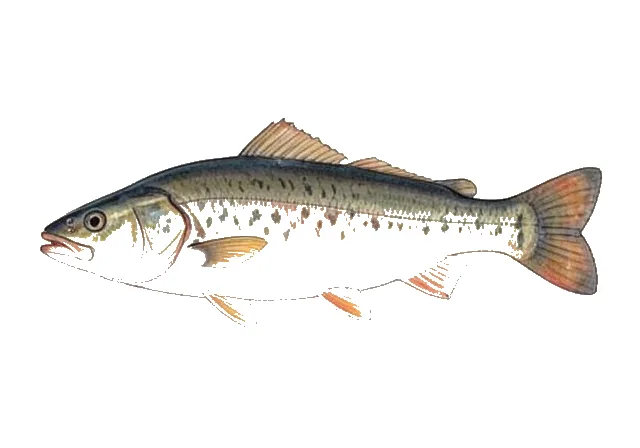
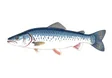
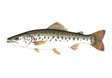
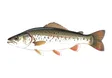
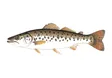
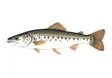
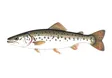
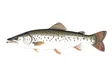
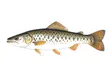
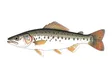
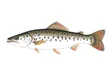
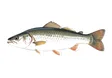
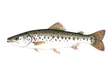
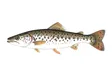
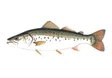
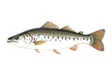
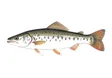
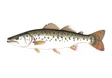
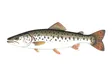
The flathead catfish is olive colored on its sides and dorsum, with a white to yellow underside. Individuals, particularly young specimens from clearer waters, may be strongly mottled with dark brown to black color. The eyes are small and the lower jaw prominently projects beneath the upper. A premaxillary tooth pad has posterior extensions. The caudal fin is emarginate in structure, and its upper lobe may bear an isolated white margin. The fins are otherwise brown, though the body's mottling may extend into the fins. The anal fin has 14 to 17 rays and a round margin.
The flathead catfish grows to a length of 155 cm (61 in) and may weigh up to 55.79 kg (123.0 lb), making it the second-largest North American catfish (after the blue catfish, Ictalurus furcatus). More commonly, adult length is about 15–45 inches (38–114 cm). Its maximum recorded lifespan is 28 years. Reproductive maturity is reached between 4 and 5 years, or at approximately 18 inches (46 cm). The world angling record flathead catfish was caught May 19, 1998, from Elk City Reservoir, Kansas, and weighed 55.79 kg (123.0 lb). However, a record from 1982, caught by "other methods", shows that the flathead catfish could be North America's longest species of catfish, after a specimen pulled from the Arkansas River measured 175 centimetres (69 in) and weighed 63.45 kilograms (139 lb 14 oz).
Distribution and habitat
The native range of the flathead catfish includes a broad area west of the Appalachian Mountains encompassing large rivers of the Mississippi, Missouri, and Ohio basins. The range extends as far north as Canada, as far west as Texas, and south to the Gulf of Mexico including northeastern Mexico. The flathead catfish cannot live in full-strength seawater (which is about 35 parts per thousand or about 35 grams of salt per liter of water), but it can survive in 10 ppt for a while and thrive in up to about 5 ppt.
Flathead catfish are a benthic fish species meaning they are a fish which prefers to lay on the bottom of a body of water. These catfish prefer medium to large sized rivers with relatively warm water and stable slow moving currents. Flathead catfish prefer habitats with vertical banks, meaning the bank of land slightly overhangs the water and an area with fallen trees or woody debris. Specifically, these catfish prefer a woody debris depth of at least 3 metres (9.8 ft) and a diameter of woody debris of at least 3 metres (9.8 ft) to provide cover. Flathead catfish tend to have a home range of less than 2 kilometres (1.2 mi), this means that they are a non-migratory species of fish.
Diet
The flathead catfish prefers live prey. It is a voracious carnivore and feeds primarily on fishes, insects, annelid worms, and crustaceans. It also feeds on other small catfish and almost anything that moves and makes vibration. They are known to eat crayfish, American gizzard shad, (Dorosoma cepedianum), blueback herring, insects and larvae, channel catfish (Ictalurus punctatus), drum (Aplodinotus grunniens), other flatheads, green sunfish (Lepomis cyanellus), and carp. Insect larvae are the major prey type until an individual reaches approximately 100 mm (3.9 in) in total length, at which point the diet expands to include crayfish and small fishes. Individuals above 250 mm (9.8 in) in length feed almost exclusively on other fish.
At about the age of two years old, flathead catfish have a diet mainly consisting of crayfish; however, their use of crayfish slowly declines until about the age of six years old. When the catfish are around six years old, they completely cut crayfish out of their diet and they eat almost entirely a diet consisting of fish; this is called a piscivorous diet. Flathead catfish experience this diet change from the ages of two to six for one of two reasons, those being either a distribution to a habitat that doesn't contain crayfish or a change in diet because of the increase in size of the catfish. The flathead catfish of six years or older that eat mainly fish have a seasonal diet shift, meaning they eat different kinds of fish depending on the time of year. Flathead catfish are a warm-water species; because of this the average consumption of juvenile flathead catfish increases with increasing temperature, and their average consumption decreases with decreasing temperatures. These catfish have a large increase in feeding at roughly 66 °F (19 °C) and their appetite remains increased up to about 90 °F (32 °C). Their appetite starts to decrease at 60 °F (16 °C), most flatheads stop eating at 52 °F (11 °C), and no catfish ate any food at or below 45 °F (7 °C).
Breeding
Spawning of P. olivaris occurs in late June and early July, and the nests are made in areas with submerged logs and other debris. The males, which also build the nests, fiercely and tirelessly defend and fan the clutch. The size of the clutch varies proportionately to the size of the female; an average of 2,640 eggs per kilogram of fish are laid.
On average each female flathead lays a clutch of roughly 100,000 eggs. The role of the male catfish in fanning the clutch is to provide oxygen to the eggs through the use of his fins. The spawning of these catfish occurs when the temperature reaches roughly 66 to 75 °F (19 to 24 °C) and the flow of the stream or river becomes steady. When flathead catfish reach the ages of three to six years old they are considered sexually mature and the catfish are able to start reproducing. As the current of the river or stream erodes away some of the river bed it creates natural depressions, these depressions tend to be where flathead catfish build their nests.
The fry frequent shallow areas with rocky and sandy substrates, where they feed on insects and worms such as annelids and polychaetes. Young flathead catfish are also cannibalistic, which has largely precluded their presence in aquaculture.
Diel movement
Diel movement is the migration of an animal during a 24-hour period. Flathead catfish have a change in their diel movement depending on the season. In the spring and summer, flathead catfish have an increase in their movement activity from midnight to dawn, with their diel movement being the greatest in summer. By contrast, in the fall and winter, flathead catfish do not show any increased movement within a 24-hour time frame, with their diel movement being the smallest in the winter. Flathead catfish have a diel movement which is the largest in the summer time because of their spawning, which takes place from late spring to early summer, while in the winter they have the smallest diel movement because they are waiting for winter to end, which is called the overwintering phase.
Article text: Wikipedia contributors, Flathead catfish (source revision). Licensed under CC BY-SA 4.0. Retrieved 2026-10-11.
Diet and feeding
The FishTraits compilation records these diet categories for this species: invertebrates or larval fish; larger animal prey (a source category covering fish, crayfish, crabs, or frogs). These are broad categories, not a claim that every individual consumes every example in a category.
Reported feeding positions include bottom feeding and surface or water-column feeding. The compilation combines published observations; diets can vary with age, locality, and available food.
Habitat preferences
Reported habitat associations include medium to large rivers, streams and small rivers, still-water habitats.
The source records associations with gravel, cobble, boulders, bedrock, organic debris, large woody material. An association indicates reported use, rather than an exclusive requirement.
Reproduction and parental care
The compilation reports a representative maturity age of 4.5 years. Its maturity field summarizes mean, median, or modal estimates, usually for females; male estimates can be used when female data are unavailable. It is not a fixed age at which every fish first breeds.
Recorded spawning months are Jun, Jul for the source’s reporting region (NC). This is a regional calendar, not a range-wide schedule.
The reproductive-guild classification includes guarding eggs or young at a spawning substrate or nest.
Size and recorded longevity
FishTraits reports a maximum total length of 155 centimetres. Some entries use an estimated asymptotic length; this value should not be treated as a certified record catch.
Recorded longevity in the compilation is 23 years. Wild observations were preferred, but captive records were accepted where wild records were unavailable, and unspecified records were assumed wild. The value is not a guaranteed wild lifespan or an aquarium life expectancy.
Identification and appearance
Wide, flat head - more so than native catfishes. Yellow to purple-brown dorsal coloration and pale white to yellow belly. Projecting lower jaw, pale tips on tail fin, short anal fin. Becker (1983); Page and Burr (1991); Etnier and Starnes (1993); Jenkins and Burkhead (1994).Projecting lower jaw, pale tips on tail fin, short anal fin. Becker (1983); Page and Burr (1991); Etnier and Starnes (1993); Jenkins and Burkhead (1994).
Native range
Mississippi River basin from western Pennsylvania to White-Little Missouri River system, North Dakota, and south to Louisiana; Gulf Slope from Mobile Bay drainage, Georgia and Alabama, to Mexico (Page and Burr 1991).Mississippi River basin from western Pennsylvania to White-Little Missouri River system, North Dakota, and south to Louisiana; Gulf Slope from Mobile Bay drainage, Georgia and Alabama, to Mexico (Page and Burr 1991).
Habitat and ecology
Unlike other catfish, Flathead Catfish feed on only live prey. Adult Flathead Catfish are piscivorous ambush predators (Eggleton and Schramm 2004). This species has a diverse diet, feeding on macroinvertebrates and fish, including shads, centrarchids, bass, and crayfish (Schmitt et al. 2019; Montague and Shoup 2021).
Age at sexual maturity appears to be regionally dependent, ranging from 3–5 years for males and 3–7 years for females. Spawning occurs once in late spring to early summer when water temperatures reach 19 to 24 degrees Celsius. One or both parents excavate a nest that is usually made in a natural cavity or near a large submerged object (Jackson 1999). Females lay a mass of up to 100,000 adhesive eggs (Jackson 1999), or 1,637 to 5,025 eggs/kg (Gima 2009). Males guard the nest and agitate the eggs to keep them clean and aerated. The young remain in a school near the nest for several days after hatching, but soon disperse. Flathead Catfish can live up to 28 years (Jackson 1999).
Introduction history
The Flathead Catfish has been intentionally stocked in most cases. In Idaho, however, flatheads were accidentally stocked instead of blue catfish (Simpson and Wallace 1978). Populations in the Apalachicola River, Florida, probably spread from introductions upstream in the Flint River, Georgia. It is believed that flatheads were stocked by anglers circa 1950 in the vicinity of Potato Creek in Upson County, Georgia, with stock from the Tennessee drainage (Quinn 1988). They were recorded in the Flint River below the Warwick Dam at Lake Blackshear in the early 1960s, and at Albany in the early 1970s (Quinn 1988). The species was apparently first stocked in the Cape Fear River in 1966 when 11 sexually mature fish were released near Fayetteville, North Carolina, by North Carolina Wildlife Resources Commission biologists (Guire et al. 1984; Ashley and Buff 1986). Flatheads were stocked in Atlantic drainages (Savannah and Altamaha) in Georgia in the 1970s (Bart et al. 1994; C. Jennings, personal communication). According to Bart et al. (1994), at least some of these were the result of stocking by Georgia Department of Natural Resource personnel. The first known reports of this fish in California were recorded catches made in the lower Colorado River near Yuma in 1966 (Dill and Cordone 1997). The Colorado River populations in California and Arizona resulted, at least in part, from a stocking of about 600 Flathead Catfish above Imperial Dam made by the Arizona Game and Fish Department in 1962 (Dill and Cordone 1997). According to Dill and Cordone (1997), the believed route of the Flathead Catfish was downstream to Imperial Dam and subsequently into the All American Canal system to the Imperial Valley. Minckley (1973) reported that the species was introduced prior to 1950 into the Gila River system, a tributary of the Colorado River; however, Dill and Cordone (1997) indicated that the Flathead Catfish was not taken in the lower Colorado River basin until after 1962. A single fish was taken 20 November 1995 in Arizona from the upper San Pedro River, about 32 kilometers from the Mexican border (S. Stefferud, personal communication). It is not known how the species gained access to the upper reach of this river. In Wisconsin, flatheads probably entered the Wolf and Fox drainages via the canal at Portage (Becker 1983). The Ochlockonee River introduction in Florida and Georgia was probably due to illegal stocking by anglers with fish from the nearby Apalachicola River, where the fish had also been introduced. The flathead's presence in eastern Pennsylvania is most likely due to stock contamination of channel catfish shipments (M. Kaufman, personal communication).
Ecological impacts
Summary of species impacts derived from literature review. Click on an icon to find out more... Many feeding studies have found that Flathead Catfish prey heavily on sunfish Lepomis spp. (Quinn 1988). One study found that they reduced the number of common carp Cyprinus carpio and bullheads Ameiurus spp. (Quinn 1988). However, the introduced population in the Flint River system was found to prey largely on crayfish, and that young-of-the-year flatheads fed on darters Etheostoma spp. clupeids, catostomids, ictalurids (including other flatheads), and centrarchids were also consumed (Quinn 1988). According to Quinn (1988), introduced flatheads in the Flint River rely more on crayfish than any other catfish population yet described. A severe decline in native fish species, particularly native bullhead species, was observed in the Cape Fear River within 15 years of the first Flathead Catfish introduction (Guire et al. 1984; Jenkins and Burkhead 1994). Feeding studies conducted in the Cape Fear River showed that flatheads consume mainly bullheads, catfishes, shad, and sunfishes (Guire et al. 1984; Ashley and Buff 1986). In 1979, flatheads in the Cape Fear River fed primarily on bullheads. However, by 1986, bullhead populations had declined and Flathead Catfish had switched to preying on shad (Ashley and Buff 1986). Diet studies also have been conducted in the Oconee River in Georgia, where this catfish had been implicated in causing declines of native bullheads and sunfishes (especially redbreast sunfish Lepomis auritus). However, findings of that initial study were inconclusive since most of the Flathead Catfish examined had empty stomachs (C. Jennings, personal communication). Flathead Catfish also may be responsible for declines in other native species in the Altamaha drainage (C. Jennings, personal communication). In the Ocmulgee River, Georgia, abundances of silver redhorse Moxostoma anisurum, robust redhorse M. robustum, snail bullhead Ameiurus brunneus, flat bullhead A. platycephalus, and redbreast sunfish Lepomis auritus, were negatively correlated with Flathead Catfish occurrence and abundance (Bart et al. 1994). This correlation may be due to direct predation. Several authors have reported suckers and catfish as common prey items of flatheads (Bart et al. 1994). The snail bullhead and flat bullhead appear to be most affected by the presence of Flathead Catfish in the Ocmulgee drainage (Bart et al. 1994). It is suspected flatheads may be contributing to the decline of the federally threatened Gulf sturgeon Acipenser oxyrinchus desotoi by consuming the young benthic fish in the Apalachicola River (J. Williams, personal communication). The Flathead Catfish is thought to be contributing to the decline of the razorback sucker Xyrauchen texanus. For instance, Marsh and Brooks (1989) found that intensive predation by Flathead Catfish and channel catfish on juvenile razorback suckers is likely to prevent hatchery transplants of this southwestern endangered sucker from becoming re-established in portions of its natural range. If the Flathead Catfish becomes established in the San Pedro River, it could mean a major loss for recovery of several species (S. Stefferud, personal communication). Introductions of Flathead Catfish are probably the most biologically harmful of all fish introductions in North America (C. Gilbert, personal communication). Flathead Catfish, along with other nonnative piscivorous fishes, have been shown to reduce the abundance and diversity of native prey species in several Pacific Northwest rivers (Hughes and Herlihy 2012).