Stonecat

Noturus flavus

Ictaluridae · freshwater water fish

5 minute read · Species guide

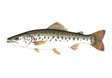
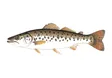
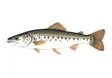
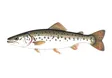
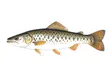
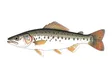
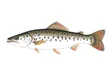
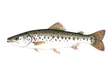
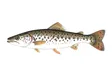
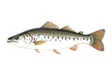
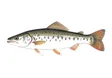
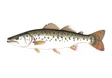
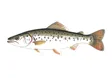
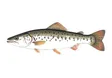
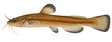
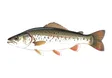
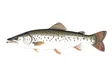
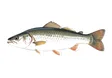
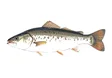
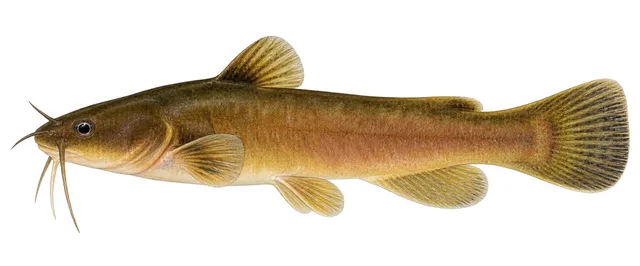
Stonecat field guide illustration

About Stonecat

Noturus flavus, the stonecat, is a North American freshwater catfish of the family Ictaluridae. The common name is due to its habit of hiding near or under stones in fast-moving water.

Anatomy

Stonecats are small, slender, flat-headed catfishes, with the adipose fin keel-like and continuous with the caudal fin except for a shallow notch. While the dorsal and pectoral spines of most members of this family cause wounds that irritate, the stonecat has venom glands, particularly on the bases of the pectoral spines, that cause extreme pain similar to that of a wasp sting. The pectoral fin lacks any posterior serrae. Anal fin rays number 15 to 18, pectoral fin rays 9 to 11, and pelvic fin rays 8 to 10. The caudal fin rays number 55 to 67.

The upper jaw projects beyond the lower jaw and the tooth pad on the upper jaw has a narrow, crescent-shaped extension on each side. The premaxillary band of teeth has lateral backward extensions.

The skin of the stonecat is thick and is yellowish-brown in color. The sides of the head shade to yellow. The belly is whitish.

The stonecat has two forms. In the Cumberland drainage in Tennessee, a scientifically undescribed form possesses two light bars (perpendicular to body length) on its nape. In other areas, a patch exists in place of the bars. In both forms, the stonecat has a white spot at the rear of the dorsal fin base and one on the upper edge of the caudal fin. The rear of the pectoral spine has either no or a few weak teeth.

Size/age

Stonecats typically reach four to eight inches in length, but can reach 12 inches, at weights of 0.22 to 1.1 lbs. Typically, Stonecats live five to six years.

Distribution

The stonecat has a widespread distribution. Stonecats exist in the Great Lakes, the St. Lawrence River, drainages of Hudson Bay, and the Mississippi River basin. Stonecats can also be found from the Hudson River drainage of New York west to the Red River drainage of Hudson Bay. Stonecats inhabit the drainage of the Mississippi River basin from Quebec to Alberta, southerly to northern Alabama and Mississippi and westerly to northeastern Oklahoma. In Colorado, stonecats are present in St. Vrain Creek near Longmont, Colorado and in the Republican River south of Wray, Colorado.

Habitat

Stonecats live in freshwater environments, and are found from large creeks to small rivers. They occasionally are found in tiny creeks, or rivers as large as the Lower Mississippi. Stonecats occupy gently to fast-moving riffle areas with rocky substrates. They spend the majority of their time in moderate-moving, shallow riffles, but can also be found in deeper water (2 to 3 meters deep). Stonecat inhabit natural lakes, such as Lake Erie, where it prefers rock and gravel bars that are subject to significant wave action.

Diet

The stonecat is a benthic, opportunistic feeder, using its sensitive barbels during the night to search for food on the river bottom. Stonecats eat a diversity of food items, such as aquatic insect larvae (e.g., mayflies), mollusks, minnows, fish eggs, isopods, amphipods, crayfish, plant material, worms and chilopods.

Reproduction

Females mature in three to four years and a mean standard length of 4.7 inches. Stonecats form monogamous pairs for breeding, and spawn when water temperatures reach 25 °C. Clutches are guarded by males under large, flat rocks in pools or crests of riffles. Rocks used as spawning cover averaged 200 square inches and were found in water depths averaging 34 inches. The eggs are amber-yellow and are very large, ranging between 3.5 and 4 mm in diameter, with the whole egg mass enveloped by a gelatinous material. A female stonecat may produce between 200 and 1,200 eggs per year. Stonecats exhibit parental care, with the male or both sexes guarding the clutch, until the young head to shallower, calmer streams and waters to mature.

Etymology

The genus name Noturus, meaning "back tail", refers to the fusion of the adipose and caudal fins. The specific epithet flavus meaning "yellow", refers to the color distinction.

Importance/conservation status

Stonecats serve as indicators of water quality: they are not present in highly polluted or heavily silted areas. Stonecats are a valuable indicator species to humans, as they may also be useful as a marker for water temperature.

The US Endangered Species Act lists the status of N. flavus as not threatened or no special status, meaning that this species faces no risk of extinction.

Article text: Wikipedia contributors, Noturus flavus (source revision). Licensed under CC BY-SA 4.0. Retrieved 2026-10-11.
Diet and feeding

The FishTraits compilation records these diet categories for this species: algae or phytoplankton; aquatic or other vascular plants; invertebrates or larval fish; larger animal prey (a source category covering fish, crayfish, crabs, or frogs). These are broad categories, not a claim that every individual consumes every example in a category.

Reported feeding positions include bottom feeding. The compilation combines published observations; diets can vary with age, locality, and available food.

Habitat preferences

Reported habitat associations include medium to large rivers, streams and small rivers, creeks.

The source records associations with sand, gravel, cobble, boulders. An association indicates reported use, rather than an exclusive requirement.

Reproduction and parental care

The compilation reports a representative maturity age of 3 years. Its maturity field summarizes mean, median, or modal estimates, usually for females; male estimates can be used when female data are unavailable. It is not a fixed age at which every fish first breeds.

Batch or serial spawning has been reported somewhere in the species’ range. This does not establish the same spawning pattern for every population.

Recorded spawning months are Apr, May, Jun, Jul for the source’s reporting region (NC). This is a regional calendar, not a range-wide schedule.

The reproductive-guild classification includes guarding eggs or young at a spawning substrate or nest.

Size and recorded longevity

FishTraits reports a maximum total length of 31 centimetres. Some entries use an estimated asymptotic length; this value should not be treated as a certified record catch.

Recorded longevity in the compilation is 8 years. Wild observations were preferred, but captive records were accepted where wild records were unavailable, and unspecified records were assumed wild. The value is not a guaranteed wild lifespan or an aquarium life expectancy.

Native range

St. Lawrence-Great Lakes, Hudson Bay (Red River), and Mississippi River basins from Quebec to Alberta, and southern to northern Alabama, northern Mississippi, and northeastern Oklahoma; Hudson River drainage, New York (Page and Burr 1991).

Introduction history

Unknown; possible bait bucket introduction or stock contamination.

Record fish

State records in 2 states

  • Montana0.54 lbs.

    Milk River · 6/16/96 · Dale Bjerga

  • Wisconsin0 lbs.5.4 oz.

    Prairie River · Lincoln · 07/04/2017

Each figure is the state agency’s own certified record. The site holds record tables for 11 states so far, so a state missing here has not been read yet. It is not a state where this fish holds no record.

Range

Where it lives

Share of 5,216 GBIF observation records with a state location, across 32 states. The orange dots are USGS stream-survey sites where this species was caught.
0%
15.7%
Share of 5,216 GBIF observation records with a state location, across 32 states. The orange dots are USGS stream-survey sites where this species was caught.

A blank area on the dot layer usually means nobody sampled there, not that the fish is absent. Turn on “every survey site” to see where the survey looked.

The USGS stream survey caught it at 1,807 of its sites, in 25 states. That survey and the GBIF records are two different counts of two different things, so the site keeps them apart.

Habitat

Water and movement

Water
WoRMS records this species in fresh water.
USGS NAS habitat
Freshwater
US status
Native transplant — native to part of the United States, moved to other waters inside it.
Migration
Migratory
Pattern

Classification

Taxonomy

Kingdom
Animalia
Phylum
Chordata
Superclass
Actinopterygii
Class
Teleostei
Order
Siluriformes
Genus
Noturus
Species
Noturus flavus
ITIS TSN
164013
WoRMS AphiaID
723266
GBIF key
2341033
Outside the US
ITIS also files it in Canada.

Common questions about Stonecat

What is the scientific name of Stonecat?
The scientific name is Noturus flavus, in the family Ictaluridae. Classification follows ITIS.
Does Stonecat live in fresh water or salt water?
WoRMS records this species in fresh water.
Where has Stonecat been recorded in the United States?
GBIF has observations in 32 states, with the most records in Iowa, Ohio, Illinois. The map shows observation records, which do not establish the complete natural range.

Closest relatives

Other Noturus species

Same family

More Ictaluridae

Black Bullhead46 states
Ameiurus melasIctaluridaeNative and introducedFresh
Black Madtom5 states
Noturus funebrisIctaluridaeNativeFresh
Black River Madtom2 states
Noturus maydeniIctaluridaeNativeFresh
Blue Catfish31 states
Ictalurus furcatusIctaluridaeNative and introducedFreshBrackish
Brindled Madtom16 states
Noturus miurusIctaluridaeNativeFresh
Brown Bullhead44 states
Ameiurus nebulosusIctaluridaeNative and introducedFresh
Brown Madtom6 states
Noturus phaeusIctaluridaeNativeFresh
Caddo Madtom1 states
Noturus tayloriIctaluridaeNativeFresh
Carolina Madtom2 states
Noturus furiosusIctaluridaeNativeFresh
Channel Catfish47 states
Ictalurus punctatusIctaluridaeNative and introducedFresh
Checkered Madtom3 states
Noturus flavaterIctaluridaeNativeFresh
Chucky Madtom1 states
Noturus crypticusIctaluridaeNativeFresh
Elegant Madtom4 states
Noturus elegansIctaluridaeNativeFresh
Flat Bullhead7 states
Ameiurus platycephalusIctaluridaeNative and introducedFresh
Flathead Catfish34 states
Pylodictis olivarisIctaluridaeNative and introducedFresh
Frecklebelly Madtom5 states
Noturus munitusIctaluridaeNativeFresh
Freckled Madtom15 states
Noturus nocturnusIctaluridaeNativeFresh
Headwater Catfish2 states
Ictalurus lupusIctaluridaeNativeFresh
Least Madtom4 states
Noturus hildebrandiIctaluridaeNativeFresh
Margined Madtom21 states
Noturus insignisIctaluridaeNative and introducedFresh
Mountain Madtom15 states
Noturus eleutherusIctaluridaeNativeFresh
Neosho Madtom3 states
Noturus placidusIctaluridaeNativeFresh
Northern Madtom9 states
Noturus stigmosusIctaluridaeNativeFresh
Orangefin Madtom3 states
Noturus gilbertiIctaluridaeNative and introducedFresh

All 42 species in Ictaluridae