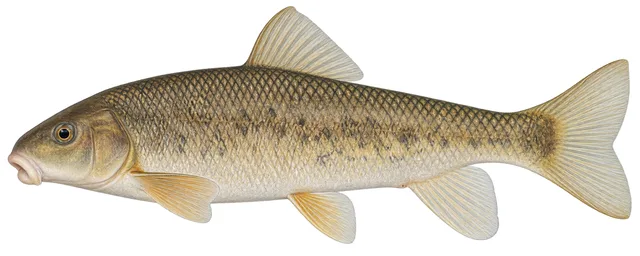
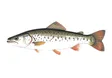
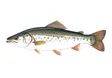
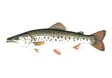
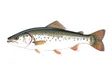
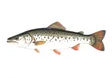
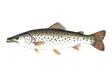
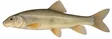
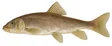
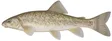
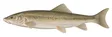
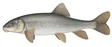
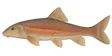
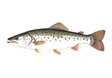
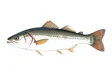
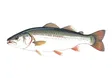
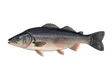
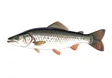
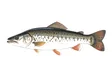
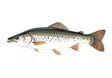
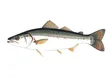
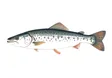
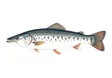
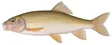
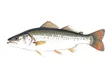
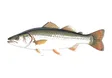
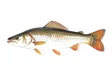
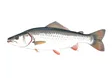
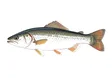
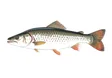
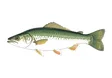
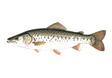
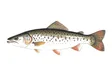
Other common names for the white sucker include bay fish, brook sucker, common sucker, and mullet. The white sucker is often confused with the longnose sucker (C. catostomus), because they look very similar.
Etymology
The specific name, commersonii, is in honor of French naturalist Philibert Commerson.
Distribution and habitat
The white sucker is highly adaptable to different habitats and changing environmental influences. Generally, the white sucker is found in small streams, rivers, and lakes in the Midwest and East Coast of the United States. The white sucker is also relatively tolerant of turbid and polluted waters. It does, however, have low breeding success in acidified waters, which can be caused by acid rain.
Description
The white sucker is a long, round-bodied fish with a dark green, grey, copper, brown, or black back and sides and a light underbelly. The fish also has typical features of primitive Cypriniformes fishes, such as a homocercal tail, cycloid scales, and dorsal, pectoral, and pelvic fin rays. When full grown, it can reach lengths of 12–20 in (30–51 cm) and weigh 2–6 lb (0.91–2.72 kg). The fish's suckermouth, with its fleshy lips, is located in an inferior position at the bottom of its head, as the fish obtains its food from bottom surfaces. The white sucker is often mistaken for different species of suckers and redhorses, but can be distinguished by the complete lateral line system containing 55–85 small scales. The white sucker is able to use chemosensory to sense and avoid predators and other conspecific species during day and night.
Diet habits
The white sucker is a bottom feeder, meaning that it uses its fleshy lips to suck up bottom sediments and other organisms that may be located there. It will eat almost anything it can, but most commonly small invertebrates, algae, and plant matter. Larger predatory fish species such as walleye, trout, bass, northern pike, catfish, muskellunge, and sauger naturally prey on the white sucker.
Reproduction
The white sucker usually spawns in shallow water or streams in April and May; spawning may possibly be initiated by temperature changes and runoff from early snow melt. Two or more males may gather with one female, which releases up to 10,000 eggs that can be fertilized by the gathered males.
Importance to humans
A very common fish, the white sucker is usually not fished for food, though some consider it good to eat. It is most often used as bait; the young are sold as sucker minnows. When it is eaten by humans, it is usually processed and sold under the name of mullet. The IGFA world record for white sucker stands at 6 lb 8 oz (2.9 kg) taken from the Rainy River near Loman, Minnesota in 1984.
Fossil record
Fossils of this fish, C. commersonii, in the United States occur as early as the Early Pleistocene (1.8 million years ago).
Article text: Wikipedia contributors, White sucker (source revision). Licensed under CC BY-SA 4.0. Retrieved 2026-10-11.
Diet and feeding
The FishTraits compilation records these diet categories for this species: algae or phytoplankton; aquatic or other vascular plants; detritus or unidentified plant material; invertebrates or larval fish; fish or frog eggs. These are broad categories, not a claim that every individual consumes every example in a category.
Reported feeding positions include bottom feeding. The compilation combines published observations; diets can vary with age, locality, and available food.
Habitat preferences
Reported habitat associations include medium to large rivers, streams and small rivers, creeks, still-water habitats.
The source records associations with muck, clay or silt, sand, gravel, cobble, boulders, bedrock, vegetation, organic debris. An association indicates reported use, rather than an exclusive requirement.
Reproduction and parental care
The compilation reports a representative maturity age of 3 years. Its maturity field summarizes mean, median, or modal estimates, usually for females; male estimates can be used when female data are unavailable. It is not a fixed age at which every fish first breeds.
Recorded spawning months are Mar, Apr for the source’s reporting region (NC). This is a regional calendar, not a range-wide schedule.
The reproductive-guild classification includes spawning on open substrates without guarding the brood.
Size and recorded longevity
FishTraits reports a maximum total length of 64 centimetres. Some entries use an estimated asymptotic length; this value should not be treated as a certified record catch.
Recorded longevity in the compilation is 8 years. Wild observations were preferred, but captive records were accepted where wild records were unavailable, and unspecified records were assumed wild. The value is not a guaranteed wild lifespan or an aquarium life expectancy.
Native range
Atlantic, Arctic, Great Lakes, and Mississippi River basins from continental Newfoundland (i.e. Labrador) to Mackenzie River, Northwest Territories; south to the Tennessee River drainage, northern Alabama, and Arkansas River drainage, New Mexico; south on Atlantic Slope to Santee River drainage, South Carolina; upper Rio Grande drainage, New Mexico; Skeena and Fraser River drainages (Pacific Slope), British Columbia (Page and Burr 1991).
Introduction history
Bait bucket release and trout stock contamination in Colorado. Probably as bait bucket release in Utah, and Wyoming. Unknown means in Georgia, North Carolina, and New Mexico. Woodling (1985) reported the first introductions in the Colorado River took place in the 1860s and 1870s. Holden and Stalnaker (1975) reported later introductions: one in 1926, and another in 1938. They also assumed a population in the Yampa River was from a separate introduction.
Ecological impacts
In Colorado, the White Sucker is replacing native suckers in the Rio Grande and Colorado river drainages (Walker 1993). Hybridization between native flannelmouth and bluehead sucker, and non-native White Sucker Catostomus commersoni, longnose sucker Catostomus catostomus, and Utah sucker Catostomus ardens is occurring. Some combinations are fertile and will lead to introgression (Wyoming Game and Fish Department 2010).