Blacktail Redhorse

Moxostoma poecilurum

Catostomidae · freshwater water fish

5 minute read · Species guide

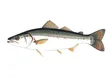
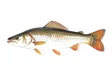
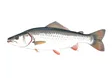
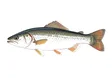
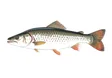
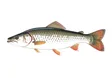
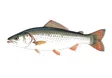
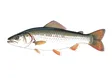
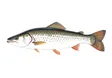
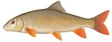
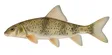
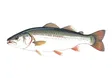
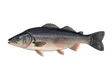
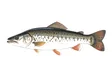
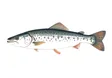
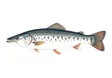
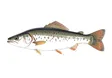
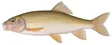
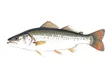
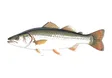
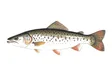
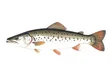
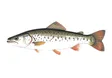
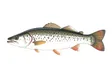
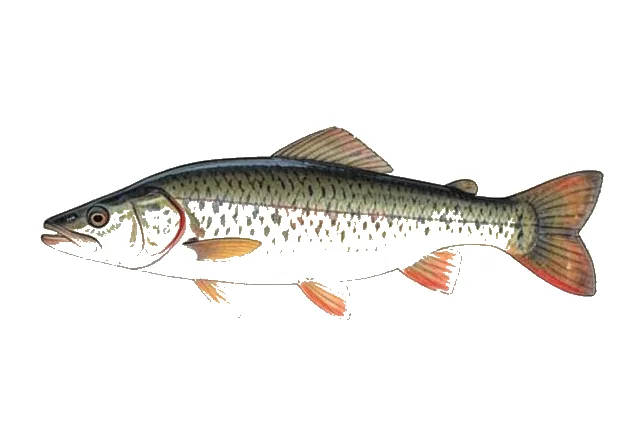
Blacktail Redhorse field guide illustration

About Blacktail Redhorse

The blacktail redhorse (Moxostoma poecilurum) is a species of ray-finned fish in the genus Moxostoma. The blacktail redhorse occupies North America, being located throughout Mississippi River tributaries on the former Mississippi Embayment, ranging from Southern Kentucky to Galveston Bay in Texas.

Description

Like other Moxostoma, the blacktail redhorse has a long and cylindrical body. It is gold to bronze on the upper half with a silver-green iridescence, and is a silver yellow to white on the lower half. The caudal and lower fins are red, with a black stripe on the lower half of the forked caudal fin, which is normally larger than the upper half. The edge of the dorsal fin is usually concave, and the fin is a dusky grey on the lower half and more red on the upper half.

There are normally 41 to 44 lateral scales, and 12 to 13 dorsal rays.

The fish has a maximum total length of 51 cm (20 in), but is normally has a total length of 25 cm (10 in) to 41 cm (16 in).

Distribution and habitat

Moxostoma poecilurum is found throughout Mississippi River tributaries on the former Mississippi Embayment running from Southern Kentucky to Southern Arkansas, south to Louisiana. It can also be found in gulf slope drainages from the Choctawhatchee River in Alabama and Florida to Galveston Bay in Texas. It is endemic to the Southeastern United States. The distribution has not been noticeably decreased for any reason, nor has the Blacktail Redhorse been extirpated from any particular location.

Moxostoma poecilurum is a demersal, temperate, freshwater fish, most commonly found in sandy and rocky pools, runs, and riffles of small to medium-sized streams and rivers. Due to their adaptive abilities and widespread distribution throughout the Southeast, they can sometimes also be found in reservoirs, swamps, and the Mobile Delta. They generally occur in swift to standing water over sand, silt, rock, or gravel substrates and around aquatic vegetation. It is a benthic feeder and has a relatively diverse diet ranging from detritus, diatoms, and a wide variety of small invertebrates including microcrustacea, rotifers and the larvae of many insects. A Louisiana State University study revealed a specific diet "primarily composed of chironomid (55%) and heptageniid larvae (17%)". Due to its relatively small size, the blacktail redhorse is a common prey species among many avian and mammalian predators.

Life cycle

Blacktail redhorse spawn in rocky shoal areas of small streams from late April through early May, when water temperatures approach 20 degrees Celsius. They utilize an aggregation spawning technique in which 2–3 males swim around a female, spawning intermittently. The fertilized eggs are dimersal and nonadhesive and hatching occurs 6–8 days after fertilization. The larvae move off the bottom and into the water column roughly 6 days after hatching. Females reach maturity at roughly 3 years of age and have an average clutch size of 17,000 eggs. blacktail redhorse can reach lengths of up to 51 centimetres (20 in), and have a maximum lifespan of 10 years. During colder months of the year, mature individuals are known to display seasonal migration, moving downstream into deeper water.

Relationship with humans

Currently, Moxostoma poecilurum is listed as threatened in Kentucky due to aquatic habitat degradation, siltation, and increased turbidity. While the most noticeable causes of the species, decline result from anthropogenic factors, some biological factors negatively impact the blacktail redhorse. While the fish commonly falls prey to avian and mammalian predators, it also deals with multiple parasites; Eocollis catostomi, Pellucidhaptor orthacis, and Pellucidhaptor pterigynus parasitize the blacktail redhorse throughout its native range. Overall, habit destruction is the leading cause for the decline of the species. Agriculture, road construction, urbanization, and quarrying increase siltation and turbidity, as well as create migration barriers, inhibiting reproduction and health of the species. That being said, places such as Big Thicket Biosphere Reserve (National Park) in Texas and Horseshoe Bend National Military Park in Alabama are protected areas, providing effective conservation habitat for the blacktail redhorse. The IGFA world record for blacktail redhorse stands at 0.68 kg (1 lb 8 oz) taken from the Tallapoosa River in Alabama in 2005.

Article text: Wikipedia contributors, Blacktail redhorse (source revision). Licensed under CC BY-SA 4.0. Retrieved 2026-10-11.
Diet and feeding

The FishTraits compilation records these diet categories for this species: algae or phytoplankton; detritus or unidentified plant material; invertebrates or larval fish. These are broad categories, not a claim that every individual consumes every example in a category.

Reported feeding positions include bottom feeding. The compilation combines published observations; diets can vary with age, locality, and available food.

Habitat preferences

Reported habitat associations include medium to large rivers, streams and small rivers.

The source records associations with muck, clay or silt, sand, gravel, cobble, boulders, bedrock. An association indicates reported use, rather than an exclusive requirement.

Reproduction and parental care

The compilation reports a representative maturity age of 3.5 years. Its maturity field summarizes mean, median, or modal estimates, usually for females; male estimates can be used when female data are unavailable. It is not a fixed age at which every fish first breeds.

Recorded spawning months are Mar, Apr for the source’s reporting region (AL). This is a regional calendar, not a range-wide schedule.

The reproductive-guild classification includes spawning on open substrates without guarding the brood.

Size and recorded longevity

FishTraits reports a maximum total length of 51 centimetres. Some entries use an estimated asymptotic length; this value should not be treated as a certified record catch.

Recorded longevity in the compilation is 9.5 years. Wild observations were preferred, but captive records were accepted where wild records were unavailable, and unspecified records were assumed wild. The value is not a guaranteed wild lifespan or an aquarium life expectancy.

Range

Where it lives

Share of 3,149 GBIF observation records with a state location, across 9 states. The orange dots are USGS stream-survey sites where this species was caught.
0%
32.5%
Share of 3,149 GBIF observation records with a state location, across 9 states. The orange dots are USGS stream-survey sites where this species was caught.

A blank area on the dot layer usually means nobody sampled there, not that the fish is absent. Turn on “every survey site” to see where the survey looked.

The USGS stream survey caught it at 258 of its sites, in 8 states. That survey and the GBIF records are two different counts of two different things, so the site keeps them apart.

Habitat

Water and movement

Water
WoRMS records this species in fresh water.
Migration
Migratory
Pattern

Classification

Taxonomy

Kingdom
Animalia
Phylum
Chordata
Superclass
Actinopterygii
Class
Teleostei
Order
Cypriniformes
Genus
Moxostoma
Species
Moxostoma poecilurum
ITIS TSN
163932
WoRMS AphiaID
1378190
GBIF key
2358991

Common questions about Blacktail Redhorse

What is the scientific name of Blacktail Redhorse?
The scientific name is Moxostoma poecilurum, in the family Catostomidae. Classification follows ITIS.
Does Blacktail Redhorse live in fresh water or salt water?
WoRMS records this species in fresh water.
Where has Blacktail Redhorse been recorded in the United States?
GBIF has observations in 9 states, with the most records in Alabama, Mississippi, Florida. The map shows observation records, which do not establish the complete natural range.

Closest relatives

Other Moxostoma species

Same family

More Catostomidae

Alabama Hog Sucker6 states
Hypentelium etowanumCatostomidaeNative and introducedFresh
Bigeye Jumprock3 states
Moxostoma ariommumCatostomidaeNativeFresh
Bigmouth Buffalo26 states
Ictiobus cyprinellusCatostomidaeNative and introducedFresh
Black Buffalo26 states
Ictiobus nigerCatostomidaeNative and introducedFresh
Black Redhorse
Moxostoma duquesneiCatostomidaeNativeFresh
Blackfin Sucker2 states
Thoburnia atripinnisCatostomidaeNativeFresh
Blacktip Jumprock7 states
Moxostoma cervinumCatostomidaeNative and introducedFresh
Blue Sucker22 states
Cycleptus elongatusCatostomidaeNativeFresh
Bluehead Sucker7 states
Pantosteus discobolusCatostomidaeNativeFresh
Bridgelip Sucker5 states
Catostomus columbianusCatostomidaeNativeFresh
Creek Chubsucker31 states
Erimyzon oblongusCatostomidaeNativeFresh
Cui-ui2 states
Chasmistes cujusCatostomidaeNativeFresh
Desert Sucker9 states
Pantosteus clarkiiCatostomidaeNativeFresh
Flannelmouth Sucker8 states
Catostomus latipinnisCatostomidaeNativeFresh
Golden Redhorse29 states
Moxostoma erythrurumCatostomidaeNative and introducedFresh
Gray Redhorse2 states
Moxostoma congestumCatostomidaeNative and introducedFresh
Greater Jumprock4 states
Moxostoma lachneriCatostomidaeNative and introducedFresh
Greater Redhorse11 states
Moxostoma valenciennesiCatostomidaeNativeFresh
Green Sucker4 states
Pantosteus virescensCatostomidaeNativeFresh
Highfin Carpsucker23 states
Carpiodes veliferCatostomidaeNative and introducedFresh
June Sucker1 states
Chasmistes liorusCatostomidaeNativeFresh
Klamath Largescale Sucker2 states
Catostomus snyderiCatostomidaeNativeFresh
Klamath Smallscale Sucker2 states
Catostomus rimiculusCatostomidaeNativeFresh
Lake Chubsucker26 states
Erimyzon sucettaCatostomidaeNative and introducedFresh

All 67 species in Catostomidae