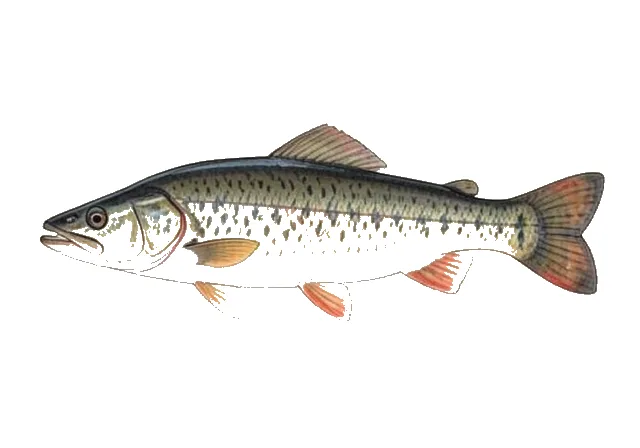
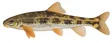
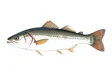
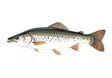
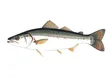
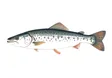
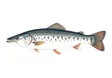
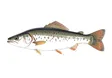
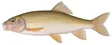
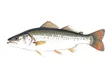
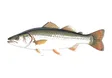
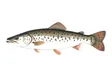
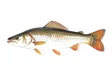
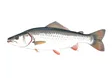
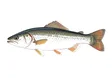
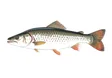
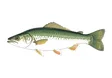
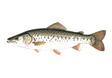
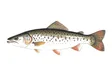
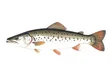
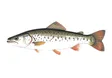
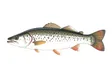
Prior to 2025, it was placed in the genus Thoburnia. However, a phylogenetic analysis found it to actually comprise a distinct lineage sister to the hogsuckers (genus Hypentelium), and it was thus placed in its own genus, Vexillichthys. The genus was named after the Latin word vexillum (meaning "flag"), referencing the distinctive pattern of approximately 13 horizontal light & dark stripes on adults, which resembles the American flag.
Article text: Wikipedia contributors, Blackfin sucker (source revision). Licensed under CC BY-SA 4.0. Retrieved 2026-10-12.
Diet and feeding
The FishTraits compilation records these diet categories for this species: invertebrates or larval fish. These are broad categories, not a claim that every individual consumes every example in a category.
Reported feeding positions include bottom feeding. The compilation combines published observations; diets can vary with age, locality, and available food.
Habitat preferences
Reported habitat associations include streams and small rivers, creeks.
The source records associations with gravel, cobble, bedrock. An association indicates reported use, rather than an exclusive requirement.
Reproduction and parental care
The compilation reports a representative maturity age of 3 years. Its maturity field summarizes mean, median, or modal estimates, usually for females; male estimates can be used when female data are unavailable. It is not a fixed age at which every fish first breeds.
Batch or serial spawning has been reported somewhere in the species’ range. This does not establish the same spawning pattern for every population.
Recorded spawning months are Apr for the source’s reporting region (TN). This is a regional calendar, not a range-wide schedule.
The reproductive-guild classification includes spawning on open substrates without guarding the brood.
Size and recorded longevity
FishTraits reports a maximum total length of 15.5 centimetres. Some entries use an estimated asymptotic length; this value should not be treated as a certified record catch.
Recorded longevity in the compilation is 5 years. Wild observations were preferred, but captive records were accepted where wild records were unavailable, and unspecified records were assumed wild. The value is not a guaranteed wild lifespan or an aquarium life expectancy.