Longnose Sucker

Catostomus catostomus

Catostomidae · freshwater and brackish water fish

5 minute read · Species guide

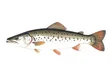
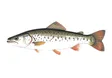
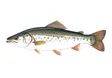
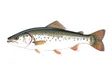
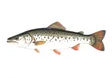
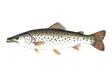
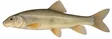
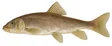
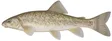
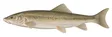
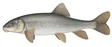
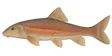
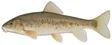
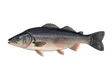
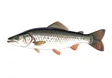
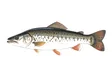
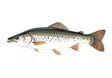
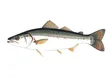
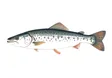
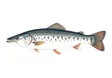
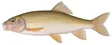
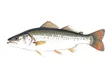
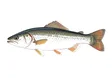
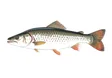
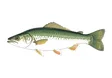
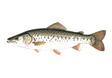
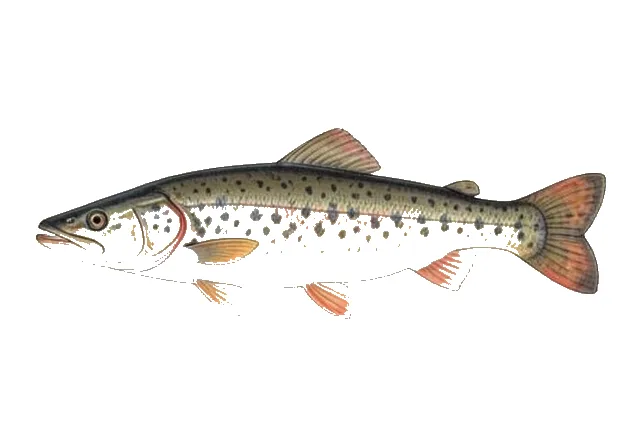
Longnose Sucker field guide illustration

About Longnose Sucker

The longnose sucker (Catostomus catostomus) is a species of cypriniform freshwater fish in the family Catostomidae. It is native to North America from the northern United States to the top of the continent. It is also found in Russia in rivers of eastern Siberia, and is one of only two species of sucker native to Asia (the other is the Chinese Myxocyprinus asiaticus).

Description

The body of the longnose sucker is long and round with dark olive or grey sides and top and a light underside. They are up to 64 cm (25 in) in total length and weigh up to 3.3 kg (7.3 lb).

Longnose suckers are easily confused with white suckers (Catostomus commersoni), which appear very similar. However, longnose suckers can be distinguished by their comparatively finer scales.

The longnose sucker is distinctive for its physical characteristics.

First, the longnose sucker, as the name suggests, has an elongated snout which helps to distinguish the species from other suckers. The elongated snout can be 1/3 of the total body length. The longnose sucker has a circular suction disc (large lips) on the ventral side, located near the mouth. These large lips are an adaptation that allows the longnose sucker to attach itself to rocks and other substrate types in a fast-moving environment. The longnose sucker also has large and prominent scales that cover the body. These large scales provide protection from potential predators.

Distribution and ecology

The longnose sucker inhabits cold, clear waters, including lakes, pools, rivers and streams, and occasionally also brackish waters. In North America, it ranges north from the Columbia, Delaware, Missouri and Monongahela river basins, as well as the Great Lakes basin. The Russian population, which sometimes is referred to as the Siberian sucker (C. c. rostratus), is found in the Yana, Indigirka, Alazeya and Kolyma river basins.

It is a bottom-feeding fish, eating aquatic plants, algae, and small invertebrates. They are preyed upon by larger predatory fish, such as bass, walleye, trout, northern pike, muskellunge and burbot.

Relationship with humans

They are fished for game and food and also used as bait to catch the larger predators. The International Game Fish Association (IGFA) world record sits at 2.97 kg (6 lb 9 oz) taken from the St. Joseph River in Michigan on December 2, 1989, by angler Ben Knoll.

The longnose sucker is a freshwater fish native to North America, particularly found in rivers and lakes. Its relationship with humans is based around recreational fishing.

In recreational fishing, longnose suckers are occasionally targeted by anglers for sport or as bait fish. They provide a challenge to anglers as they have strong fighting abilities. Longnose suckers are typically not sought after for human consumption.

The longnose sucker plays a crucial and vital ecological role as they are bottom feeders. As bottom feeders, the longnose suckers consume detritus and algae while stirring up the sediment. The bottom feeding behavior helps maintain water quality and helps improve the health of the aquatic ecosystem.

As for conservation, the longnose sucker faces habitat loss, water pollution, and competition from invasive species. Trout Unlimited, a conservation organization, is focused on habitat restoration and research initiatives to protect and enhance longnose sucker populations.

Breeding process

During the spring, when water temperatures rise, longnose suckers migrate to their spawning grounds in rivers and streams. Males develop tubercles on their heads and bodies, indicating their readiness to breed. They compete for the attention of females by displaying vibrant colors and engaging in energetic courtship behaviors. Once a female selects a mate, they engage in an elaborate spawning ritual. The female releases her eggs while the male fertilizes them externally. After spawning, the adults return to their regular habitats, leaving the eggs to develop and hatch. The young longnose suckers then begin their journey, growing and adapting to their environment. The breeding life of longnose suckers contributes to the biodiversity and vitality of freshwater ecosystems.

Article text: Wikipedia contributors, Longnose sucker (source revision). Licensed under CC BY-SA 4.0. Retrieved 2026-10-11.
Diet and feeding

The FishTraits compilation records these diet categories for this species: aquatic or other vascular plants; invertebrates or larval fish; fish or frog eggs. These are broad categories, not a claim that every individual consumes every example in a category.

Reported feeding positions include bottom feeding. The compilation combines published observations; diets can vary with age, locality, and available food.

Habitat preferences

Reported habitat associations include streams and small rivers, creeks, still-water habitats.

The source records associations with sand, gravel. An association indicates reported use, rather than an exclusive requirement.

Reproduction and parental care

The compilation reports a representative maturity age of 4 years. Its maturity field summarizes mean, median, or modal estimates, usually for females; male estimates can be used when female data are unavailable. It is not a fixed age at which every fish first breeds.

Recorded spawning months are Jun, Jul for the source’s reporting region (WY). This is a regional calendar, not a range-wide schedule.

The reproductive-guild classification includes spawning on open substrates without guarding the brood.

Size and recorded longevity

FishTraits reports a maximum total length of 64 centimetres. Some entries use an estimated asymptotic length; this value should not be treated as a certified record catch.

Recorded longevity in the compilation is 12 years. Wild observations were preferred, but captive records were accepted where wild records were unavailable, and unspecified records were assumed wild. The value is not a guaranteed wild lifespan or an aquarium life expectancy.

Spawning movements

The compilation records significant spawning-related movement. Its combined migration flag covers movements within fresh water as well as between rivers and the sea; this flag alone does not establish which migration pattern applies.

Identification and appearance

Scott and Crossman (1973); Smith (1979); Smith (1985); Page and Burr (1991). Size: 64 cm; some populations are dwarfed (Lee et al. 1980 et seq.)

Native range

Atlantic, Arctic, and Pacific basins throughout most of Canada and Alaska; Atlantic Slope south to Delaware River drainage, New York; Great Lakes basin; upper Monongahela River drainage, Maryland and West Virginia; Missouri River drainage south to northeastern and central Colorado. Also in Arctic basin of eastern Siberia (Page and Burr 1991).

Introduction history

Bait bucket release and contamination of trout stock (Brown and Graham 1954; Woodling 1985). Beckman (1952) reported a recent intentional introduction of this species into the Colorado River drainage in Colorado. No method of introduction given for Connecticut. First found in that state in 1992 (Whitworth 1996).

Ecological impacts

Hybridization between native flannelmouth and bluehead sucker, and non-native white sucker Catostomus commersoni, Longnose Sucker C. catostomus, and Utah sucker C. ardens is occurring. Some combinations are fertile and will lead to introgression (Wyoming Game and Fish Department 2010).

Record fish

State records in 3 states

  • Montana4.78 lbs.

    Hauser Reservoir · 5/10/22 · Jonathan Miller

  • Wisconsin4 lbs. 1 oz.

    Menominee River · Marinette · 04/12/2025

  • Minnesota3 lb 10 oz

    Brule River · Cook · 5/19/2005

Each figure is the state agency’s own certified record. The site holds record tables for 11 states so far, so a state missing here has not been read yet. It is not a state where this fish holds no record.

Range

Where it lives

Share of 3,424 GBIF observation records with a state location, across 29 states. The orange dots are USGS stream-survey sites where this species was caught.
0%
43.3%
Share of 3,424 GBIF observation records with a state location, across 29 states. The orange dots are USGS stream-survey sites where this species was caught.

A blank area on the dot layer usually means nobody sampled there, not that the fish is absent. Turn on “every survey site” to see where the survey looked.

The USGS stream survey caught it at 606 of its sites, in 14 states. That survey and the GBIF records are two different counts of two different things, so the site keeps them apart.

Habitat

Water and movement

Water
WoRMS records this species in fresh water and brackish water.
USGS NAS habitat
Freshwater
US status
Native transplant — native to part of the United States, moved to other waters inside it.
Migration
Migratory
Pattern

Classification

Taxonomy

Kingdom
Animalia
Phylum
Chordata
Superclass
Actinopterygii
Class
Teleostei
Order
Cypriniformes
Genus
Catostomus
Species
Catostomus catostomus
ITIS TSN
163894
WoRMS AphiaID
158706
GBIF key
4286868
Outside the US
ITIS also files it in Canada.

Common questions about Longnose Sucker

What is the scientific name of Longnose Sucker?
The scientific name is Catostomus catostomus, in the family Catostomidae. Classification follows ITIS.
Does Longnose Sucker live in fresh water or salt water?
WoRMS records this species in fresh water and brackish water.
Where has Longnose Sucker been recorded in the United States?
GBIF has observations in 29 states, with the most records in Wyoming, Colorado, Vermont. The map shows observation records, which do not establish the complete natural range.

Closest relatives

Other Catostomus species

Same family

More Catostomidae

Alabama Hog Sucker6 states
Hypentelium etowanumCatostomidaeNative and introducedFresh
Bigeye Jumprock3 states
Moxostoma ariommumCatostomidaeNativeFresh
Bigmouth Buffalo26 states
Ictiobus cyprinellusCatostomidaeNative and introducedFresh
Black Buffalo26 states
Ictiobus nigerCatostomidaeNative and introducedFresh
Black Redhorse
Moxostoma duquesneiCatostomidaeNativeFresh
Blackfin Sucker2 states
Thoburnia atripinnisCatostomidaeNativeFresh
Blacktail Redhorse9 states
Moxostoma poecilurumCatostomidaeNativeFresh
Blacktip Jumprock7 states
Moxostoma cervinumCatostomidaeNative and introducedFresh
Blue Sucker22 states
Cycleptus elongatusCatostomidaeNativeFresh
Bluehead Sucker7 states
Pantosteus discobolusCatostomidaeNativeFresh
Bridgelip Sucker5 states
Catostomus columbianusCatostomidaeNativeFresh
Creek Chubsucker31 states
Erimyzon oblongusCatostomidaeNativeFresh
Cui-ui2 states
Chasmistes cujusCatostomidaeNativeFresh
Desert Sucker9 states
Pantosteus clarkiiCatostomidaeNativeFresh
Flannelmouth Sucker8 states
Catostomus latipinnisCatostomidaeNativeFresh
Golden Redhorse29 states
Moxostoma erythrurumCatostomidaeNative and introducedFresh
Gray Redhorse2 states
Moxostoma congestumCatostomidaeNative and introducedFresh
Greater Jumprock4 states
Moxostoma lachneriCatostomidaeNative and introducedFresh
Greater Redhorse11 states
Moxostoma valenciennesiCatostomidaeNativeFresh
Green Sucker4 states
Pantosteus virescensCatostomidaeNativeFresh
Highfin Carpsucker23 states
Carpiodes veliferCatostomidaeNative and introducedFresh
June Sucker1 states
Chasmistes liorusCatostomidaeNativeFresh
Klamath Largescale Sucker2 states
Catostomus snyderiCatostomidaeNativeFresh
Klamath Smallscale Sucker2 states
Catostomus rimiculusCatostomidaeNativeFresh

All 67 species in Catostomidae