June Sucker

Chasmistes liorus

Catostomidae · freshwater water fish

4 minute read · Species guide

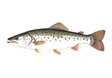
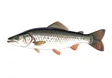
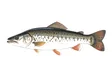
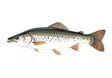
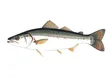
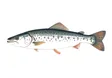
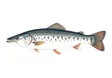
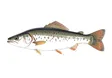
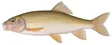
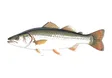
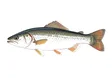
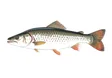
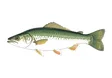
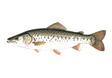
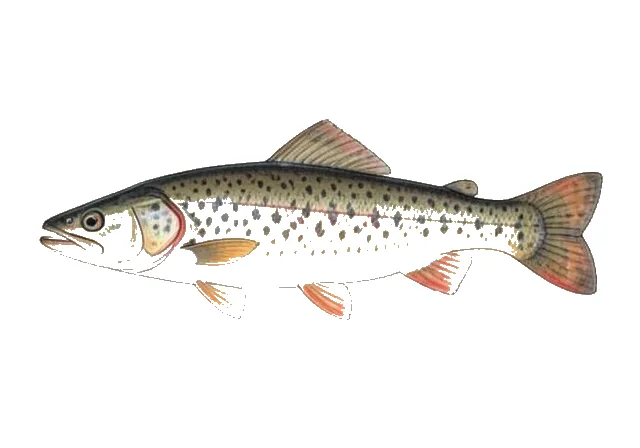
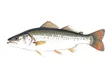
June Sucker field guide illustration

About June Sucker

The June sucker (Chasmistes liorus) is an endangered species of fish endemic to Utah Lake and the Provo River in the U.S. state of Utah. It is named after the month in which it spawns. It is a gray or brownish fish with a paler belly, growing up to about 24 in (61 cm). It lives alongside the Utah sucker, which has a much wider range. Due to the populations of both fish becoming greatly reduced in the lake as a result of fishing, other species such as the common carp have been introduced into the lake. As a result, the June sucker has become "critically endangered" as the pure species is lost as a result of hybridization with the Utah sucker, and predatory fish feed on its larvae. Conservation measures have been put in place and fish are being raised in a fish hatchery for reintroduction.

Description

It is a member of the sucker family Catostomidae, and occurs in sympatry with the demersal Utah sucker Catostomus ardens. Unlike most other suckers, the June sucker is not a bottom-feeder. Its mouth is more rostrally oriented, allowing it to collect zooplankton from the midwater. The fish is dark gray or brownish dorsally, with a white or slightly greenish belly. It has a lifespan over 40 years. Typical specimens range from 17 to 24 in (43 to 61 cm) and reach a weight of 5 lb (2.3 kg).

Distribution

The June sucker is known only from Utah Lake in the United States, its feeder streams, and the adjacent Provo River.

Status

This species was once plentiful in its native lake. Some contributions to its decline include predation on its young by introduced species such as the white bass and walleye, pollution and turbidity, drought, alteration of water flow, and loss of some native vegetation. It also hybridizes with the Utah sucker (Catostomus ardens) and unhybridized fish may not remain.

June sucker were stocked into Red Butte Reservoir, where a natural sustaining population has been established. Fish have also been intensively cultured at the Logan Fish Hatchery in Logan, Utah since 1991. The goal is to release 25,000 12 in (30 cm) individuals into Utah Lake from the hatchery annually. The Springville State Hatchery has also grown fish in ponds historically for population augmentation. As of Spring 2023, more than 1,000,000 June suckers have been raised and released into Utah Lake and other local waters from Logan Fish Hatchery as a protective measure against extinction.

The June Sucker Recovery Implementation Program coordinates and implements recovery actions for the June sucker.

In 2021, the federal listing of the June sucker was downgraded from endangered to threatened by the U.S. Fish & Wildlife Service. The population has rebounded from an effective population size of approximately 300 fish in 1999 to around 3,500 in 2016. The June sucker had been listed as endangered in 1986. Recovery efforts included habitat restoration to combat significant channelization, impoundment and loss of gradient in tributary streams that was preventing June sucker spawning and recruitment. Studies to determine the extent of natural recruitment were ongoing at the time of publication. The June Sucker Recovery Implementation Program will work on managing reservoir releases in the Provo River and Hobble Creek systems to facilitate the spawning and rearing of June suckers.

Article text: Wikipedia contributors, June sucker (source revision). Licensed under CC BY-SA 4.0. Retrieved 2026-10-11.
Diet and feeding

The FishTraits compilation records these diet categories for this species: invertebrates or larval fish. These are broad categories, not a claim that every individual consumes every example in a category.

Reported feeding positions include surface or water-column feeding. The compilation combines published observations; diets can vary with age, locality, and available food.

Habitat preferences

Reported habitat associations include medium to large rivers, still-water habitats.

The source records associations with sand, gravel, vegetation. An association indicates reported use, rather than an exclusive requirement.

Reproduction and parental care

Recorded spawning months are Jun for the source’s reporting region (UT). This is a regional calendar, not a range-wide schedule.

The reproductive-guild classification includes spawning on open substrates without guarding the brood.

Size and recorded longevity

FishTraits reports a maximum total length of 24 centimetres. Some entries use an estimated asymptotic length; this value should not be treated as a certified record catch.

Recorded longevity in the compilation is 40 years. Wild observations were preferred, but captive records were accepted where wild records were unavailable, and unspecified records were assumed wild. The value is not a guaranteed wild lifespan or an aquarium life expectancy.

Spawning movements

The compilation records significant spawning-related movement. Its combined migration flag covers movements within fresh water as well as between rivers and the sea; this flag alone does not establish which migration pattern applies.

Range

Where it lives

Share of 34 GBIF observation records with a state location, across 1 states.
0%
100%
Share of 34 GBIF observation records with a state location, across 1 states.

Share of records by state

Habitat

Water and movement

Water
WoRMS records this species in fresh water.
Migration
Migratory
Pattern

Classification

Taxonomy

Kingdom
Animalia
Phylum
Chordata
Superclass
Actinopterygii
Class
Teleostei
Order
Cypriniformes
Genus
Chasmistes
Species
Chasmistes liorus
ITIS TSN
163963
WoRMS AphiaID
1020097
GBIF key
4286865

Common questions about June Sucker

What is the scientific name of June Sucker?
The scientific name is Chasmistes liorus, in the family Catostomidae. Classification follows ITIS.
Does June Sucker live in fresh water or salt water?
WoRMS records this species in fresh water.
Where has June Sucker been recorded in the United States?
GBIF has observations in 1 states, with the most records in Utah. The map shows observation records, which do not establish the complete natural range.

Closest relatives

Other Chasmistes species

Same family

More Catostomidae

Alabama Hog Sucker6 states
Hypentelium etowanumCatostomidaeNative and introducedFresh
Bigeye Jumprock3 states
Moxostoma ariommumCatostomidaeNativeFresh
Bigmouth Buffalo26 states
Ictiobus cyprinellusCatostomidaeNative and introducedFresh
Black Buffalo26 states
Ictiobus nigerCatostomidaeNative and introducedFresh
Black Redhorse
Moxostoma duquesneiCatostomidaeNativeFresh
Blackfin Sucker2 states
Thoburnia atripinnisCatostomidaeNativeFresh
Blacktail Redhorse9 states
Moxostoma poecilurumCatostomidaeNativeFresh
Blacktip Jumprock7 states
Moxostoma cervinumCatostomidaeNative and introducedFresh
Blue Sucker22 states
Cycleptus elongatusCatostomidaeNativeFresh
Bluehead Sucker7 states
Pantosteus discobolusCatostomidaeNativeFresh
Bridgelip Sucker5 states
Catostomus columbianusCatostomidaeNativeFresh
Creek Chubsucker31 states
Erimyzon oblongusCatostomidaeNativeFresh
Cui-ui2 states
Chasmistes cujusCatostomidaeNativeFresh
Desert Sucker9 states
Pantosteus clarkiiCatostomidaeNativeFresh
Flannelmouth Sucker8 states
Catostomus latipinnisCatostomidaeNativeFresh
Golden Redhorse29 states
Moxostoma erythrurumCatostomidaeNative and introducedFresh
Gray Redhorse2 states
Moxostoma congestumCatostomidaeNative and introducedFresh
Greater Jumprock4 states
Moxostoma lachneriCatostomidaeNative and introducedFresh
Greater Redhorse11 states
Moxostoma valenciennesiCatostomidaeNativeFresh
Green Sucker4 states
Pantosteus virescensCatostomidaeNativeFresh
Highfin Carpsucker23 states
Carpiodes veliferCatostomidaeNative and introducedFresh
Klamath Largescale Sucker2 states
Catostomus snyderiCatostomidaeNativeFresh
Klamath Smallscale Sucker2 states
Catostomus rimiculusCatostomidaeNativeFresh
Lake Chubsucker26 states
Erimyzon sucettaCatostomidaeNative and introducedFresh

All 67 species in Catostomidae