Spotted Bass

Micropterus punctulatus

Centrarchidae · freshwater water fish

6 minute read · Species guide

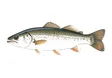
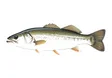
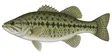
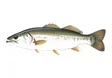
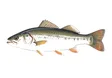
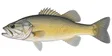
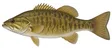
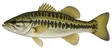
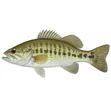
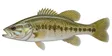
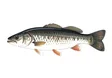
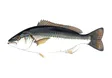
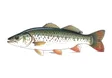
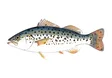
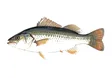
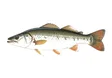
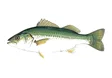
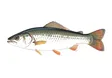
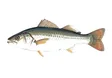
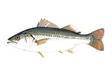
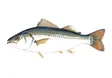
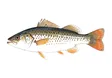
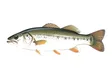
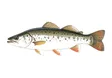
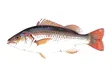
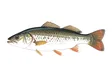
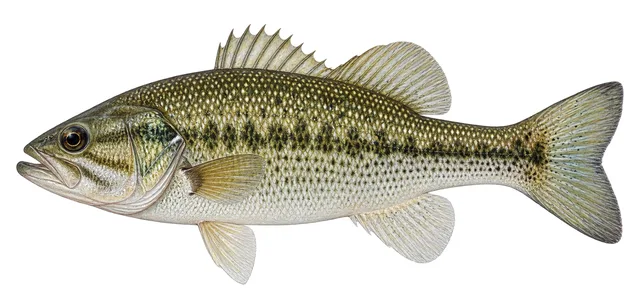
Spotted Bass field guide illustration

About Spotted Bass

The spotted bass (Micropterus punctulatus), also called spotty, or spots in various fishing communities, is a species of North American freshwater fish belonging to the sunfish family (Centrarchidae) of the order Centrarchiformes. It is noted for the rows of dark spots below the lateral line, which give it its common name. One of the black basses, it is native to the Mississippi River basin and across the Gulf states, from central Texas through the Florida panhandle. Its native range extends into the western Mid-Atlantic states and it has been introduced into western North Carolina and Virginia. It has also been introduced to southern Africa, where it has become established in some isolated waters as an invasive species.

Spotted bass can reach an overall length of almost 64 cm (25 in), and can weigh up to 5.2 kg (11 lb). It can live to an age of at least seven years. Preferring cool and warm mountain streams and reservoirs with rocky bottoms, the spotted bass feeds on insects, crustaceans, frogs, annelid worms and smaller fish. It is often mistaken for the similar and more common largemouth bass. A convenient way to distinguish between a largemouth and a spotted bass is by the size of the mouth. A spotted bass will resemble a largemouth bass in coloration but will have a smaller mouth.

In 2010, the scientific community officially recognized a separate subspecies of spotted bass, native to the Tallapoosa and Coosa Rivers and their lakes. This species is commonly known as the Alabama spotted bass (M. henshalli) and known locally as the "Coosa spotted bass", not to be confused with the redeye Coosa bass found in north Georgia. The Alabama spotted bass is highly prized as a gamefish and average size is much larger than the more common Kentucky spotted bass. The current record spotted bass, caught in Pine Flat Lake in California, weighed 10.27 lb (4.66 kg).

Description

Many anglers who catch a spotted bass mistake it for a largemouth bass due to the coloration, although there are subtle differences. The spotted bass, like all black basses except the largemouth, has scales on the base portion of the second dorsal fin, its first and second dorsal fin are clearly connected, and its upper jaw bone does not extend back to or beyond the rear edge of the eyes.

The spotted bass is also often confused with a smallmouth bass (or "smally" for short), but it lacks the vertical bars that are present on the sides of a smallmouth's body. The spotted bass also has small black spots below the lateral line unlike either the large or smallmouth bass. Juveniles often resemble the young smallmouth bass in having a broad band of orange at the base of the tail, followed by a broad black band and white edge. The spotted bass is known to hybridize with the smallmouth, which sometimes makes identification difficult. Spotted bass can be found in deeper water than smallmouth bass, at depths up to 100 ft (30 m).

Distribution and habitat

Spotted bass seem to be segregated by habitat type from closely related species such as the largemouth and smallmouth bass. They tend to be found in areas with more water current than the largemouth, and usually inhabit areas that are too warm, turbid and sluggish for smallmouth bass. They usually occur around aquatic vegetation, submerged logs, and rock or riprap walls in small to large flowing streams, rivers, and reservoirs. Spotted bass are distributed throughout the Ohio River basin as well as the central and lower Mississippi River basin. The species may be found in Gulf Coast states from Texas east to Florida. Spotted bass are native to portions of East Texas, particularly in the Sabine, Neches and Cypress Rivers.

Diet

Spotted bass usually feed on small fishes, crayfish and aquatic insects. The young begin with copepods and other small crustaceans and soon begin to eat insects. The spotted bass' diet falls in between the largemouth and smallmouth bass. It isn't nearly as predatory as the largemouth and only consumes about half the amount of the fish. Like all bass the spotted bass feeds by opening its mouth and creating a negative pressure that sucks in the prey.

Reproduction and life cycle

The spotted bass can live approximately six years. Spawning occurs from April to May in habitat similar to that used by smallmouth. The males build their nest in gravel or other substrate, then entices a female to deposit her eggs. The males guard the eggs until they disperse. Several spotted and smallmouth bass hybrids have been collected recently in area reservoirs suggesting there is occasionally competition between the two species for spawning habitat.

Importance to humans

The spotted bass is a popular game fish that is fished regularly. In this context spotted bass is a good food fish for human consumption.

Invasive species

The spotted bass was introduced to the Thee River, Olifants ‐ Doring River system, Western Cape Province, South Africa, as game fish before 2007, and is now rated as an invasive species. The population was successfully eradicated in 2014, where gillnets and hand nets were used to remove the majority of the stock, while individuals were also caught by spearguns, seine nets and backpack electrofishing. The spotted bass was held responsible for a decline in abundance of native fiery redfin (Pseudobarbus phlegethon Barnard, 1938) and Cape galaxias (Galaxias zebratus Castelnau, 1861).

Article text: Wikipedia contributors, Spotted bass (source revision). Licensed under CC BY-SA 4.0. Retrieved 2026-10-11.
Diet and feeding

The FishTraits compilation records these diet categories for this species: invertebrates or larval fish; larger animal prey (a source category covering fish, crayfish, crabs, or frogs). These are broad categories, not a claim that every individual consumes every example in a category.

Reported feeding positions include bottom feeding and surface or water-column feeding. The compilation combines published observations; diets can vary with age, locality, and available food.

Habitat preferences

Reported habitat associations include medium to large rivers, streams and small rivers, creeks, still-water habitats.

The source records associations with muck, clay or silt, sand, vegetation, organic debris, large woody material. An association indicates reported use, rather than an exclusive requirement.

Reproduction and parental care

The compilation reports a representative maturity age of 2.5 years. Its maturity field summarizes mean, median, or modal estimates, usually for females; male estimates can be used when female data are unavailable. It is not a fixed age at which every fish first breeds.

Recorded spawning months are Apr, May, Jun for the source’s reporting region (NC). This is a regional calendar, not a range-wide schedule.

The reproductive-guild classification includes guarding eggs or young at a spawning substrate or nest.

Size and recorded longevity

FishTraits reports a maximum total length of 63.5 centimetres. Some entries use an estimated asymptotic length; this value should not be treated as a certified record catch.

Recorded longevity in the compilation is 7 years. Wild observations were preferred, but captive records were accepted where wild records were unavailable, and unspecified records were assumed wild. The value is not a guaranteed wild lifespan or an aquarium life expectancy.

Identification and appearance

Moyle (1976); Hubbs et al. (1991); Page and Burr (1991); Etnier and Starnes (1993); Jenkins and Burkhead (1994). This species was formerly composed of three subspecies: the northern Spotted Bass (M. p. punctulatus), the Alabama Spotted Bass (M. p. henshalli) and the Wichita Spotted Bass (M. p. wichitae). Cofer (1995) determined the Wichita subspecies was actually a hybrid with M. dolomieu and is therefore invalid.

Native range

Mississippi River basin from southern Ohio and West Virginia to southeastern Kansas, and south to the Gulf; Gulf Slope drainages from the Chattahoochee River, Georgia (where possibly introduced), to the Guadalupe River, Texas (Page and Burr 1991).

Introduction history

Intentional stocking for sportfishing. In Missouri, the Spotted Bass was stocked in the Sac River and spread downstream through the Osage River into the Missouri River (MacCrimmon and Robbins 1975).

Ecological impacts

Introduced predatory centrarchids are likely responsible for the decline of native ranid frogs in California and for the decline of California tiger salamander Ambystoma californiense populations (Hayes and Jennings 1986; Dill and Cordone 1997).

Record fish

State records in 6 states

  • Alabama8 lbs 15 oz

    Smith Lake · 3/18/1978 · Phillip C. Terry, Decatur

  • Georgia8 lb, 2 oz

    Lake Burton · February 23, 2005 · Wayne Holland

  • Oklahoma8 lbs 2.00 ozs

    Pittsburg Co. Pond · 06/27/1958 · O.J. Stone · rod and line

  • Arkansas7 lbs., 15 oz.

    Bull Shoals Lake · 03/26/1983 · Mike Heilich, St. Louis, MO · rod and reel

  • Texas4.35 lb

    Ray Roberts · May 3, 2019 · Jose A. C. Vasquez · topwater minnow

  • Florida3.93 lb

    Apalachicola River · Gulf County · 6/28/2025 · Joe Durden

  • Texaslength record

    Conroe · Mar 15, 2012 · David Cook · Fly Rod, wolly bugger

Each figure is the state agency’s own certified record. The site holds record tables for 11 states so far, so a state missing here has not been read yet. It is not a state where this fish holds no record.

Statute

The official state fish of Kentucky

  • Kentuckyas Kentucky spotted bass, named 1956

A state fish is chosen by statute. It says nothing about how common the fish is in the state. See every official state fish.

Range

Where it lives

Share of 20,609 GBIF observation records with a state location, across 30 states. The orange dots are USGS stream-survey sites where this species was caught.
0%
23.9%
Share of 20,609 GBIF observation records with a state location, across 30 states. The orange dots are USGS stream-survey sites where this species was caught.

A blank area on the dot layer usually means nobody sampled there, not that the fish is absent. Turn on “every survey site” to see where the survey looked.

The USGS stream survey caught it at 2,266 of its sites, in 23 states. That survey and the GBIF records are two different counts of two different things, so the site keeps them apart.

Habitat

Water and movement

Water
WoRMS records this species in fresh water.
USGS NAS habitat
Freshwater
US status
Native transplant — native to part of the United States, moved to other waters inside it.
Migration
Undetermined
Pattern
Disagreement
5 published references do not agree on the pattern: Non-migratory, Potamodromous. The site shows every assignment rather than picking one.

Classification

Taxonomy

Kingdom
Animalia
Phylum
Chordata
Superclass
Actinopterygii
Class
Teleostei
Order
Perciformes
Genus
Micropterus
Species
Micropterus punctulatus
ITIS TSN
168161
WoRMS AphiaID
1030583
GBIF key
5211245

Common questions about Spotted Bass

What is the scientific name of Spotted Bass?
The scientific name is Micropterus punctulatus, in the family Centrarchidae. Classification follows ITIS.
Does Spotted Bass live in fresh water or salt water?
WoRMS records this species in fresh water.
Where has Spotted Bass been recorded in the United States?
GBIF has observations in 30 states, with the most records in Georgia, Texas, Oklahoma. The map shows observation records, which do not establish the complete natural range.

Closest relatives

Other Micropterus species

Same family

More Centrarchidae

Alabama Bass11 states
Micropterus henshalliCentrarchidaeNative and introducedFresh
Banded Sunfish15 states
Enneacanthus obesusCentrarchidaeNativeFresh
Bantam Sunfish12 states
Lepomis symmetricusCentrarchidaeNativeFresh
Black Crappie49 states
Pomoxis nigromaculatusCentrarchidaeNative and introducedFresh
Blackbanded Sunfish8 states
Enneacanthus chaetodonCentrarchidaeNativeFresh
Bluegill49 states
Lepomis macrochirusCentrarchidaeNative and introducedFresh
Bluespotted Sunfish14 states
Enneacanthus gloriosusCentrarchidaeNative and introducedFresh
Cahaba Bass1 states
Micropterus cahabaeCentrarchidaeNativeFresh
Chattahoochee Bass2 states
Micropterus chattahoochaeCentrarchidaeNativeFresh
Dollar Sunfish18 states
Lepomis marginatusCentrarchidaeNativeFresh
Flier18 states
Centrarchus macropterusCentrarchidaeNativeFresh
Florida Largemouth Bass9 states
Micropterus floridanusCentrarchidaeNative and introducedFresh
Green Sunfish46 states
Lepomis cyanellusCentrarchidaeNative and introducedFresh
Guadalupe Bass2 states
Micropterus treculiiCentrarchidaeNative and introducedFresh
Largemouth Bass48 states
Micropterus salmoidesCentrarchidaeNative and introducedFresh
Lepomis solis7 states
CentrarchidaeNative
Longear Sunfish31 states
Lepomis megalotisCentrarchidaeNative and introducedFresh
Mud Sunfish11 states
Acantharchus pomotisCentrarchidaeNativeFresh
Northern Sunfish8 states
Lepomis peltastesCentrarchidaeNativeFresh
Orangespotted Sunfish27 states
Lepomis humilisCentrarchidaeNative and introducedFresh
Ozark Bass3 states
Ambloplites constellatusCentrarchidaeNativeFresh
Pumpkinseed46 states
Lepomis gibbosusCentrarchidaeNative and introducedFreshBrackish
Redbreast Sunfish29 states
Lepomis auritusCentrarchidaeNative and introducedFresh
Redear Sunfish37 states
Lepomis microlophusCentrarchidaeNative and introducedFresh

All 40 species in Centrarchidae