Flier

Centrarchus macropterus

Centrarchidae · freshwater water fish

5 minute read · Species guide

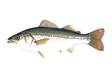
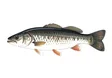
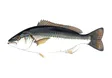
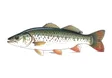
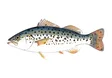
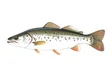
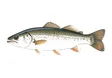
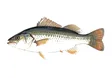
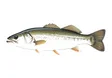
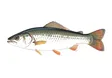
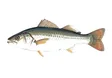
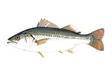
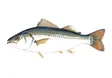
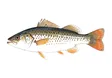
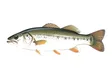
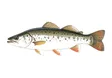
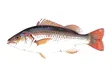
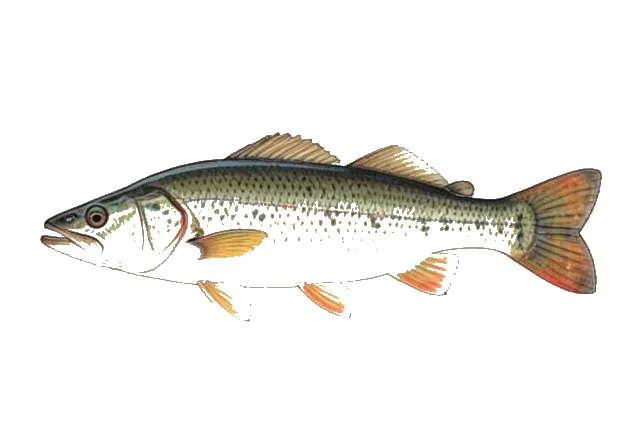
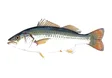
Flier field guide illustration

About Flier

The flier (Centrarchus macropterus) is a species of freshwater ray-finned fish, a sunfish from the family Centrarchidae which is endemic to the southern United States. It is the only species in the monospecific genus Centrarchus. A Second World War United States Navy submarine was named the USS Flier after this fish.

Description

The flier is a small, strongly compressed species of sunfish which has a moderately sized, oblique mouth. The dorsal fin has 11–13 spines and 12–14 soft rays while the anal fin has 7–8 spines and 13–15 soft rays. It has a lateral line and the scales are ctenoid. The flanks have a scattering of dark spots, the underside is pale, and the upperparts are olive in color. There is a vertical dark line through the eye which continues below the eye in what has been described as a "teardrop". Fish of a standard length less than around 45 millimeters (1.8 in) have an obvious dark eyespot, or ocellus, which has a reddish margin on the soft part of the dorsal fin. The pectoral and pelvic fins are dusky with paler reticulations. The maximum total length recorded is 29.2 centimeters (11.5 in) but they are more commonly around 13 centimeters (5.1 in) and the maximum published weight is 1.35 pounds.

Distribution

The flier is found in the southern part of the United States along the Atlantic seaboard from the Potomac River drainage in Maryland, where it was most likely introduced, to central Florida. It is then found along the Gulf of Mexico drainages as far west as the Trinity River in Texas, and then north in Mississippi River system to above the fall line in southern Illinois and southern Indiana.

Habitat and biology

The flier is found in clear, acidic waters including ponds in swamps, sloughs, oxbows, slow-flowing creeks and steams. These habitats should be heavily vegetated and have an average water temperature of 23 to 29 °C (73 to 84 °F). They feed largely on invertebrates including insects, snails, worms and leeches although they will also eat smaller fishes and some phytoplankton. Breeding normally occurs March to May when the water temperature reaches 14–17 °C (57–63 °F) but it has been recorded as early as February. The gravid females have been collected from a variety of habitat including debris filled ditches with soft bottoms as well as gravel bottomed streams and heavily vegetated sand and gravel pits. They will spawn in a variety of water conditions ranging from free-flowing clear or turbid water through stagnant water in ditches and pools. Fliers create nests in rocks or gravel and surround their eggs with a round adhesive egg envelope. They are colonial nesters, nesting in aggregations with the nests quite closely spaced. Sexual maturity is attained at one year old and when they are 70 millimeters (2.8 in) long. The male parent guards the eggs and newly hatched fry. If they are frightened or alarmed, these fish will look for shelter among aquatic vegetation, submerged tree roots or mats of floating vegetation.

Taxonomy and etymology

The flier was first formally described by the French naturalist Bernard Germain de Lacépède (1756–1825) in 1801 as Labrus macropterus with the type locality given as South Carolina. In 1829 Georges Cuvier placed it in the genus Centrarchus. The genus Centrarchus is the sister taxon to the Archoplites and in turn these two are sister to Pomoxis. The generic name is a compound of the Greek kentron meaning "sting"and archos meaning"anus", a reference to the long spines in the anal fin. The specific name macropterus is also Greek and means "long fin".

Cultural references

A Gato -class submarine, USS Flier, built in 1943, was named for this species.

Article text: Wikipedia contributors, Flier (fish) (source revision). Licensed under CC BY-SA 4.0. Retrieved 2026-10-11.
Diet and feeding

The FishTraits compilation records these diet categories for this species: algae or phytoplankton; invertebrates or larval fish; larger animal prey (a source category covering fish, crayfish, crabs, or frogs). These are broad categories, not a claim that every individual consumes every example in a category.

Reported feeding positions include bottom feeding and surface or water-column feeding. The compilation combines published observations; diets can vary with age, locality, and available food.

Habitat preferences

Reported habitat associations include medium to large rivers, streams and small rivers, creeks, still-water habitats.

The source records associations with muck, vegetation. An association indicates reported use, rather than an exclusive requirement.

Reproduction and parental care

The compilation reports a representative maturity age of 1 years. Its maturity field summarizes mean, median, or modal estimates, usually for females; male estimates can be used when female data are unavailable. It is not a fixed age at which every fish first breeds.

Recorded spawning months are Apr, May for the source’s reporting region (NC). This is a regional calendar, not a range-wide schedule.

The reproductive-guild classification includes guarding eggs or young at a spawning substrate or nest.

Size and recorded longevity

FishTraits reports a maximum total length of 29.2 centimetres. Some entries use an estimated asymptotic length; this value should not be treated as a certified record catch.

Recorded longevity in the compilation is 7 years. Wild observations were preferred, but captive records were accepted where wild records were unavailable, and unspecified records were assumed wild. The value is not a guaranteed wild lifespan or an aquarium life expectancy.

Native range

Coastal Plain from Potomac drainage, Maryland (introduced), to central Florida and west to Trinity River, Texas; north in former Mississippi Embayment to southern Illinois and southern Indiana; above Fall Line in southern Indiana, southern Illinois; rarely elsewhere.

Introduction history

Probably stocked, either intentionally or as stock contamination. Lee et al. (1981) questioned the Flier's native status in Maryland. Jenkins and Burkhead (1994) stated that if it is native to the Potomac River in Maryland, it should have been found in the Virginia portion of that river as well (it was not).

Record fish

State records in 3 states

  • Florida1.36 lb

    Ocheesee Pond · Jackson · 6/1/2025 · Michael Baxley

  • Florida1.35 lb

    A Cypress Pond · Jackson · 5/9/2015 · Twila Gates

  • Georgia1 lb, 4 oz

    Lowndes County pond · February 26, 1996 · Curt Brooks

  • Arkansas0 lbs., 14 oz.

    Saline River · 07/10/1985 · Harvey Jones, Warren, AR · rod and reel

Each figure is the state agency’s own certified record. The site holds record tables for 11 states so far, so a state missing here has not been read yet. It is not a state where this fish holds no record.

Range

Where it lives

Share of 3,932 GBIF observation records with a state location, across 18 states. The orange dots are USGS stream-survey sites where this species was caught.
0%
17.6%
Share of 3,932 GBIF observation records with a state location, across 18 states. The orange dots are USGS stream-survey sites where this species was caught.

A blank area on the dot layer usually means nobody sampled there, not that the fish is absent. Turn on “every survey site” to see where the survey looked.

The USGS stream survey caught it at 215 of its sites, in 15 states. That survey and the GBIF records are two different counts of two different things, so the site keeps them apart.

Habitat

Water and movement

Water
WoRMS records this species in fresh water.
USGS NAS habitat
Freshwater
US status
Native transplant — native to part of the United States, moved to other waters inside it.
Migration
Not migratory

Classification

Taxonomy

Kingdom
Animalia
Phylum
Chordata
Superclass
Actinopterygii
Class
Teleostei
Order
Perciformes
Genus
Centrarchus
Species
Centrarchus macropterus
ITIS TSN
168102
WoRMS AphiaID
1022967
GBIF key
2394521

Common questions about Flier

What is the scientific name of Flier?
The scientific name is Centrarchus macropterus, in the family Centrarchidae. Classification follows ITIS.
Does Flier live in fresh water or salt water?
WoRMS records this species in fresh water.
Where has Flier been recorded in the United States?
GBIF has observations in 18 states, with the most records in Florida, North Carolina, Texas. The map shows observation records, which do not establish the complete natural range.

Same family

More Centrarchidae

Alabama Bass11 states
Micropterus henshalliCentrarchidaeNative and introducedFresh
Banded Sunfish15 states
Enneacanthus obesusCentrarchidaeNativeFresh
Bantam Sunfish12 states
Lepomis symmetricusCentrarchidaeNativeFresh
Black Crappie49 states
Pomoxis nigromaculatusCentrarchidaeNative and introducedFresh
Blackbanded Sunfish8 states
Enneacanthus chaetodonCentrarchidaeNativeFresh
Bluegill49 states
Lepomis macrochirusCentrarchidaeNative and introducedFresh
Bluespotted Sunfish14 states
Enneacanthus gloriosusCentrarchidaeNative and introducedFresh
Cahaba Bass1 states
Micropterus cahabaeCentrarchidaeNativeFresh
Chattahoochee Bass2 states
Micropterus chattahoochaeCentrarchidaeNativeFresh
Dollar Sunfish18 states
Lepomis marginatusCentrarchidaeNativeFresh
Florida Largemouth Bass9 states
Micropterus floridanusCentrarchidaeNative and introducedFresh
Green Sunfish46 states
Lepomis cyanellusCentrarchidaeNative and introducedFresh
Guadalupe Bass2 states
Micropterus treculiiCentrarchidaeNative and introducedFresh
Largemouth Bass48 states
Micropterus salmoidesCentrarchidaeNative and introducedFresh
Lepomis solis7 states
CentrarchidaeNative
Longear Sunfish31 states
Lepomis megalotisCentrarchidaeNative and introducedFresh
Mud Sunfish11 states
Acantharchus pomotisCentrarchidaeNativeFresh
Northern Sunfish8 states
Lepomis peltastesCentrarchidaeNativeFresh
Orangespotted Sunfish27 states
Lepomis humilisCentrarchidaeNative and introducedFresh
Ozark Bass3 states
Ambloplites constellatusCentrarchidaeNativeFresh
Pumpkinseed46 states
Lepomis gibbosusCentrarchidaeNative and introducedFreshBrackish
Redbreast Sunfish29 states
Lepomis auritusCentrarchidaeNative and introducedFresh
Redear Sunfish37 states
Lepomis microlophusCentrarchidaeNative and introducedFresh
Redeye Bass12 states
Micropterus coosaeCentrarchidaeNative and introducedFresh

All 40 species in Centrarchidae