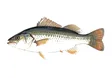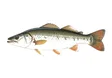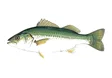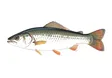
Guadalupe Bass

Micropterus treculii

Centrarchidae · freshwater water fish

5 minute read · Species guide

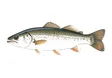
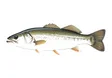
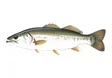
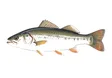
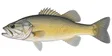
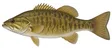
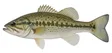
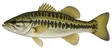
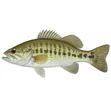
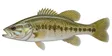
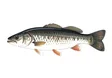
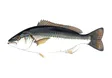
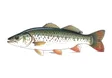
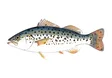
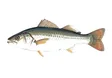
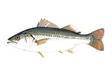
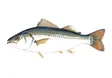
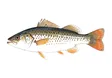
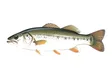
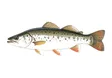
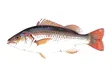
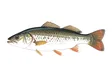
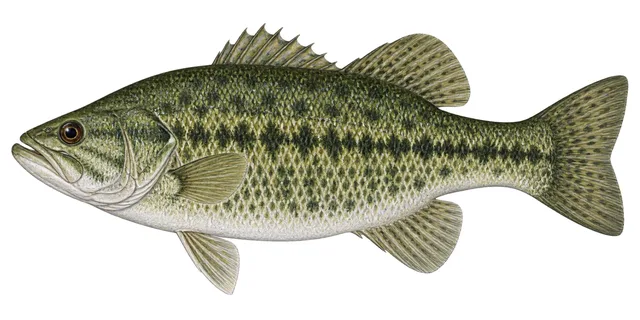
Guadalupe Bass field guide illustration

About Guadalupe Bass

The Guadalupe bass (Micropterus treculii) is a rare species of fish endemic to the U.S. state of Texas, where it also is the official state fish. It is restricted to creeks and rivers (including the Guadalupe River, hence the name Guadalupe bass), and is listed as near threatened. Today, most fly fishermen and anglers practice catch-and-release techniques to improve fish populations. The Guadalupe bass is often difficult to distinguish from the smallmouth bass or spotted bass, and the fish is known to hybridize.

Distribution

The fish is only found in the Edwards Plateau in central Texas. Its main habitats are the San Marcos, Colorado, Llano, and Guadalupe Rivers, but can also be found in smaller streams such as Barton Creek, Onion Creek, San Gabriel River and the Comal River. The species has also been farm-raised and stocked in the Llano River.

Description

Guadalupe bass, like most black bass, are lime to olive green in color, this particular species being lighter in shade usually in river specimens. They have a lateral line covered in mostly separate diamond-shaped or circular spots, which with age fade from black to olive. Also, many smaller diamond marks are scattered on the back, which are less distinguished than the ones on the lateral line. They have a rectangular tooth patch on the tongue. Its physical traits are very similar to the spotted bass (i.e. small mouth that does not extend past the eye, sleek figure, etc.) with one exception; the green coloring tends to extend lower on the body past the lateral line than their relatives. So far, the record catch is 3.71 lb (3 lb 11.4 oz), caught by Dr. Bryan Townsend of Austin in 2014.

Threats and predators

The Guadalupe bass has almost no predators. Its main threat is not predation, but hybridization with the introduced smallmouth bass. The two species are very closely related and in some rivers almost half the Guadalupe bass are hybrids. The Texas Parks and Wildlife Dept stated it will likely stock many bass in the future to beat out the hybrid population. This will be a pilot for several other areas where rare spotted bass subspecies are having the same problems.

Habitat

Typically, Guadalupe bass are found in streams and reservoirs; they are absent from extreme headwaters. They prefer flowing waters of streams within native variety, and use covers such as large rocks, cypress trees, or stumps for refuge. Juvenile fish are often found in fast-moving water but begin transitioning to deeper, moderate current towards the end of their first year.

Diet

The fish (especially juveniles and very old fish), unlike other bass, have an inclination towards insects. Guadalupe bass at their predatory peak prefer larger bait fish such as shad and small bass or bluegills.

Fishing

While almost unheard of elsewhere, the Guadalupe bass is very popular among fishermen in Central Texas. It is prized for its long, tough fights, in which it manipulates the current and its unusually strong muscles, and beautiful colors which tend to be more natural and bright than those of spotted bass. Its preference for strong current and its large diet of insects earned it the name "Texas brook trout" and make it popular for fly fishermen. It fights similarly to both smallmouth bass and rainbow trout—making long runs and manipulating current, but also making sharp turns and attempting to entangle the line on structures, and even making large jumps like both species.

The IGFA all-tackle world record for the species stands at 1.67 kg (3 lb 11 oz) caught in Lake Travis in Texas in 1983.

Reproduction

Both male and female Guadalupe Bass reach adulthood and sexually maturity at one year of age. Their spawning begins as early as March and continues into June depending on the locale and water conditions. However, unlike many other bass, a secondary spawn is possible in late summer or early fall. The male Guadalupe Bass builds and picks out a gravel nest for spawning in shallow water where there is a high flow rate but out of the way of fast moving water. It is important the male finds a good-looking nest, for these gravel nests attract the females. The female lays between 400 and 9000 eggs, but is chased away by the male immediately after she lays the eggs. From this point on, the male guards the nest from predators and will not eat, but may strike a lure in order to defend its territory. The male Guadalupe stays guard over the fry as they hatch. After hatching, the fry feed on invertebrates.

Article text: Wikipedia contributors, Guadalupe bass (source revision). Licensed under CC BY-SA 4.0. Retrieved 2026-10-11.
Diet and feeding

The FishTraits compilation records these diet categories for this species: invertebrates or larval fish; larger animal prey (a source category covering fish, crayfish, crabs, or frogs). These are broad categories, not a claim that every individual consumes every example in a category.

Reported feeding positions include bottom feeding and surface or water-column feeding. The compilation combines published observations; diets can vary with age, locality, and available food.

Habitat preferences

Reported habitat associations include medium to large rivers, streams and small rivers.

The source records associations with gravel. An association indicates reported use, rather than an exclusive requirement.

Reproduction and parental care

The compilation reports a representative maturity age of 1 years. Its maturity field summarizes mean, median, or modal estimates, usually for females; male estimates can be used when female data are unavailable. It is not a fixed age at which every fish first breeds.

Batch or serial spawning has been reported somewhere in the species’ range. This does not establish the same spawning pattern for every population.

Recorded spawning months are Mar, Apr, May, Jun for the source’s reporting region (TX). This is a regional calendar, not a range-wide schedule.

The reproductive-guild classification includes guarding eggs or young at a spawning substrate or nest.

Size and recorded longevity

FishTraits reports a maximum total length of 46.4 centimetres. Some entries use an estimated asymptotic length; this value should not be treated as a certified record catch.

Recorded longevity in the compilation is 7 years. Wild observations were preferred, but captive records were accepted where wild records were unavailable, and unspecified records were assumed wild. The value is not a guaranteed wild lifespan or an aquarium life expectancy.

Native range

Edwards Plateau in the Brazos, Colorado, Guadalupe, and San Antonio river drainages, Texas (Page and Burr 1991).

Record fish

State records in 1 states

  • Texaslength record

    Inks · May 26, 2024 · Immanuel Barela · 7" Swimbait

  • Texaslength record

    Blanco River · Aug 19, 2022 · Charles Luton · Fly Rod, Hopper Fly

Each figure is the state agency’s own certified record. The site holds record tables for 11 states so far, so a state missing here has not been read yet. It is not a state where this fish holds no record.

Statute

The official state fish of Texas

  • Texasas Guadalupe bass (freshwater), named 1989

A state fish is chosen by statute. It says nothing about how common the fish is in the state. See every official state fish.

Range

Where it lives

Share of 2,751 GBIF observation records with a state location, across 2 states.
0%
99.8%
Share of 2,751 GBIF observation records with a state location, across 2 states.

Share of records by state

Habitat

Water and movement

Water
WoRMS records this species in fresh water.
USGS NAS habitat
Freshwater
US status
Native transplant — native to part of the United States, moved to other waters inside it.
Migration
Undetermined

Classification

Taxonomy

Kingdom
Animalia
Phylum
Chordata
Superclass
Actinopterygii
Class
Teleostei
Order
Perciformes
Genus
Micropterus
Species
Micropterus treculii
ITIS TSN
168162
WoRMS AphiaID
1463308
GBIF key
5211243

Common questions about Guadalupe Bass

What is the scientific name of Guadalupe Bass?
The scientific name is Micropterus treculii, in the family Centrarchidae. Classification follows ITIS.
Does Guadalupe Bass live in fresh water or salt water?
WoRMS records this species in fresh water.
Where has Guadalupe Bass been recorded in the United States?
GBIF has observations in 2 states, with the most records in Texas, Alabama. The map shows observation records, which do not establish the complete natural range.

Closest relatives

Other Micropterus species

Same family

More Centrarchidae

Alabama Bass11 states
Micropterus henshalliCentrarchidaeNative and introducedFresh
Banded Sunfish15 states
Enneacanthus obesusCentrarchidaeNativeFresh
Bantam Sunfish12 states
Lepomis symmetricusCentrarchidaeNativeFresh
Black Crappie49 states
Pomoxis nigromaculatusCentrarchidaeNative and introducedFresh
Blackbanded Sunfish8 states
Enneacanthus chaetodonCentrarchidaeNativeFresh
Bluegill49 states
Lepomis macrochirusCentrarchidaeNative and introducedFresh
Bluespotted Sunfish14 states
Enneacanthus gloriosusCentrarchidaeNative and introducedFresh
Cahaba Bass1 states
Micropterus cahabaeCentrarchidaeNativeFresh
Chattahoochee Bass2 states
Micropterus chattahoochaeCentrarchidaeNativeFresh
Dollar Sunfish18 states
Lepomis marginatusCentrarchidaeNativeFresh
Flier18 states
Centrarchus macropterusCentrarchidaeNativeFresh
Florida Largemouth Bass9 states
Micropterus floridanusCentrarchidaeNative and introducedFresh
Green Sunfish46 states
Lepomis cyanellusCentrarchidaeNative and introducedFresh
Largemouth Bass48 states
Micropterus salmoidesCentrarchidaeNative and introducedFresh
Lepomis solis7 states
CentrarchidaeNative
Longear Sunfish31 states
Lepomis megalotisCentrarchidaeNative and introducedFresh
Mud Sunfish11 states
Acantharchus pomotisCentrarchidaeNativeFresh
Northern Sunfish8 states
Lepomis peltastesCentrarchidaeNativeFresh
Orangespotted Sunfish27 states
Lepomis humilisCentrarchidaeNative and introducedFresh
Ozark Bass3 states
Ambloplites constellatusCentrarchidaeNativeFresh
Pumpkinseed46 states
Lepomis gibbosusCentrarchidaeNative and introducedFreshBrackish
Redbreast Sunfish29 states
Lepomis auritusCentrarchidaeNative and introducedFresh
Redear Sunfish37 states
Lepomis microlophusCentrarchidaeNative and introducedFresh
Redeye Bass12 states
Micropterus coosaeCentrarchidaeNative and introducedFresh

All 40 species in Centrarchidae