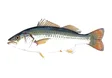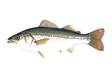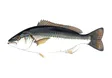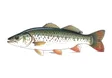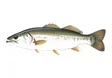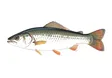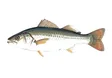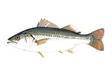
Black Crappie

Pomoxis nigromaculatus

Centrarchidae · freshwater water fish

7 minute read · Species guide

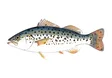
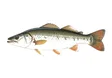
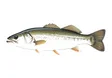
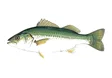
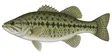
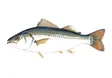
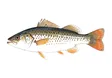
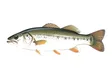
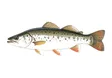
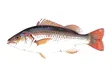
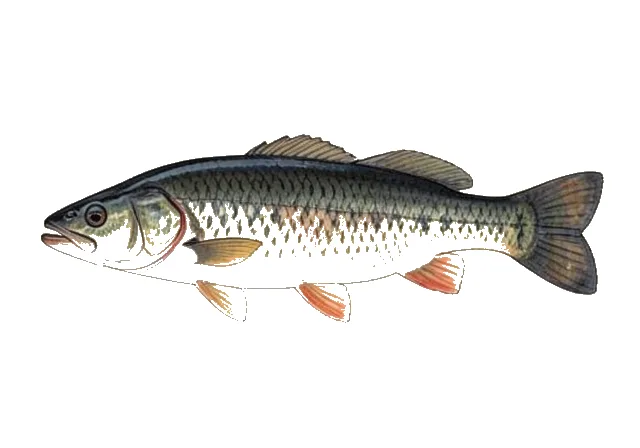
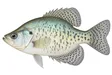
Black Crappie field guide illustration

About Black Crappie

The black crappie (Pomoxis nigromaculatus) is a freshwater fish in the sunfish family (Centrarchidae). It is endemic to North America, one of the two types of crappies. It is very similar to the white crappie (P. annularis) in size, shape, and habits, except that it is darker, with a pattern of black spots. Alternate names for the species include calico bass, speck, speckled perch, speckled bass, moonfish, grass bass, strawberry bass, shiner, crappie, oswego bass, sac-a-lait, and marigane noire.

Taxonomy

The genus name Pomoxis comes from the Greek words "poma"and"oxys."These words are related to the fish's sharp operculum, or gill cover. The name refers to the sharp and spiny structure around the fish's gills. The species name nigromaculatus comes from Latin and means"black-spotted." This name also describes the dark spots and markings that can be seen on the body of the black crappie.

Description

Black crappies are most accurately identified by the seven or eight spines on its dorsal fin (white crappies have five or six dorsal spines). Crappies have a deep and laterally compressed body. They are usually silvery-gray to green in color and show irregular or mottled black splotches over the entire body. Black crappies have rows of dark spots on their dorsal, anal, and caudal fins. The dorsal and anal fins resemble each other in shape. Both crappies have large mouths extending to below the eye, and thin lips—both suggestive of their piscivorous feeding habits. Crappies are typically about 4–8 inches (10–20 cm) long. The current all-tackle fishing world record for a black crappie is 2.47 kg (5 lb 7 oz). The maximum length reported for a black crappie is 19.3 inches (49 cm) and the maximum published weight is just under 6 pounds (2,700 g).

Distribution

The black crappie's range is uncertain, since it has been widely transplanted, but it is presumed to be similar to the white crappie's. Its native range is suspected to be in the eastern United States and Canada, and as of 2005, populations existed in all of the 48 contiguous U.S. states. Introduced populations also exist in Mexico and Panama.

Habitat

The black crappie's habitats are lakes, reservoirs, borrow pits, and navigation pools in large rivers. They prefer areas with little or no current, clear water, and abundant cover such as submerged timber or aquatic vegetation, as well as sand or mud bottoms like those found in lakes, ponds, streams, and sloughs.

Like P. annularis, P. nigromaculatus is very prolific and can tend to overpopulate its environment, with negative consequences both for the crappie and for other fish species. A commercial supplier of the fish, however, claims that it can be safely stocked in ponds as small as one acre (0.40 hectares) in area.

Diet

Crappies feed early in the morning and from about midnight until approximately 2 am. Individuals smaller than about 16 centimetres (6.3 in) in length eat plankton and minuscule crustaceans, while larger individuals feed on small fish (like shad), as well as minnows. Adult black crappies feed on fewer fish than white crappies do; instead they consume a larger volume of insects, insect larvae and crustaceans. According to scientific studies carried out in California, the mysid shrimp Neomysis awatschensis and amphipods of genus Corophium were most commonly eaten by all sizes of black crappie, followed by copepods, cladocerans and chironomid larvae and pupae. Although this diet is popular among black crappies in general, their diet may significantly change based on habitat, availability of food, and other biotic factors such as amount of resource competition. The same study also showed that young, small crappie tend to feed on small aquatic invertebrate animals and changed to a fish-filled diet as they matured to adulthood. Its diet, as an adult, tends to be less dominated by other fish than that of the white crappie.

Relationships with humans

Crappies are a very popular sport fish, as they are easy to catch during their feeding times. There are minimal number and size restriction limits for fishing the crappie species.

Angling

Crappie are commonly caught on small jigs and minnow rigs. Unlike their cousins, the white crappies, black crappies are more commonly caught in clear water around structure. A common technique is spider rigging, in which one usually has eight long rods protruding from the boat, all rigged with minnows. Fishermen can also troll for crappie with small cranks. When trolling, one should use electronics to locate suspending groups and bring one's lure near them. Another technique for fishing docks is dock shooting, or arrow casting. To arrow cast, one should use a spinning reel. Fishermen open their bail, hold the lure and push the rod forward so that the rod is bent. They then aim the lure where they want to cast, and they simultaneously let go of the lure and release the line. This technique is used to cast the lure into the small space under a dock or tree.

Conservation status

Black crappies can be safely harvested under minimal, reasonable regulations, as long as there is no permanent damage to the fishery or environment. The black crappie is not listed as a species under threat on the IUCN Red List.

Reproduction and life cycle

Black crappies mature at two to four years. Growth during the first four years of their life is faster in the warm waters of the southern part of its range than in cooler waters in the north. White crappie have a higher growth rate in terms of length than black crappie. Most fish that are caught for sport are between two and five years old.

The breeding season varies by location, due to the species' great range. Breeding temperature is 14‒20 °C (58‒68 °F) and spawning occurs in spring and early summer. Spawning occurs in a nest built by the male. Males use their bodies and tails to sweep out an area of sand or mud in shallow water (between one and six feet deep) usually near a shoreline and vegetation to create a nest. Black crappies appear to nest in the most protected areas (such as places with woody debris or live vegetation) possible.

Female crappies produce an average of 40,000 spherical eggs, the number depending on their age and size. After spawning, the male watches over the nest until eggs hatch, which is usually about two to three days. Newly hatched fish larvae are about 2.32 millimetres (0.091 in) long and appear translucent. They stay in the nest for several days before moving to shallow, sheltered waters.

The oldest recorded age of a specimen is fifteen years, although seven years is a more typical life span for the species.

Article text: Wikipedia contributors, Black crappie (source revision). Licensed under CC BY-SA 4.0. Retrieved 2026-10-11.
Diet and feeding

The FishTraits compilation records these diet categories for this species: invertebrates or larval fish; larger animal prey (a source category covering fish, crayfish, crabs, or frogs). These are broad categories, not a claim that every individual consumes every example in a category.

Reported feeding positions include bottom feeding and surface or water-column feeding. The compilation combines published observations; diets can vary with age, locality, and available food.

Habitat preferences

Reported habitat associations include medium to large rivers, streams and small rivers, creeks, still-water habitats.

The source records associations with muck, clay or silt, sand, vegetation, organic debris, large woody material. An association indicates reported use, rather than an exclusive requirement.

Reproduction and parental care

The compilation reports a representative maturity age of 2.5 years. Its maturity field summarizes mean, median, or modal estimates, usually for females; male estimates can be used when female data are unavailable. It is not a fixed age at which every fish first breeds.

Recorded spawning months are Apr, May, Jun for the source’s reporting region (NC). This is a regional calendar, not a range-wide schedule.

The reproductive-guild classification includes guarding eggs or young at a spawning substrate or nest.

Size and recorded longevity

FishTraits reports a maximum total length of 49 centimetres. Some entries use an estimated asymptotic length; this value should not be treated as a certified record catch.

Recorded longevity in the compilation is 8 years. Wild observations were preferred, but captive records were accepted where wild records were unavailable, and unspecified records were assumed wild. The value is not a guaranteed wild lifespan or an aquarium life expectancy.

Native range

So widely introduced that native range is difficult to determine; presumably Atlantic Slope from Virginia to Florida, Gulf Slope west to Texas, St. Lawrence, Great Lakes and Mississippi River basins from Quebec to Manitoba south to the Gulf (Page and Burr 1991).

Introduction history

Its popularity as a sport fish has led to stockings throughout the west and northeast. Intentional stocking for sportfishing.

Ecological impacts

Black Crappie prey on threatened and endangered juvenile salmon that spawn in rivers of the Northwest United States and may further contribute to salmon decline through habitat alteration, though the extent of those impacts are unknown (Sanderson et al. 2009). Nonnative predators, including crappie, have been shown to reduce the abundance and diversity of native prey species in several Pacific Northwest rivers (Hughes and Herlihy 2012).

Record fish

State records in 11 states

  • Arkansas5 lbs., 0 oz.

    Lake Wilhelmina · 06/06/2011 · Donivan Echols, Mena, AR · rod and reel

  • Oklahoma4 lbs 10.00 ozs

    Ottawa Co. Pond · 06/16/1974 · Rollie Williams · rod and line

  • Wisconsin4 lbs. 8 oz.

    Gile Flowage · Iron · 08/12/1967

  • Alabama4 lbs 5 oz

    Fort Payne Res. · 3/27/2007 · Shelley Meadows/Mentone

  • Alabama4 lbs 5 oz

    Jefferson Co. pond · 6/2/1997 · William D. Webb, B'ham

  • Alabama4 lbs 4 oz

    Paint Creek · 3/18/1984 · Sherril Harris, Sylacauga

  • Georgia4 lb, 4 oz

    Acree's Lake · June 1, 1971 · Shirley Lavender

  • Georgia4 lb, 4 oz

    Lake Spivey · March 1975 · Steve Cheek

  • Minnesota4 lb 1 oz

    Cedar Lake · Rice · 5/3/2026 · David Selle, Lino Lakes

  • Florida3.83 lb

    Lake Talquin · Gadsden County · 1/21/1992 · Ben Curry, Sr.

  • Idaho3.56 lb

    Brownlee Reservoir · 06/08/2003 · Jason Monson

  • Montana3.45 lbs.

    Tongue River Reservoir · 1/13/26 · Swayne Redinger

  • Utah3 lbs. 5 oz.

    Lake Powell · 2009 · James Maack

  • Texas2.93 lb

    Texoma · Mar 13, 2014 · Johnny Summers Jr. · Blue & Silver Rattletrap

Each figure is the state agency’s own certified record. The site holds record tables for 11 states so far, so a state missing here has not been read yet. It is not a state where this fish holds no record.

Range

Where it lives

Share of 69,775 GBIF observation records with a state location, across 49 states. The orange dots are USGS stream-survey sites where this species was caught.
0%
34.7%
Share of 69,775 GBIF observation records with a state location, across 49 states. The orange dots are USGS stream-survey sites where this species was caught.

A blank area on the dot layer usually means nobody sampled there, not that the fish is absent. Turn on “every survey site” to see where the survey looked.

The USGS stream survey caught it at 1,811 of its sites, in 44 states. That survey and the GBIF records are two different counts of two different things, so the site keeps them apart.

Habitat

Water and movement

Water
WoRMS records this species in fresh water.
USGS NAS habitat
Freshwater
US status
Native transplant — native to part of the United States, moved to other waters inside it.
Migration
Migratory
Pattern

Classification

Taxonomy

Kingdom
Animalia
Phylum
Chordata
Superclass
Actinopterygii
Class
Teleostei
Order
Perciformes
Genus
Pomoxis
Species
Pomoxis nigromaculatus
ITIS TSN
168167
WoRMS AphiaID
592856
GBIF key
2394526
Outside the US
ITIS also files it in Canada.

Common questions about Black Crappie

What is the scientific name of Black Crappie?
The scientific name is Pomoxis nigromaculatus, in the family Centrarchidae. Classification follows ITIS.
Does Black Crappie live in fresh water or salt water?
WoRMS records this species in fresh water.
Where has Black Crappie been recorded in the United States?
GBIF has observations in 49 states, with the most records in Pennsylvania, Minnesota, Georgia. The map shows observation records, which do not establish the complete natural range.

Closest relatives

Other Pomoxis species

Same family

More Centrarchidae

Alabama Bass11 states
Micropterus henshalliCentrarchidaeNative and introducedFresh
Banded Sunfish15 states
Enneacanthus obesusCentrarchidaeNativeFresh
Bantam Sunfish12 states
Lepomis symmetricusCentrarchidaeNativeFresh
Blackbanded Sunfish8 states
Enneacanthus chaetodonCentrarchidaeNativeFresh
Bluegill49 states
Lepomis macrochirusCentrarchidaeNative and introducedFresh
Bluespotted Sunfish14 states
Enneacanthus gloriosusCentrarchidaeNative and introducedFresh
Cahaba Bass1 states
Micropterus cahabaeCentrarchidaeNativeFresh
Chattahoochee Bass2 states
Micropterus chattahoochaeCentrarchidaeNativeFresh
Dollar Sunfish18 states
Lepomis marginatusCentrarchidaeNativeFresh
Flier18 states
Centrarchus macropterusCentrarchidaeNativeFresh
Florida Largemouth Bass9 states
Micropterus floridanusCentrarchidaeNative and introducedFresh
Green Sunfish46 states
Lepomis cyanellusCentrarchidaeNative and introducedFresh
Guadalupe Bass2 states
Micropterus treculiiCentrarchidaeNative and introducedFresh
Largemouth Bass48 states
Micropterus salmoidesCentrarchidaeNative and introducedFresh
Lepomis solis7 states
CentrarchidaeNative
Longear Sunfish31 states
Lepomis megalotisCentrarchidaeNative and introducedFresh
Mud Sunfish11 states
Acantharchus pomotisCentrarchidaeNativeFresh
Northern Sunfish8 states
Lepomis peltastesCentrarchidaeNativeFresh
Orangespotted Sunfish27 states
Lepomis humilisCentrarchidaeNative and introducedFresh
Ozark Bass3 states
Ambloplites constellatusCentrarchidaeNativeFresh
Pumpkinseed46 states
Lepomis gibbosusCentrarchidaeNative and introducedFreshBrackish
Redbreast Sunfish29 states
Lepomis auritusCentrarchidaeNative and introducedFresh
Redear Sunfish37 states
Lepomis microlophusCentrarchidaeNative and introducedFresh
Redeye Bass12 states
Micropterus coosaeCentrarchidaeNative and introducedFresh

All 40 species in Centrarchidae