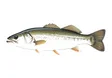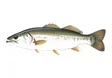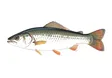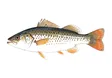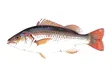
Bluespotted Sunfish

Enneacanthus gloriosus

Centrarchidae · freshwater water fish

6 minute read · Species guide

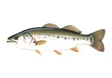
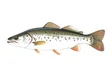
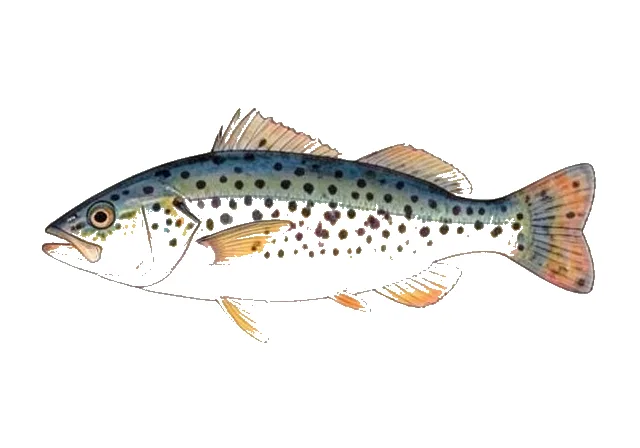
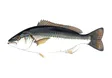
Bluespotted Sunfish field guide illustration

About Bluespotted Sunfish

The bluespotted sunfish (Enneacanthus gloriosus) is a species of fish in the family Centrarchidae, the sunfishes. It is native to the southeastern and eastern United States, its distribution extending as far north as New Jersey, Pennsylvania, and far southern New York. It is native throughout most of its range, but some populations represent introductions, such as those in Lake Ontario and the upper Susquehanna River system.

In many areas, this fish is sympatric with a closely related member of its genus, the banded sunfish (E. obesus). The two species are hard to tell apart. They are known to hybridize.

Description

This fish reaches about 9.5 centimeters (3.7 in) in maximum length. It is one of the smallest fish in its family. It has spines in its dorsal and anal fins. Its tail fin is rounded in outline. Its body is covered in white or blue dots. Some individuals have iridescent spots. There may be a few pale bars on its sides, but these are rare, especially in adults.

A number of parasitic flatworms have been observed in this fish, such as Gyrodactylus gloriosi and several Urocleidus species.

Habitat

Several aspects of the life history of the fish vary geographically. Fish on the Eastern Seaboard are larger than individuals in Mississippi, for example. The fish becomes sexually mature at larger sizes in more northern latitudes. This may be because fish in milder climates can begin reproductive investment earlier, putting their energy into gonadal growth instead of body growth at younger ages. Fish in the east can reach a maximum age around five years, but fish in the south generally do not reach that age. The spawning season is also much longer in southern regions, probably because of warmer temperatures and longer photoperiod.

This freshwater fish occupies ponds, lakes, creeks, streams, and medium-sized rivers. It can tolerate slightly brackish water in areas near the coast. It thrives in small backwaters filled with vegetation and tree roots.

Reproduction

The fish spawns several times in a season, sometimes daily for a long period of time. The male builds a nest in the substrate or in plant matter. Clutch sizes of 42 to 216 have been observed.

Diet

The diet of the fish is rich in plankton. It consumes cyclopoid copepods, water fleas, midge larvae, ostracods, amphipods, and snails. Its preference for tiny aquatic larvae makes it a suitable mosquito control agent.

Article text: Wikipedia contributors, Bluespotted sunfish (source revision). Licensed under CC BY-SA 4.0. Retrieved 2026-10-11.
Diet and feeding

The FishTraits compilation records these diet categories for this species: aquatic or other vascular plants; invertebrates or larval fish. These are broad categories, not a claim that every individual consumes every example in a category.

Reported feeding positions include bottom feeding and surface or water-column feeding. The compilation combines published observations; diets can vary with age, locality, and available food.

Habitat preferences

Reported habitat associations include streams and small rivers, creeks, still-water habitats.

The source records associations with muck, clay or silt, sand, vegetation, organic debris, large woody material. An association indicates reported use, rather than an exclusive requirement.

Reproduction and parental care

The compilation reports a representative maturity age of 2 years. Its maturity field summarizes mean, median, or modal estimates, usually for females; male estimates can be used when female data are unavailable. It is not a fixed age at which every fish first breeds.

Batch or serial spawning has been reported somewhere in the species’ range. This does not establish the same spawning pattern for every population.

Recorded spawning months are Jul, Aug, Sep for the source’s reporting region (NJ). This is a regional calendar, not a range-wide schedule.

The reproductive-guild classification includes guarding eggs or young at a spawning substrate or nest.

Size and recorded longevity

FishTraits reports a maximum total length of 9.5 centimetres. Some entries use an estimated asymptotic length; this value should not be treated as a certified record catch.

Recorded longevity in the compilation is 6 years. Wild observations were preferred, but captive records were accepted where wild records were unavailable, and unspecified records were assumed wild. The value is not a guaranteed wild lifespan or an aquarium life expectancy.

Identification and appearance

The bluespotted sunfish has a single dorsal fin, spines present in the dorsal and anal fins, three anal spines, a rounded caudal fin, a dark, vertical bar below each eye, middle and rear dorsal spines of approximately equal length, 18 or less scale rows around caudal peduncle, light spots on sides (blue to white in life), and vertical bars that are generally lacking, but if present, indistinct and numbering five or less. For further identification details, see Smith (1985); Page and Burr (1991); Jenkins and Burkhead (1994); Mettee et al. (1996).

Native range

Atlantic and Gulf Slope drainages below Fall Line from southern New York to lower Tombigbee River, Alabama, south to southern Florida; above Fall Line in New York and Pennsylvania (Page and Burr 1991).

Habitat and ecology

The preferred habitats for the bluespotted sunfish are oxbows and side ponds characterized by dense submerged aquatic vegetation (Peterson and Vanderkooy 1997). Enneacanthus gloriosus is an opportunistic forager in areas with submerged aquatic vegetation and exhibits no seasonal pattern of prey consumption (Snyder and Peterson 1980). Bluespotted sunfish is planktivorous, feeding primarily on cyclopoid copepods, cladocerans, chironomid larvae, and ostracods, or similar invertebrate assemblages throughout their range (Snyder and Peterson 1999). In New York and New Jersey, E. gloriosus had a protracted spawning season, extending from late spring through summer (Snyder 1999). In Mississippi, spawning occurred from mid-April thorugh September, and in Florida, spawning occurred between April and October. Snyder (1999) also found that bluespotted sunfish in Florida and Mississippi spawned during their first year of life at <30 mm TL, whereas specimens from New England were found to spawn in their second year between 40 and 50 mm. These fish have been found to adopt a crepuscular feeding pattern in both laboratory and field observations (Casterlin and Reynolds 1980).

Introduction history

The presence of this species in the Jamesville Reservoir is probably due to an aquarium release sometime between 1951 and 1966 (Werner 1972). However, it is theoretically possible that the species migrated up from the Hudson River, through the Erie or Barge Canal, to Oneida Lake, then up the Chittenango River and Butternut Creek into Jamesville Reservoir. Although Werner (1972) states that no specimens have ever been collected in the intervening area, there is a collection from Oneida Lake dating back to 1916; the only other collection in the Great Lakes basin (Smith 1985). These fish may either represent a relict population or an introduction earlier than what was calculated in Jamesville Reservoir (Smith 1985). One factor against the canal migration hypothesis is that there is a 2–3 m-high weir with which a fish moving upstream from Oneida Lake to Jamesville Reservoir would have to contend (Werner 1972). Jamesville Reservoir was created in 1874, the same year the Erie Canal opened (Werner 1972). The origin of the Pennsylvania fish is unknown. They may be either natural populations or accidental introductions. Because this species is sometime kept as an aquarium species, aquarium release is a possible means of introductions in Pennsylvania (Denoncourt et al. 1975). Unknown means of introduction for the Big Black River drainage, Mississippi.

Range

Where it lives

Share of 4,963 GBIF observation records with a state location, across 14 states. The orange dots are USGS stream-survey sites where this species was caught.
0%
38.2%
Share of 4,963 GBIF observation records with a state location, across 14 states. The orange dots are USGS stream-survey sites where this species was caught.

A blank area on the dot layer usually means nobody sampled there, not that the fish is absent. Turn on “every survey site” to see where the survey looked.

The USGS stream survey caught it at 310 of its sites, in 10 states. That survey and the GBIF records are two different counts of two different things, so the site keeps them apart.

Habitat

Water and movement

Water
WoRMS records this species in fresh water.
USGS NAS habitat
Freshwater
US status
Native transplant — native to part of the United States, moved to other waters inside it.
Migration
Not migratory

Classification

Taxonomy

Kingdom
Animalia
Phylum
Chordata
Superclass
Actinopterygii
Class
Teleostei
Order
Perciformes
Genus
Enneacanthus
Species
Enneacanthus gloriosus
ITIS TSN
168113
WoRMS AphiaID
1165234
GBIF key
2394551

Common questions about Bluespotted Sunfish

What is the scientific name of Bluespotted Sunfish?
The scientific name is Enneacanthus gloriosus, in the family Centrarchidae. Classification follows ITIS.
Does Bluespotted Sunfish live in fresh water or salt water?
WoRMS records this species in fresh water.
Where has Bluespotted Sunfish been recorded in the United States?
GBIF has observations in 14 states, with the most records in Florida, North Carolina, New Jersey. The map shows observation records, which do not establish the complete natural range.

Closest relatives

Other Enneacanthus species

Same family

More Centrarchidae

Alabama Bass11 states
Micropterus henshalliCentrarchidaeNative and introducedFresh
Banded Sunfish15 states
Enneacanthus obesusCentrarchidaeNativeFresh
Bantam Sunfish12 states
Lepomis symmetricusCentrarchidaeNativeFresh
Black Crappie49 states
Pomoxis nigromaculatusCentrarchidaeNative and introducedFresh
Blackbanded Sunfish8 states
Enneacanthus chaetodonCentrarchidaeNativeFresh
Bluegill49 states
Lepomis macrochirusCentrarchidaeNative and introducedFresh
Cahaba Bass1 states
Micropterus cahabaeCentrarchidaeNativeFresh
Chattahoochee Bass2 states
Micropterus chattahoochaeCentrarchidaeNativeFresh
Dollar Sunfish18 states
Lepomis marginatusCentrarchidaeNativeFresh
Flier18 states
Centrarchus macropterusCentrarchidaeNativeFresh
Florida Largemouth Bass9 states
Micropterus floridanusCentrarchidaeNative and introducedFresh
Green Sunfish46 states
Lepomis cyanellusCentrarchidaeNative and introducedFresh
Guadalupe Bass2 states
Micropterus treculiiCentrarchidaeNative and introducedFresh
Largemouth Bass48 states
Micropterus salmoidesCentrarchidaeNative and introducedFresh
Lepomis solis7 states
CentrarchidaeNative
Longear Sunfish31 states
Lepomis megalotisCentrarchidaeNative and introducedFresh
Mud Sunfish11 states
Acantharchus pomotisCentrarchidaeNativeFresh
Northern Sunfish8 states
Lepomis peltastesCentrarchidaeNativeFresh
Orangespotted Sunfish27 states
Lepomis humilisCentrarchidaeNative and introducedFresh
Ozark Bass3 states
Ambloplites constellatusCentrarchidaeNativeFresh
Pumpkinseed46 states
Lepomis gibbosusCentrarchidaeNative and introducedFreshBrackish
Redbreast Sunfish29 states
Lepomis auritusCentrarchidaeNative and introducedFresh
Redear Sunfish37 states
Lepomis microlophusCentrarchidaeNative and introducedFresh
Redeye Bass12 states
Micropterus coosaeCentrarchidaeNative and introducedFresh

All 40 species in Centrarchidae