Yellow Bullhead

Ameiurus natalis

Ictaluridae · freshwater water fish

6 minute read · Species guide

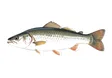
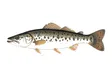
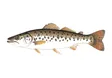
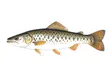
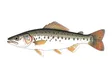
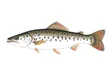
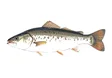
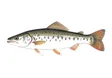
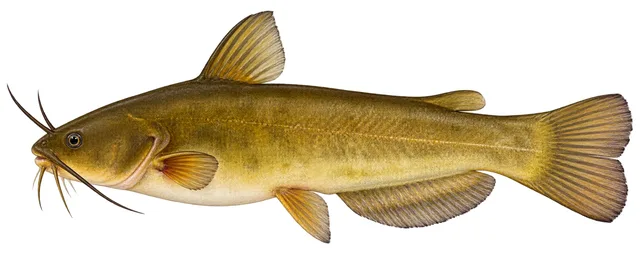
Yellow Bullhead field guide illustration

About Yellow Bullhead

The yellow bullhead (Ameiurus natalis) is a species of bullhead catfish, a ray-finned fish that lacks scales.

Description

The yellow bullhead is a medium-sized member of the catfish family. It is typically yellow-olive to slate black on the back and may appear mottled depending on its habitat, though generally not as strongly as the brown bullhead (Ameiurus nebulosus). The sides are lighter and more yellowish, while the underside of the head and body are bright yellow, yellow white, or bright white. The rear edge of its caudal fin is rounded. The anal fin has anywhere between 24 and 27 constituent rays, more than that of other bullheads. The yellow bullhead can be easily distinguished from A. nebulosus and the black bullhead (A. melas) by the group of white barbels or "whiskers" under its chin. The pectoral spines are barbed posteriorly like those of the brown bullhead. Unlike flathead catfish (Pylodictis olivaris), there are no lateral extensions present on the upper (premaxillary) tooth patch. Its eyes are generally smaller than those of the snail bullhead (A. brunneus) or the flat bullhead (A. platycephalus) and there is no blotch at the base of the dorsal fin.

Yellow bullheads are medium-sized bullheads that rarely grow larger than 2 lb (0.91 kg), but can reach up to 6 lb 6 oz (2.89 kg). Yellow bullheads may grow to a maximum total length (TL) of 60 centimetres (24 in), though they are more commonly 22.5 centimetres (8.9 in) TL, and can live up to 12 years.

Diet

The yellow bullhead is a voracious scavenger that will almost eat anything. It locates prey by brushing the stream bottom with its barbels. Taste buds on the barbels tell the yellow bullhead whether or not contact is made with edible prey. They typically feed at night on a variety of plant and animal material, both live and dead, most commonly consisting of worms, insects, snails, minnows, clams, crayfish, other small aquatic organisms, plant matter, and decaying animal matter. Compared to black and brown bullheads, yellow bullheads consume more aquatic vegetation.

Habitat

Yellow bullhead are bottom dwellers, living in areas with muck, rock, sand, or clay substrates. Its habitat includes river pools, backwaters, and sluggish current over soft or mildly rocky substrate in creeks, small to larger rivers, and shallow portions of lakes and ponds. Their habitat can vary from a slow current with poorly oxygenated, highly silted, and highly polluted water to a more swift current with clean and clear water that has aquatic vegetation. Fishermen often find them in sluggish creeks and rivers with a gravel bottom.

Reproduction and life cycle

Bullheads have a monogamous relationship with spawning beginning in mid-May or early-June, with both sexes participating in nest-building. Bullheads usually use a natural cavity or make saucer-shaped depressions near submerged cover, such as tree roots or sunken logs. The female will lay anywhere from 300 to 700 eggs at a time in a gelatinous mass, with up to 4300 eggs deposited into the nest in total. After fertilization the male protects and continually fans the nest of eggs. The eggs hatch in 5 to 7 days on average. Young fry are herded into tight schools by the male and are protected by both parents until they are approximately two inches long. They grow to about three inches by one year of age. Sexual maturity is achieved after two to three years, by which time the fish have reached 140 millimetres (5.5 in) in length.

Distribution

Yellow bullhead have a wide range across the central and eastern US from the Rio Grande River to North Dakota and south-eastern Canada, and east through the Great Lakes region to the East Coast. They have also been introduced to the West and can be caught as far up as northern Washington state.

Ecology

Ameiurus natalis can serve as a host to the glochidia —larvae of freshwater mussels of family Unionidae —of Cyclonaias tuberculata, Tritogonia verrucosa and Strophitus undulatus. It is additionally parasitized by leeches.

Angling

Yellow bullheads are considered a minor game fish, and their meat is considered sweet and has a good flavor, but the meat can become soft in summer. They are not as sought after as other catfish. They can be caught on natural baits such as worms, crickets or chicken liver fished on the bottom at night.

Etymology

Named both Ictalurus natalis and Ameiurus natalis. Ictalurus, Greek, meaning "fish cat"; Ameiurus, Greek, meaning "privative curtailed,"in reference to the caudal fin lacking a notch; natalis, Latin, meaning"of birth." Charles Alexandre Lesueur, when he originally described the species in 1819, invented a common name Pimelode Noël, which likely commemorates the naturalist Simon Barthélemy Joseph Noël de la Morinière (1765–1822) and also may be the source of the specific name he assigned (from French: Noel), though it was not explicitly stated in either case.

Article text: Wikipedia contributors, Yellow bullhead (source revision). Licensed under CC BY-SA 4.0. Retrieved 2026-10-11.
Diet and feeding

The FishTraits compilation records these diet categories for this species: algae or phytoplankton; aquatic or other vascular plants; detritus or unidentified plant material; invertebrates or larval fish; larger animal prey (a source category covering fish, crayfish, crabs, or frogs); fish or frog eggs. These are broad categories, not a claim that every individual consumes every example in a category.

Reported feeding positions include bottom feeding and surface or water-column feeding. The compilation combines published observations; diets can vary with age, locality, and available food.

Habitat preferences

Reported habitat associations include medium to large rivers, streams and small rivers, creeks, still-water habitats.

The source records associations with clay or silt, sand, gravel, cobble, boulders, bedrock, vegetation, organic debris, large woody material. An association indicates reported use, rather than an exclusive requirement.

Reproduction and parental care

The compilation reports a representative maturity age of 2.5 years. Its maturity field summarizes mean, median, or modal estimates, usually for females; male estimates can be used when female data are unavailable. It is not a fixed age at which every fish first breeds.

Batch or serial spawning has been reported somewhere in the species’ range. This does not establish the same spawning pattern for every population.

Recorded spawning months are Apr, May for the source’s reporting region (NC). This is a regional calendar, not a range-wide schedule.

The reproductive-guild classification includes guarding eggs or young at a spawning substrate or nest.

Size and recorded longevity

FishTraits reports a maximum total length of 47 centimetres. Some entries use an estimated asymptotic length; this value should not be treated as a certified record catch.

Recorded longevity in the compilation is 7 years. Wild observations were preferred, but captive records were accepted where wild records were unavailable, and unspecified records were assumed wild. The value is not a guaranteed wild lifespan or an aquarium life expectancy.

Identification and appearance

Yellow Bullhead is superficially similar to Black Bullhead (Ameiurus melas) and Brown Bullhead (A. nebulosus). Yellow Bullhead can be distinguished from both species by the presence of white or yellow chin barbels (vs. dusky or black), a nearly straight caudal fin margin (vs. slightly notched), and a long, nearly straight anal fin with 24 or more rays (vs. short, rounded anal fin with 23 or fewer). Yellow Bullhead can be distinguished from Black Bullhead by the presence of saw-like teeth on the posterior edge of the pectoral spine (vs. lack of teeth). Yellow Bullhead can be distinguished from Brown Bullhead by a uniform yellow-brown color or a slight gradient from dark to bright yellow from top to bottom (vs. strong mottled coloration).

Native range

Atlantic and Gulf Slope drainages from New York to northern Mexico, and St. Lawrence-Great Lakes and Mississippi River basins from southern Quebec west to central North Dakota, and south to Gulf (Page and Burr 1991).

Introduction history

Intentionally stocked.

Ecological impacts

Introduced predatory fishes, including the Yellow Bullhead, are likely at least partially responsible for the decline of the Chiricahua leopard frog Lithobates chiricahuensis in southeastern Arizona (Rosen et al. 1995), and have been shown to reduce the abundance and diversity of native prey species in several Pacific Northwest rivers (Hughes and Herlihy 2012).

Record fish

State records in 7 states

  • Florida5.05 lb

    Crystal River · Citrus County · 12/17/2010 · Tom Flynn

  • Georgia4 lb, 15 oz

    Ogeechee River · October 12, 2003 · Glenn Settles

  • Arkansas4 lbs., 9 oz.

    Blue Bayou · 05/22/2005 · Joshua Rosenbaum, Nashville, AR · other legal means

  • Wisconsin4 lbs. 5 oz.

    White Mound Park Lake · Sauk · 08/06/2021

  • Minnesota3 lb 10 oz

    Lake Osakis · Todd · 8/5/2002

  • Arkansas2 lbs., 7 oz.

    Private lake · 09/21/2014 · Jackie R. Mullins, Texarkana, AR · rod and reel

  • Oklahoma2 lbs 5.00 ozs

    Okfuskee Co. Pond · 05/03/2014 · Nathan Williams · rod and line

  • Montana1.910 lbs.

    Tongue River Reservoir · 12/17/20 · Roberta Legge

Each figure is the state agency’s own certified record. The site holds record tables for 11 states so far, so a state missing here has not been read yet. It is not a state where this fish holds no record.

Range

Where it lives

Share of 34,872 GBIF observation records with a state location, across 48 states. The orange dots are USGS stream-survey sites where this species was caught.
0%
22.9%
Share of 34,872 GBIF observation records with a state location, across 48 states. The orange dots are USGS stream-survey sites where this species was caught.

A blank area on the dot layer usually means nobody sampled there, not that the fish is absent. Turn on “every survey site” to see where the survey looked.

The USGS stream survey caught it at 6,851 of its sites, in 42 states. That survey and the GBIF records are two different counts of two different things, so the site keeps them apart.

Habitat

Water and movement

Water
WoRMS records this species in fresh water.
USGS NAS habitat
Freshwater
US status
Native transplant — native to part of the United States, moved to other waters inside it.
Migration
Not migratory

Classification

Taxonomy

Kingdom
Animalia
Phylum
Chordata
Superclass
Actinopterygii
Class
Teleostei
Order
Siluriformes
Genus
Ameiurus
Species
Ameiurus natalis
ITIS TSN
164041
WoRMS AphiaID
154201
GBIF key
2340969
Outside the US
ITIS also files it in Canada, Mexico.

Common questions about Yellow Bullhead

What is the scientific name of Yellow Bullhead?
The scientific name is Ameiurus natalis, in the family Ictaluridae. Classification follows ITIS.
Does Yellow Bullhead live in fresh water or salt water?
WoRMS records this species in fresh water.
Where has Yellow Bullhead been recorded in the United States?
GBIF has observations in 48 states, with the most records in Minnesota, Pennsylvania, Texas. The map shows observation records, which do not establish the complete natural range.

Closest relatives

Other Ameiurus species

Same family

More Ictaluridae

Black Bullhead46 states
Ameiurus melasIctaluridaeNative and introducedFresh
Black Madtom5 states
Noturus funebrisIctaluridaeNativeFresh
Black River Madtom2 states
Noturus maydeniIctaluridaeNativeFresh
Blue Catfish31 states
Ictalurus furcatusIctaluridaeNative and introducedFreshBrackish
Brindled Madtom16 states
Noturus miurusIctaluridaeNativeFresh
Brown Bullhead44 states
Ameiurus nebulosusIctaluridaeNative and introducedFresh
Brown Madtom6 states
Noturus phaeusIctaluridaeNativeFresh
Caddo Madtom1 states
Noturus tayloriIctaluridaeNativeFresh
Carolina Madtom2 states
Noturus furiosusIctaluridaeNativeFresh
Channel Catfish47 states
Ictalurus punctatusIctaluridaeNative and introducedFresh
Checkered Madtom3 states
Noturus flavaterIctaluridaeNativeFresh
Chucky Madtom1 states
Noturus crypticusIctaluridaeNativeFresh
Elegant Madtom4 states
Noturus elegansIctaluridaeNativeFresh
Flat Bullhead7 states
Ameiurus platycephalusIctaluridaeNative and introducedFresh
Flathead Catfish34 states
Pylodictis olivarisIctaluridaeNative and introducedFresh
Frecklebelly Madtom5 states
Noturus munitusIctaluridaeNativeFresh
Freckled Madtom15 states
Noturus nocturnusIctaluridaeNativeFresh
Headwater Catfish2 states
Ictalurus lupusIctaluridaeNativeFresh
Least Madtom4 states
Noturus hildebrandiIctaluridaeNativeFresh
Margined Madtom21 states
Noturus insignisIctaluridaeNative and introducedFresh
Mountain Madtom15 states
Noturus eleutherusIctaluridaeNativeFresh
Neosho Madtom3 states
Noturus placidusIctaluridaeNativeFresh
Northern Madtom9 states
Noturus stigmosusIctaluridaeNativeFresh
Orangefin Madtom3 states
Noturus gilbertiIctaluridaeNative and introducedFresh

All 42 species in Ictaluridae