Spotted Bullhead

Ameiurus serracanthus

Ictaluridae · freshwater water fish

3 minute read · Species guide

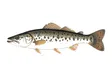
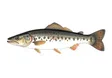
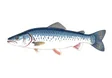
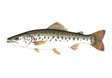
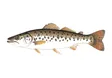
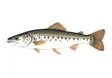
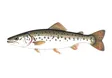
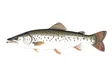
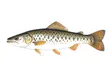
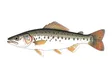
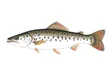
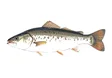
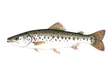
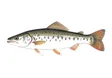
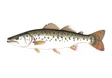
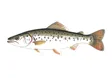
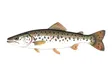
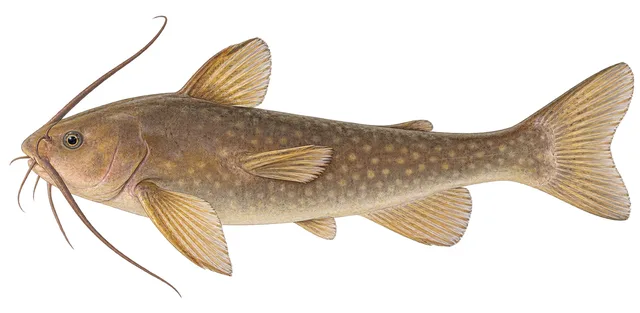
Spotted Bullhead field guide illustration

About Spotted Bullhead

The spotted bullhead (Ameiurus serracanthus) is a species of bullhead catfish endemic to the Southeastern United States.

Description

The spotted bullhead is the smallest of the bullhead catfish, with its maximum length being only 9 inches (23 cm). The spotted bullhead is one of the more striking members of the bullhead family, with its yellow or cream colored spots being its most distinguishing feature. It is a member of a group of bullhead species having a black blotch at the base of the dorsal fin and a relatively large eye. The spotted catfish has a strongly serrated pectoral spine which has 6 to 20 large serrae. All the fins are edged in black, and the caudal fin is moderately emarginate.

Distribution

The spotted bullhead has confirmed records spanning Florida's northwest, northern, central and eastern Alabama, and northern and western Georgia.

Habitat

The spotted bullhead is a freshwater demersal fish, known to inhabit mainstem and large tributaries. It inhabits rocky or sandy substrates with moderate currents and is particularly fond of deep holes in the river systems. The spotted bullhead has been occasionally spotted over mud near vegetation, stumps and impounded portions of rivers.

Diet

While no detailed studies of the diet of the spotted bullhead have been made, residents of northern Florida often refer to the spotted bullhead as "snailcat," (not to be confused with the snail bullhead) due to it being known to consume mollusks. Four different species of mollusks identified from stomach contents.

Mortality

Aside from human consumption and sport fishing the spotted bullhead may fall victim to predators such as otters and snapping turtles but it is particularly threatened by the presence of larger catfish. Bullhead catfishes are extremely vulnerable to predation by introduced species of large catfishes, such as flathead catfish and the blue catfish. Both of these species have been introduced into the Flint and Chattahoochee River systems. Population fragmentation is also a threat, particularly in heavily impounded Chattahoochee River.

Angling and human use

The spotted bullhead is not sought after commercially due to its small size, though it has been known to occasionally appear in markets for human consumption. No Office International des Epizooties (OIE)–reportable diseases have been documented for this species.

Article text: Wikipedia contributors, Spotted bullhead (source revision). Licensed under CC BY-SA 4.0. Retrieved 2026-10-11.
Diet and feeding

The FishTraits compilation records these diet categories for this species: algae or phytoplankton; aquatic or other vascular plants; invertebrates or larval fish; larger animal prey (a source category covering fish, crayfish, crabs, or frogs). These are broad categories, not a claim that every individual consumes every example in a category.

Reported feeding positions include bottom feeding. The compilation combines published observations; diets can vary with age, locality, and available food.

Habitat preferences

Reported habitat associations include streams and small rivers.

The source records associations with muck, sand, gravel, cobble, boulders, vegetation. An association indicates reported use, rather than an exclusive requirement.

Reproduction and parental care

The compilation reports a representative maturity age of 3 years. Its maturity field summarizes mean, median, or modal estimates, usually for females; male estimates can be used when female data are unavailable. It is not a fixed age at which every fish first breeds.

Batch or serial spawning has been reported somewhere in the species’ range. This does not establish the same spawning pattern for every population.

Recorded spawning months are Feb, Mar, Apr, May, Jun, Jul for the source’s reporting region (Zzz). This is a regional calendar, not a range-wide schedule.

The reproductive-guild classification includes guarding eggs or young at a spawning substrate or nest.

Size and recorded longevity

FishTraits reports a maximum total length of 28 centimetres. Some entries use an estimated asymptotic length; this value should not be treated as a certified record catch.

Recorded longevity in the compilation is 6 years. Wild observations were preferred, but captive records were accepted where wild records were unavailable, and unspecified records were assumed wild. The value is not a guaranteed wild lifespan or an aquarium life expectancy.

Range

Where it lives

Share of 422 GBIF observation records with a state location, across 4 states.
0%
76.1%
Share of 422 GBIF observation records with a state location, across 4 states.

Habitat

Water and movement

Water
WoRMS records this species in fresh water.
Migration
Not migratory

Classification

Taxonomy

Kingdom
Animalia
Phylum
Chordata
Superclass
Actinopterygii
Class
Teleostei
Order
Siluriformes
Genus
Ameiurus
Species
Ameiurus serracanthus
ITIS TSN
164047
WoRMS AphiaID
1013317
GBIF key
2340987

Common questions about Spotted Bullhead

What is the scientific name of Spotted Bullhead?
The scientific name is Ameiurus serracanthus, in the family Ictaluridae. Classification follows ITIS.
Does Spotted Bullhead live in fresh water or salt water?
WoRMS records this species in fresh water.
Where has Spotted Bullhead been recorded in the United States?
GBIF has observations in 4 states, with the most records in Florida, Georgia, Alabama. The map shows observation records, which do not establish the complete natural range.

Closest relatives

Other Ameiurus species

Same family

More Ictaluridae

Black Bullhead46 states
Ameiurus melasIctaluridaeNative and introducedFresh
Black Madtom5 states
Noturus funebrisIctaluridaeNativeFresh
Black River Madtom2 states
Noturus maydeniIctaluridaeNativeFresh
Blue Catfish31 states
Ictalurus furcatusIctaluridaeNative and introducedFreshBrackish
Brindled Madtom16 states
Noturus miurusIctaluridaeNativeFresh
Brown Bullhead44 states
Ameiurus nebulosusIctaluridaeNative and introducedFresh
Brown Madtom6 states
Noturus phaeusIctaluridaeNativeFresh
Caddo Madtom1 states
Noturus tayloriIctaluridaeNativeFresh
Carolina Madtom2 states
Noturus furiosusIctaluridaeNativeFresh
Channel Catfish47 states
Ictalurus punctatusIctaluridaeNative and introducedFresh
Checkered Madtom3 states
Noturus flavaterIctaluridaeNativeFresh
Chucky Madtom1 states
Noturus crypticusIctaluridaeNativeFresh
Elegant Madtom4 states
Noturus elegansIctaluridaeNativeFresh
Flat Bullhead7 states
Ameiurus platycephalusIctaluridaeNative and introducedFresh
Flathead Catfish34 states
Pylodictis olivarisIctaluridaeNative and introducedFresh
Frecklebelly Madtom5 states
Noturus munitusIctaluridaeNativeFresh
Freckled Madtom15 states
Noturus nocturnusIctaluridaeNativeFresh
Headwater Catfish2 states
Ictalurus lupusIctaluridaeNativeFresh
Least Madtom4 states
Noturus hildebrandiIctaluridaeNativeFresh
Margined Madtom21 states
Noturus insignisIctaluridaeNative and introducedFresh
Mountain Madtom15 states
Noturus eleutherusIctaluridaeNativeFresh
Neosho Madtom3 states
Noturus placidusIctaluridaeNativeFresh
Northern Madtom9 states
Noturus stigmosusIctaluridaeNativeFresh
Orangefin Madtom3 states
Noturus gilbertiIctaluridaeNative and introducedFresh

All 42 species in Ictaluridae