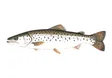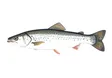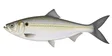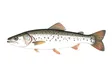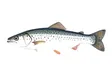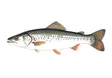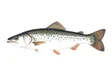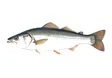
Skipjack Shad

Alosa chrysochloris

Clupeidae · freshwater and saltwater and brackish water fish

8 minute read · Species guide

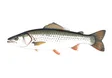
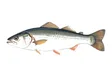
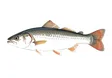
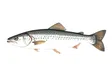
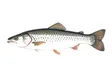
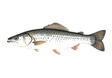
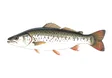
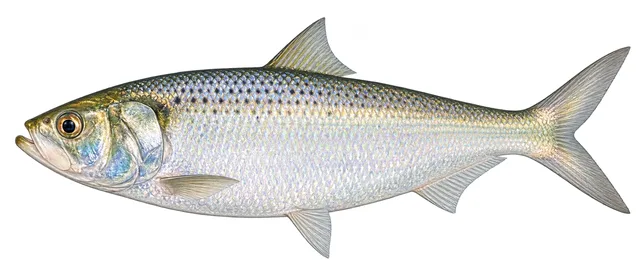
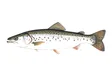
Skipjack Shad field guide illustration

About Skipjack Shad

The skipjack herring (Alosa chrysochloris) is a North American, migratory, fresh and brackish water fish species in the herring family Alosidae. The name skipjack shad comes from the fact that it is commonly seen leaping out of the water while feeding. Other common names include blue herring, golden shad, river shad, Tennessee tarpon, and McKinley shad. The skipjack shad is restricted to the Gulf of Mexico drainage basins. Skipjack are found in clear to moderately turbid water in areas with flow. Because they are a migratory species, dams often impede their reproduction. Records suggest that this species was much more abundant in the Upper Mississippi River basin before it was impounded. Currently, skipjack is most abundant in the upper Mississippi River below the mouth of the Ohio River. They are known as an "early-run" species, as they migrate to spawn in the early spring.

Distribution

Currently skipjack herring are restricted to the Gulf of Mexico and its drainage, in the United States. The Gulf of Mexico drainage includes the Mobile River basin, the ACF basin (Apalachicola / Chattahoochee / Flint River), the Mississippi basin, and the Rio Grande basin. Records indicate that this species was more abundant in the upper Mississippi River before it was impounded, and currently skipjack herring are most abundant in the upper Mississippi River below the mouth of the Ohio River. In recent years, human modifications to the middle Missouri River have made conditions more favorable for skipjack shad and their distribution has expanded upstream to the Nebraska-South Dakota border. Skipjack herring were historically found in the northern upper Mississippi River and the St. Croix River; however, there have only been four records of skipjack shad in Wisconsin waters since the 1950s. Because this fish is a migratory species, dams have diminished its distribution. It cannot continue to migrate northward over dams; therefore it is rare to see a skipjack in the upper reaches of the Gulf of Mexico drainages.

Ecology

Skipjack herring are a migratory schooling species. They are a euryhaline species that can enter brackish and freshwater bodies. They can be anadromous but are not obligated to be because they can complete their life cycle in freshwater. Skipjack shad are strongly migratory within rivers and prefer fast flowing water where they are renowned for leaping. They are found in clear to moderately turbid waters in large rivers and reservoirs usually within the current over sand or gravel. In one study, skipjack herring have been found to feed on other shad/herring species such as the threadfin shad, the gizzard shad and young of the year herring species. In some extreme cases, it was shown that they could rely on cannibalism to survive. They are also known to feed on small fishes, mostly shad, while the juveniles feed on insects. The maximum size of the shad/herring utilized by skipjack shad was found to be about 30–35% of the skipjack's body length. There is not much data on the predators of the skipjack shad. Larger fish species, seabirds, and humans prey upon them. In fact, it is shown that fish species in the family Clupeidae including the skipjack herring comprise up to 45% of the diet of these avian species.

Life history

The spawning season for skipjack herring is from early March to late April in the southern extent of its range. In the upper Mississippi river drainage spawning time is from early May to early July. Females produce about 100,000 to 300,000 eggs per year, presumably after 2 to 3 years of growth with an average size being 11.8 inches (30 cm) Spawning is thought to occur in the depths of main channel over coarse sand-gravel bars. Spawning temperature range is between 16 and 21 °C (61 and 70 °F). Eggs are broadcast over the substrate. Skipjack shad young may reach total lengths of 75–150 millimetres (3.0–5.9 in) during their first year. The maximum length in adults is 20 inches, but they are most commonly found to be between 12 and 18 inches (300–460 mm). The oldest specimen of skipjack herring reported was four years old. High population rates and the fact that there it has little to no interest to fisheries tells us that humans do not have much influence on life history. Impoundments have changed their distribution slightly, but they have no trouble spawning as a result.

Management

Human impacts on skipjack herring populations seem to be minimal in the southern parts of their distribution. Dams have limited the natural distribution of the species. Skipjacks are no longer found in high numbers in the northern reaches of their distribution because of their inability to migrate over large impoundments. The Minnesota Department of Natural Resources (DNR) webpage tells us that "Further research into the species' life history and ecological requirements is needed. It is known that lock and dam structures hinder migration of skipjack herring during the early spring. If the skipjack herring is to be reestablished in Minnesota and Wisconsin, where they are nearly extirpated, fish passage features such as ladders or lifts will be required on Mississippi River lock and dams." In Minnesota, the construction of a fish passage facility is being considered at U.S. Lock and Dam 3 near Red Wing and could help skipjack herring migration in the Mississippi River drainage. The Minnesota DNR Division of Ecological Services received a State Wildlife Grant to conduct surveys for rare fish species in the Mississippi River from the Twin Cities to the Iowa border. These surveys were conducted from 2006 to 2008, and while the skipjack shad was a targeted species, none were found. In addition to the extirpation of the skipjack herring from Minnesota and Wisconsin, the ebony shell (Fusconaia ebena) and elephant ear (Elliptio crassidens), both state endangered mussels for which the skipjack is the sole host during their larval stages, are threatened to be extirpated as well.

In order to keep their distribution from shrinking further, humans need to decrease the number of dams that are constructed, or construct dams that skipjack shads are able to migrate through. In addition to hindering their migration, dams reduce flow. Skipjacks prefer areas with fast flowing water. In addition, it is necessary to keep turbidity and siltation levels down, as this species will only live in waters that are clear to moderately turbid. Sampling of skipjack has been performed through the use of gillnetting and electro fishing. These methods are best utilized beneath impoundments over sand or gravel substrates around spawning time each spring, where they are most abundant. Sampling should be done across the entire native range to document its abundance in different locations and human induced changes. For now, skipjack have a stable abundance in the southern part of its distribution, and need more management plans put into place in the northernmost reaches of its distribution.

Systematics

While the skipjack shad has been attributed to the subgenus Potomolobius of the genus Alosa along with other North American shad species, it has been found to be phylogenetically the most basal of the Alosa species, which are also found in Europe and Western Asia.

Article text: Wikipedia contributors, Skipjack shad (source revision). Licensed under CC BY-SA 4.0. Retrieved 2026-10-11.
Diet and feeding

The FishTraits compilation records these diet categories for this species: invertebrates or larval fish; larger animal prey (a source category covering fish, crayfish, crabs, or frogs). These are broad categories, not a claim that every individual consumes every example in a category.

Reported feeding positions include surface or water-column feeding. The compilation combines published observations; diets can vary with age, locality, and available food.

Habitat preferences

Reported habitat associations include medium to large rivers, streams and small rivers, still-water habitats.

The source records associations with sand, gravel, open water. An association indicates reported use, rather than an exclusive requirement.

The species is classified as tolerant of a broad range of salinities. This flag does not specify a salinity range for aquarium care.

Reproduction and parental care

The compilation reports a representative maturity age of 2.5 years. Its maturity field summarizes mean, median, or modal estimates, usually for females; male estimates can be used when female data are unavailable. It is not a fixed age at which every fish first breeds.

Recorded spawning months are May, Jun for the source’s reporting region (NC). This is a regional calendar, not a range-wide schedule.

The reproductive-guild classification includes spawning on open substrates without guarding the brood.

Size and recorded longevity

FishTraits reports a maximum total length of 50 centimetres. Some entries use an estimated asymptotic length; this value should not be treated as a certified record catch.

Recorded longevity in the compilation is 4 years. Wild observations were preferred, but captive records were accepted where wild records were unavailable, and unspecified records were assumed wild. The value is not a guaranteed wild lifespan or an aquarium life expectancy.

Identification and appearance

Oblong body is a golden-green, silvery color and back is gray to dark blue with dark streaks. A dull, dark spot is present behind the head. Eye diameter is less than the snout length. Unlike Alosa pseudoharengus and A. aestevalis, this species has a distinctive protruding lower jaw and teeth on its tongue and upper and lower jaw (Becker 1983; Whitehead 1985; Page and Burr 1991; Etnier and Starnes 1993).

Native range

Red River drainage (Hudson Bay basin) and Mississippi River basin from central Minnesota south to the Gulf of America, and from southwestern Pennsylvania west to eastern South Dakota, Nebraska, Kansas, Oklahoma, and Texas; Gulf Slope drainages from the Apalachicola River, Florida, to the Colorado River, Texas (Page and Burr 1991). Populations are declining in the upper Mississippi River drainage, and Skipjack Herring is considered endangered in Wisconsin and Minnesota (WI DNR 2020; MN DNR 2021).

Habitat and ecology

The diet of the Skipjack Herring is broad, including plankton, insects, and small fishes. Populations often swim in schools and engage in communal feeding (Becker 1983; Dembkowski and Miranda 2014). Individuals often leap or “skip” from the water when in pursuit of fish. This species spawns in spring by casting eggs onto substrate, and females often migrate upstream but can be blocked by dams. Females mature after 2 or 3 years (Etnier and Starnes 1993). Fecundity ranges from 100,000–300,000 and averages 146,000 eggs per female (Jaric et al. 2015).

Introduction history

Skipjack Herring may enter the Great Lakes via natural dispersal from flooding or through constructed canals. This species occurs within 20 km of Lake Michigan, but is barred by the Aquatic Nuisance Species Barrier in the Chicago Sanitary and Ship Canal. Between 1989 and 1993, three reports of Skipjack Herring in Lake Michigan were made by Wisconsin commercial fishermen. It likely gained access to Lake Michigan via the canal prior to the construction of the Aquatic Nuisance Species Barrier (Fago 1993). Unknown in West Virginia.

Record fish

State records in 3 states

  • Oklahoma3 lbs 7.50 ozs

    Lower Canadian River · 05/01/2023 · William E. Scott · rod and line

  • Alabama3 lbs 5 oz

    Wheeler Dam Tailwater · 3/18/2020 · Chris S. Fuller, Athens

  • Alabama3 lbs 4 oz

    Mulberry Fork · 5/2/2012 · Bobby Lee Davis , Bessemer

  • Arkansas2 lbs., 14.6 oz.

    Ozark Dam · 04/08/2026 · Jeared Barnett, Ozark, AR · rod and reel

Each figure is the state agency’s own certified record. The site holds record tables for 11 states so far, so a state missing here has not been read yet. It is not a state where this fish holds no record.

Range

Where it lives

Share of 5,015 GBIF observation records with a state location, across 24 states. The orange dots are USGS stream-survey sites where this species was caught.
0%
63%
Share of 5,015 GBIF observation records with a state location, across 24 states. The orange dots are USGS stream-survey sites where this species was caught.

A blank area on the dot layer usually means nobody sampled there, not that the fish is absent. Turn on “every survey site” to see where the survey looked.

The USGS stream survey caught it at 151 of its sites, in 18 states. That survey and the GBIF records are two different counts of two different things, so the site keeps them apart.

Habitat

Water and movement

Water
WoRMS records this species in fresh water, brackish water and the sea.
USGS NAS habitat
Freshwater;Marine
US status
Native transplant — native to part of the United States, moved to other waters inside it.
Migration
Migratory
Pattern
Disagreement
6 published references do not agree on the pattern: Anadromous, Potamodromous. The site shows every assignment rather than picking one.

Classification

Taxonomy

Kingdom
Animalia
Phylum
Chordata
Superclass
Actinopterygii
Class
Teleostei
Order
Clupeiformes
Family
Clupeidae
Genus
Alosa
Species
Alosa chrysochloris
ITIS TSN
161707
WoRMS AphiaID
272250
GBIF key
2412681

Common questions about Skipjack Shad

What is the scientific name of Skipjack Shad?
The scientific name is Alosa chrysochloris, in the family Clupeidae. Classification follows ITIS.
Does Skipjack Shad live in fresh water or salt water?
WoRMS records this species in fresh water, brackish water and the sea.
Where has Skipjack Shad been recorded in the United States?
GBIF has observations in 24 states, with the most records in Texas, Florida, Georgia. The map shows observation records, which do not establish the complete natural range.

Closest relatives

Other Alosa species

Same family

More Clupeidae

Alabama Shad13 states
Alosa alabamaeClupeidaeNativeFreshSaltBrackish
Alewife29 states
Alosa pseudoharengusClupeidaeNative and introducedFreshSaltBrackish
American Gizzard Shad41 states
Dorosoma cepedianumClupeidaeNative and introducedFreshSaltBrackish
American Shad25 states
Alosa sapidissimaClupeidaeNative and introducedFreshSaltBrackish
Atlantic Herring17 states
Clupea harengusClupeidaeNativeSaltBrackish
Atlantic Menhaden19 states
Brevoortia tyrannusClupeidaeNativeSaltBrackish
Atlantic Red Herring15 states
Etrumeus teresClupeidaeNativeSalt
Atlantic Thread Herring13 states
Opisthonema oglinumClupeidaeNativeSalt
Blueback Herring21 states
Alosa aestivalisClupeidaeNative and introducedFreshSaltBrackish
Bluestripe Herring2 states
Herklotsichthys quadrimaculatusClupeidaeIntroducedFreshSaltBrackish
Dwarf Herring2 states
Jenkinsia lamprotaeniaClupeidaeNativeSalt
False Herring3 states
Harengula clupeolaClupeidaeNativeSaltBrackish
Finescale Menhaden4 states
Brevoortia gunteriClupeidaeNativeSaltBrackish
Florida Round Herring1 states
Jenkinsia stoliferaClupeidaeNativeSalt
Gulf Menhaden8 states
Brevoortia patronusClupeidaeNativeSalt
Hickory Shad15 states
Alosa mediocrisClupeidaeNativeFreshSaltBrackish
Marquesan Sardinella1 states
Sardinella marquesensisClupeidaeIntroducedSalt
Middling Thread Herring1 states
Opisthonema medirastreClupeidaeNativeSalt
Pacific Herring4 states
Clupea pallasiiClupeidaeNativeFreshSaltBrackish
Pacific Sardine5 states
Sardinops sagaxClupeidaeNativeSalt
Redear Herring5 states
Harengula humeralisClupeidaeNativeSalt
Round Sardinella12 states
Sardinella auritaClupeidaeNativeSaltBrackish
Scaled Sardine10 states
Harengula jaguanaClupeidaeNativeSaltBrackish
Threadfin Shad30 states
Dorosoma petenenseClupeidaeNative and introducedFreshSaltBrackish

All 26 species in Clupeidae