Alabama Shad

Alosa alabamae

Clupeidae · freshwater and saltwater and brackish water fish

7 minute read · Species guide

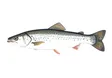
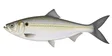
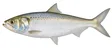
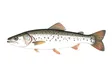
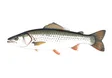
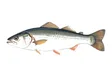
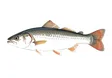
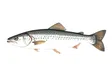
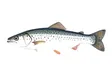
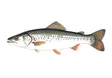
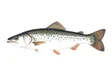
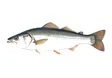
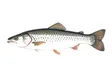
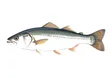
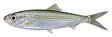
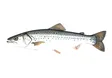
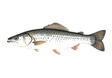
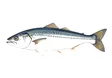
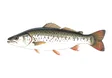
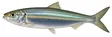
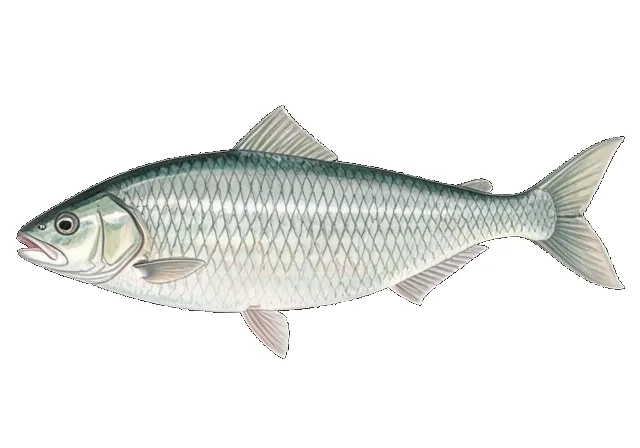
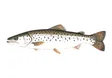
Alabama Shad field guide illustration

About Alabama Shad

The Alabama shad (Alosa alabamae) is an anadromous species of alosid fish endemic to the United States where it breeds in medium to large flowing rivers from the Mississippi River drainage to the Suwannee River, Florida, as well as some other Gulf coast drainages. The biology of this fish is little known but it has become increasingly rare. The International Union for Conservation of Nature rated it "near threatened" in 2020 and the United States National Marine Fisheries Service has listed it as a Species of Concern. A principal reason for its decline is thought to be the many locks and dams blocking access for the fish to up-river spawning grounds.

Description

The Alabama shad grows to be 12–18 inches (30–46 cm) in length and may reach 3 pounds (1.4 kg). The upper jaw of the fish bears a median notch. The Alabama shad has 42 to 48 gill rakers on the first gill arch's lower limb, which is intermediate between those of two anadromous clupeids from the Atlantic coast, the hickory shad (Alosa mediocris) and the American shad (A. sapidissima). It can be distinguished from skipjack herring (A. chrysochloris) again by its gill raker count, as well as a lower jaw that is either equal in length to or extends only slightly beyond the upper, pigmented markings on its lower jaw that extend posteriorly beyond the cusp and the presence of only one row of teeth along its tongue. The dorsal fin usually has 16 or more rays and the last ray does not extend into a filament, unlike in threadfin shad (Dorosoma petenense) and American gizzard shad (D. cepedianum).

Distribution

The Alabama shad spawns in medium to large flowing rivers from the Mississippi River drainage to the Suwannee River, Florida. They are found in some Gulf coast drainages, but are thought to be extirpated from those drainages west of the Pascagoula River drainage in Mississippi.

Ecology

Alabama shad are a schooling species. Within sandbar and channel habitat types in the Pascagoula River, Mickle (2010) found that juvenile shad preferred locations with cooler water temperatures. Juveniles remain in fresh water for the first six to eight months of their lives, feeding on small fishes and invertebrates.

Biology

The biology of the species is not well known. Spawning usually occurs around 19–23 °C (66–73 °F) in Gulf of Mexico drainages. Alabama shad historically ran as far northeast as the Monongahela River to spawn, likely in mid-June. Males seemingly weigh less than the females and mortality occurs after spawning as with numerous other species of the Alosa genus, although repeat spawning, as determined by counting of spawning marks on scales, has been described in certain drainage populations. The fish lives for approximately three or four years.

Evolution

The closest living relative of Alosa alabamae is the American shad, A. sapidissima. The ancestor of A. alabamae may have swum around the Florida peninsula and become geographically isolated no earlier than the Pleistocene epoch.

Conservation

Although once abundant enough to support commercial fisheries in Alabama, Arkansas, Kentucky, Indiana and Iowa, Alabama shad are now rare throughout much of their former range. At one point, Alosa alabamae were found in the Ohio River as well. The species is thought to have declined largely because of the many locks and dams blocking access to spawning areas and alterations in hydrology and river substrates.

The Alabama shad is a U.S. National Marine Fisheries Service Species of Concern, one of those species about which the U.S. Government's National Oceanic and Atmospheric Administration has some concerns regarding status and threats, but for which insufficient information is available to indicate a need to list the species under the U.S. Endangered Species Act (ESA). On April 20, 2010, a number of organizations submitted a petition to list the species as threatened or endangered under the ESA, which was initially rejected. On September 19, 2013, however, the National Marine Fisheries Service (NMFS) published a 90-day finding that listing under the ESA may be warranted and announced the initiation of a status review. The NMFS denied ESA listing for A. alabamae in its 12-month finding, published in 2017, though it also found that there was uncertainty in the sampling data and scarce historical data available to support a decision.

A more recent study by Rider, Powell, Dattilo & Miles (2021) concluded that the Alabama shad had likely been extirpated from the Mobile River basin and that a 98% decline in abundance occurred between 1999–2000 and 2018 in the Choctawhatchee River. They observed a small number of shad in the Conecuh River in 2010. It is likely that the largest remaining population is the one that spawns in the ACF River Basin (Apalachicola/Chattahoochee/Flint River system).

The IUCN Red List indicates A. alabamae as a near-threatened species. The American Fisheries Society lists it as threatened.

Article text: Wikipedia contributors, Alabama shad (source revision). Licensed under CC BY-SA 4.0. Retrieved 2026-10-11.
Diet and feeding

The FishTraits compilation records these diet categories for this species: algae or phytoplankton; invertebrates or larval fish. These are broad categories, not a claim that every individual consumes every example in a category.

Habitat preferences

Reported habitat associations include medium to large rivers, streams and small rivers, still-water habitats.

The source records associations with sand, gravel, open water. An association indicates reported use, rather than an exclusive requirement.

The species is classified as tolerant of a broad range of salinities. This flag does not specify a salinity range for aquarium care.

Reproduction and parental care

The compilation reports a representative maturity age of 4 years. Its maturity field summarizes mean, median, or modal estimates, usually for females; male estimates can be used when female data are unavailable. It is not a fixed age at which every fish first breeds.

Batch or serial spawning has been reported somewhere in the species’ range. This does not establish the same spawning pattern for every population.

Recorded spawning months are Feb, Mar, Apr, May for the source’s reporting region (AL). This is a regional calendar, not a range-wide schedule.

The reproductive-guild classification includes spawning on open substrates without guarding the brood.

Size and recorded longevity

FishTraits reports a maximum total length of 51 centimetres. Some entries use an estimated asymptotic length; this value should not be treated as a certified record catch.

Recorded longevity in the compilation is 6 years. Wild observations were preferred, but captive records were accepted where wild records were unavailable, and unspecified records were assumed wild. The value is not a guaranteed wild lifespan or an aquarium life expectancy.

Spawning movements

The compilation records significant spawning-related movement. Its combined migration flag covers movements within fresh water as well as between rivers and the sea; this flag alone does not establish which migration pattern applies.

NOAA Fisheries

Life history and status

ESA Candidate
Throughout Its Range
NOAA management region
Southeast

About the species

The Alabama shad is an anadromous species, carrying out life stages in both marine and freshwater environments. Alabama shad are found in the Gulf of America (formerly Gulf of Mexico), although there is very little information about their marine habitat use. As part of their anadromous life cycle, adult Alabama shad leave the Gulf, sometimes migrating several hundred kilometers, and move into freshwater rivers in the spring to spawn. Spawning typically occurs in moderate current near sandbars, limestone outcrops, or over sand substrate with water temperatures ranging from 19 to 23°C. Alabama shad have been collected in large Gulf of America drainages from the Mississippi River and several of its larger tributaries eastward to Suwannee River in Northeastern Florida.

Population status

Alabama shad historically occurred in the Mobile Basin ( i.e., Tombigbee, Black Warrior, Cahaba, Coosa, and Alabama rivers) and the Conecuh-Escambia, Yellow, and Choctawhatchee Rivers. Notably, the second largest Alabama shad population was known to occur in the Choctawhatchee River. However, recent survey efforts indicate that Alabama shad likely have been extirpated from the Mobile River Basin ( i.e., Alabama and Tombigbee Rivers), with the Conecuh and Choctawhatchee River populations have declined. It is thought that the River systems in Georgia and Florida (i.e., Apalachicola, Chattahoochee and Flint) are important to the viability of the species and that these populations may also be of concern according to the petition and 90-day finding .

Appearance

  • Alabama shad are silvery fish with a laterally compressed, fusiform body. They may be easily confused with other shad or herring. They are generalist insect feeders.

Threats

  • Threats to this species may include modification of habitat and curtailment of its range, overexploitation, disease, pollution, long-term changes in ocean conditions, and inadequacy of existing regulatory measures.

Management

NOAA Fisheries initiated a status review of this species in July 2024 in response to a petition. This status review will be used to determine whether listing the Alabama shad is threatened or endangered under the Endangered Species Act is warranted. During this time, the Alabama shad is considered a candidate species under the ESA.

Record fish

The Arkansas state record

  • Arkansas2 lbs., 13 oz.

    Ouachita River · 04/04/1997 · Monte Pascoe, Hot Springs, AR · rod and reel

Each figure is the state agency’s own certified record. The site holds record tables for 11 states so far, so a state missing here has not been read yet. It is not a state where this fish holds no record.

Range

Where it lives

Share of 465 GBIF observation records with a state location, across 13 states.
0%
51.4%
Share of 465 GBIF observation records with a state location, across 13 states.

Habitat

Water and movement

Water
WoRMS records this species in fresh water, brackish water and the sea.
Migration
Migratory
Pattern
  • Diadromous — moves between fresh water and the sea
  • Anadromous — spawns in fresh water, grows at sea

Classification

Taxonomy

Kingdom
Animalia
Phylum
Chordata
Superclass
Actinopterygii
Class
Teleostei
Order
Clupeiformes
Family
Clupeidae
Genus
Alosa
Species
Alosa alabamae
NOAA family
Alosidae
ITIS TSN
161705
WoRMS AphiaID
272248
GBIF key
2412616

Common questions about Alabama Shad

What is the scientific name of Alabama Shad?
The scientific name is Alosa alabamae, in the family Clupeidae. Classification follows ITIS.
Does Alabama Shad live in fresh water or salt water?
WoRMS records this species in fresh water, brackish water and the sea.
Where has Alabama Shad been recorded in the United States?
GBIF has observations in 13 states, with the most records in Florida, Alabama, Louisiana. The map shows observation records, which do not establish the complete natural range.

Closest relatives

Other Alosa species

Same family

More Clupeidae

Alewife29 states
Alosa pseudoharengusClupeidaeNative and introducedFreshSaltBrackish
American Gizzard Shad41 states
Dorosoma cepedianumClupeidaeNative and introducedFreshSaltBrackish
American Shad25 states
Alosa sapidissimaClupeidaeNative and introducedFreshSaltBrackish
Atlantic Herring17 states
Clupea harengusClupeidaeNativeSaltBrackish
Atlantic Menhaden19 states
Brevoortia tyrannusClupeidaeNativeSaltBrackish
Atlantic Red Herring15 states
Etrumeus teresClupeidaeNativeSalt
Atlantic Thread Herring13 states
Opisthonema oglinumClupeidaeNativeSalt
Blueback Herring21 states
Alosa aestivalisClupeidaeNative and introducedFreshSaltBrackish
Bluestripe Herring2 states
Herklotsichthys quadrimaculatusClupeidaeIntroducedFreshSaltBrackish
Dwarf Herring2 states
Jenkinsia lamprotaeniaClupeidaeNativeSalt
False Herring3 states
Harengula clupeolaClupeidaeNativeSaltBrackish
Finescale Menhaden4 states
Brevoortia gunteriClupeidaeNativeSaltBrackish
Florida Round Herring1 states
Jenkinsia stoliferaClupeidaeNativeSalt
Gulf Menhaden8 states
Brevoortia patronusClupeidaeNativeSalt
Hickory Shad15 states
Alosa mediocrisClupeidaeNativeFreshSaltBrackish
Marquesan Sardinella1 states
Sardinella marquesensisClupeidaeIntroducedSalt
Middling Thread Herring1 states
Opisthonema medirastreClupeidaeNativeSalt
Pacific Herring4 states
Clupea pallasiiClupeidaeNativeFreshSaltBrackish
Pacific Sardine5 states
Sardinops sagaxClupeidaeNativeSalt
Redear Herring5 states
Harengula humeralisClupeidaeNativeSalt
Round Sardinella12 states
Sardinella auritaClupeidaeNativeSaltBrackish
Scaled Sardine10 states
Harengula jaguanaClupeidaeNativeSaltBrackish
Skipjack Shad24 states
Alosa chrysochlorisClupeidaeNative and introducedFreshSaltBrackish
Threadfin Shad30 states
Dorosoma petenenseClupeidaeNative and introducedFreshSaltBrackish

All 26 species in Clupeidae