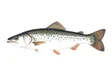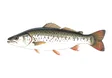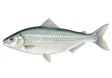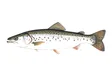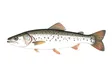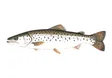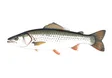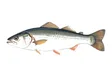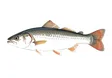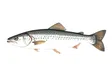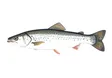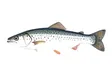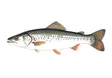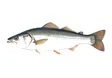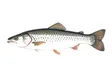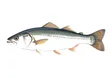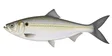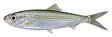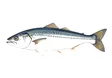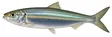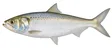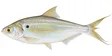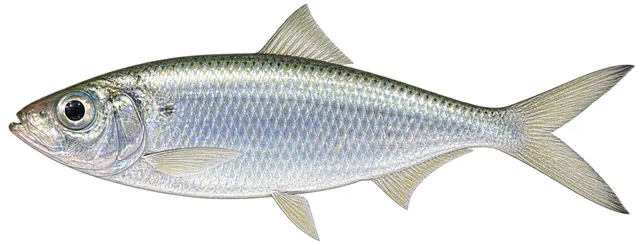
It has a solid back with dark streaks and usually a small dark spot at the upper edge of the operculum and sometimes one located at the shoulder. It grows up to 9 inches (23 cm) in length but typically is little more than half that size.
Scaled sardines are often referred to by anglers as greenbacks, though that common name can also refer to the Atlantic threadfin herring (or Atlantic thread herring). They can usually be caught with strings of wire loops known as minnow rings, sabiki rigs or by cast netting.
They are taken by anglers for use as bait or for personal consumption.
Additional field notes
Scaled sardine, also called scaled herring, is a silvery coastal schooling fish. It is a different species from the Pacific sardine and should be checked under its scientific name, Harengula jaguana.
Sources: Harengula jaguana species account
Field identification notes
The body is relatively deep for its length, with a forked tail and a short anal-fin base. A dark shoulder mark lies behind the top of the gill cover. The upper body is blue-black and the sides are silver. A row of keeled, bony scales along the belly is another structural clue.
Sources: Harengula jaguana species account
Habitat and range notes
The Smithsonian places it in coastal water over sand and mud, often in estuaries and hypersaline lagoons. The regional range extends from New Jersey to Brazil. Its pelagic habitat means it occupies the water column even where the bottom beneath a school is shallow.
Sources: Harengula jaguana species account
Feeding and life-history notes
Animal plankton is the food category recorded in the account. Its eggs and larvae are pelagic. A shoulder spot and silvery body occur in several small herrings, so identification should also consider body depth, fin placement, and the belly scutes.
Sources: Harengula jaguana species account
Guide sources
Research reviewed 2026-10-17.
- Harengula jaguana species account — Smithsonian Tropical Research Institute
Article text: Wikipedia contributors, Scaled sardine (source revision). Licensed under CC BY-SA 4.0. Retrieved 2026-10-11.