Blueback Herring

Alosa aestivalis

Clupeidae · freshwater and saltwater and brackish water fish

7 minute read · Species guide

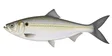
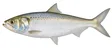
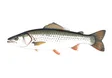
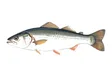
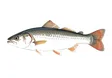
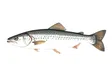
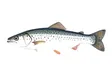
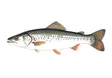
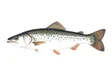
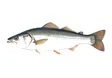
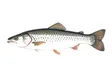
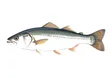
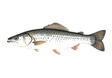
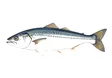
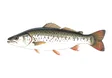
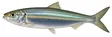
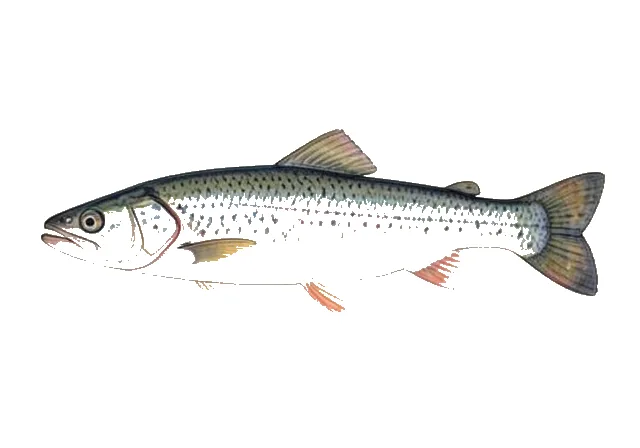
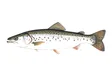
Blueback Herring field guide illustration

About Blueback Herring

The blueback herring, blueback shad, or summer shad (Alosa aestivalis) is an anadromous species of herring from the east coast of North America, with a range from Nova Scotia to Florida. Blueback herring form schools and are believed to migrate offshore to overwinter near the bottom.

These fish are silvery in color, have a series of scutes (modified, spiny and keeled scales) along their bellies, and are characterized by deep bluish-green backs. They reach a maximum size of approximately 40 centimetres (16 in) and are believed to live up to 8 years. The most distinguishing characteristic of this species is the black to dusky color of its peritoneum (the lining of the abdominal cavity). It is one of the "typical"North American shads. They are often confused with alewifes because blueback shad and alewives are difficult to distinguish from one another, and together these two species are often regarded collectively as"river herring". Alewives have larger eyes, greater body depth, and pearly to white peritoneal linings.

This fish has, in the past, been used as a baitfish for the lobster fishing industry. It is also used for human consumption, usually smoked. It is caught (during its migration up stream) using large dip nets to scoop the fish out of shallow, constricted areas on its migratory streams and rivers.

Range

The native range of this fish is found along the Atlantic Coast from Cape Breton, Nova Scotia, to the St. Johns River, Florida. During spawning season, it migrates into coastal rivers.

Non-indigenous occurrences

Blueback shad were first collected in Lake Ontario in 1995, and have been collected from the Tennessee River in Georgia and Tennessee; Oneida Lake, the Oswego River, and Lake Champlain in New York. In North Carolina, blueback shad were introduced into the Savannah, Broad, and Yadkin River basins, and into non-native areas of the Cape Fear and Roanoke River basins. It has been introduced to an unspecified location in the Chesapeake Bay basin in Pennsylvania. They have been collected in Lake Jocassee, Lake Keowee, Picalet River, Broad River, and Lake Murray in South Carolina. Stock obtained from the Cooper River, South Carolina, was released in Texas by the Texas Parks and Wildlife Department in Lake Theo, Briscoe County, and at an unidentified research site in North Texas in 1982 (and in the upper Red River drainage). Bluebacks have been collected from Lake Champlain, Vermont, and have been stocked in several inland reservoirs in Virginia, including Smith Mountain Lake, Occoquan Reservoir, Kerr Reservoir, and Lakes Anna, Brittle, and Chesdin. It is established as a species in Texas, New York, North Carolina, Vermont, and Virginia.

Ecology

This fish is anadromous, living in marine systems and spawning in deep, swift freshwater rivers with hard substrates. It migrates to spawning grounds in the spring. In Connecticut, blueback shad spawn in 14 to 17 °C (57 to 63 °F) water, usually later in the spring than the alewife. During spawning, many eggs are deposited over the stream bottom, where they stick to gravel, stones, logs, or other objects. Juveniles spend three to seven months in fresh water, then migrate to the ocean. The blueback shad is a planktivorous forage species.

Reproduction

Blueback herring spawn from late March through mid-May, depending on latitude. Females usually mature by age five and produce between 60,000 and 103,000 eggs. Males generally mature earlier at between 3 and 4 years of age and at a smaller size than the females. For both species, adults migrate quickly downstream after spawning and little is known about their life history while in the marine environment; however, they are believed to be capable of migrating long distances (over 1,900 kilometres (1,200 mi)).

Specialist hearing

While the hearing of most fishes is limited in frequency to less than 1 kHz, blueback herring demonstrate an unusual ability to detect very high frequency sound (ultrasound) above 50 kHz

Conservation

Blueback populations have exhibited drastic declines throughout much of their range. There are several threats that have most likely contributed to their decline. These threats include: loss of habitat due to decreased access to spawning areas from the construction of dams and other impediments to migration; habitat degradation; fishing; and increased predation due to recovering striped bass populations.

In response to the declining trend for river herring, the states of Alabama, Massachusetts, Rhode Island, Connecticut, Virginia, Delaware and North Carolina have instituted moratoriums on taking and possession.

The blueback herring is a U.S. National Marine Fisheries Service Species of Concern. Species of Concern are those species about which the U.S. Government's National Oceanic and Atmospheric Administration, National Marine Fisheries Service, has some concerns regarding status and threats, but for which insufficient information is available to indicate a need to list the species under the U.S. Endangered Species Act (ESA).

Article text: Wikipedia contributors, Blueback herring (source revision). Licensed under CC BY-SA 4.0. Retrieved 2026-10-11.
Diet and feeding

The FishTraits compilation records these diet categories for this species: invertebrates or larval fish; larger animal prey (a source category covering fish, crayfish, crabs, or frogs). These are broad categories, not a claim that every individual consumes every example in a category.

Reported feeding positions include surface or water-column feeding. The compilation combines published observations; diets can vary with age, locality, and available food.

Habitat preferences

Reported habitat associations include medium to large rivers, streams and small rivers, still-water habitats.

The source records associations with open water. An association indicates reported use, rather than an exclusive requirement.

The species is classified as tolerant of a broad range of salinities. This flag does not specify a salinity range for aquarium care.

Reproduction and parental care

The compilation reports a representative maturity age of 4 years. Its maturity field summarizes mean, median, or modal estimates, usually for females; male estimates can be used when female data are unavailable. It is not a fixed age at which every fish first breeds.

Recorded spawning months are Apr, May for the source’s reporting region (VA). This is a regional calendar, not a range-wide schedule.

The reproductive-guild classification includes spawning on open substrates without guarding the brood.

Size and recorded longevity

FishTraits reports a maximum total length of 40 centimetres. Some entries use an estimated asymptotic length; this value should not be treated as a certified record catch.

Recorded longevity in the compilation is 9 years. Wild observations were preferred, but captive records were accepted where wild records were unavailable, and unspecified records were assumed wild. The value is not a guaranteed wild lifespan or an aquarium life expectancy.

Identification and appearance

This fish is silvery in color, has a series of scutes (modified scales that are spiny and keeled) along its belly, and is characterized by deep bluish green backs. The most distinguishing characteristic of this species is the black to dusky in color of its peritoneum (the lining of the abdominal cavity). Blueback Herring and Alewife are difficult to distinguish from one another and are often regarded collectively as river herring. Alewife has larger eyes, greater body depth, and pearly to white peritoneal linings. Jenkins and Burkhead (1994); Owens et al. (1998); Page and Burr (1991); Smith (1985); Whitehead (1985). Comparisons between morphological and genetic identification methods found that identification between Blueback Herring and Alewife may be incorrect up to 16% of the time when using morphological methods alone (Kan et al., 2017).

Native range

Atlantic Coast from Cape Breton, Nova Scotia, to the St. Johns River, Florida. Ascends coastal rivers during spawning season (Page and Burr 1991).

Habitat and ecology

The landlocked Lake Theo, Texas population attained a smaller maximum size and had a shorter life span than anadromous native populations (Schramm et al. 1991).

Introduction history

In most areas other than New York, these fish were intentionally stocked for forage. In New York these fish are expanding their range using ship locks and canals. Blueback Herring was first recorded in the Mohawk River upstream of Cohoes Falls in 1934 (Greeley 1935). They were reported from Lake Champlain on the New York side in the late 1970s, and from the Vermont side in 1997. Juveniles were apparently present in Oneida Lake by 1981 or 1982. Adults were first documented in 1994 by Cornell researchers based at Shackleton Point. Several thousand immature fish were also documented in 1994 at a power plant in Minetto on the Oswego River. Two immature fish caught in Lake America near Oswego in October 1995 by were likely introduced by swimming up the Lake Erie Barge canal which connects Lakes Champlain and Ontario to the Mohawk-Hudson Rivers within the Blueback Herring’s native range (Owens et al., 1998). Blueback Herring in Jocassee and Keowee Reservoirs, South Carolina, were accidentally included in Threadfin Shad (Dorosoma petenense) stockings in 1972 and 1974 (Prince and Barwick 1981); the population in Lake Murray, SC, is likely the result of a bait bucket introduction.

Ecological impacts

The introduction of Blueback Herring into Theo Reservoir in Briscoe County, Texas resulted in the elimination of large-bodied zooplankton such as Leptora, Epischura, Mesocyclops, and Daphnia, while small-bodied zooplankton such as Cerio-daphnia, Tropocyclops and Bosmina increased. There appeared to be little change in lengths of the zooplankton in the reservoir after herring introduction, but the community shifted from cladoceran to copepod dominance (Guest and Dremmer 1991)

Range

Where it lives

Share of 3,565 GBIF observation records with a state location, across 21 states. The orange dots are USGS stream-survey sites where this species was caught.
0%
57.8%
Share of 3,565 GBIF observation records with a state location, across 21 states. The orange dots are USGS stream-survey sites where this species was caught.

A blank area on the dot layer usually means nobody sampled there, not that the fish is absent. Turn on “every survey site” to see where the survey looked.

The USGS stream survey caught it at 30 of its sites, in 10 states. That survey and the GBIF records are two different counts of two different things, so the site keeps them apart.

Habitat

Water and movement

Water
WoRMS records this species in fresh water, brackish water and the sea.
USGS NAS habitat
Freshwater;Marine
US status
Native transplant — native to part of the United States, moved to other waters inside it.
Migration
Migratory
Pattern
  • Diadromous — moves between fresh water and the sea
  • Anadromous — spawns in fresh water, grows at sea

Classification

Taxonomy

Kingdom
Animalia
Phylum
Chordata
Superclass
Actinopterygii
Class
Teleostei
Order
Clupeiformes
Family
Clupeidae
Genus
Alosa
Species
Alosa aestivalis
ITIS TSN
161703
WoRMS AphiaID
158667
GBIF key
2412708
Outside the US
ITIS also files it in Canada.

Common questions about Blueback Herring

What is the scientific name of Blueback Herring?
The scientific name is Alosa aestivalis, in the family Clupeidae. Classification follows ITIS.
Does Blueback Herring live in fresh water or salt water?
WoRMS records this species in fresh water, brackish water and the sea.
Where has Blueback Herring been recorded in the United States?
GBIF has observations in 21 states, with the most records in Maine, North Carolina, Georgia. The map shows observation records, which do not establish the complete natural range.

Closest relatives

Other Alosa species

Same family

More Clupeidae

Alabama Shad13 states
Alosa alabamaeClupeidaeNativeFreshSaltBrackish
Alewife29 states
Alosa pseudoharengusClupeidaeNative and introducedFreshSaltBrackish
American Gizzard Shad41 states
Dorosoma cepedianumClupeidaeNative and introducedFreshSaltBrackish
American Shad25 states
Alosa sapidissimaClupeidaeNative and introducedFreshSaltBrackish
Atlantic Herring17 states
Clupea harengusClupeidaeNativeSaltBrackish
Atlantic Menhaden19 states
Brevoortia tyrannusClupeidaeNativeSaltBrackish
Atlantic Red Herring15 states
Etrumeus teresClupeidaeNativeSalt
Atlantic Thread Herring13 states
Opisthonema oglinumClupeidaeNativeSalt
Bluestripe Herring2 states
Herklotsichthys quadrimaculatusClupeidaeIntroducedFreshSaltBrackish
Dwarf Herring2 states
Jenkinsia lamprotaeniaClupeidaeNativeSalt
False Herring3 states
Harengula clupeolaClupeidaeNativeSaltBrackish
Finescale Menhaden4 states
Brevoortia gunteriClupeidaeNativeSaltBrackish
Florida Round Herring1 states
Jenkinsia stoliferaClupeidaeNativeSalt
Gulf Menhaden8 states
Brevoortia patronusClupeidaeNativeSalt
Hickory Shad15 states
Alosa mediocrisClupeidaeNativeFreshSaltBrackish
Marquesan Sardinella1 states
Sardinella marquesensisClupeidaeIntroducedSalt
Middling Thread Herring1 states
Opisthonema medirastreClupeidaeNativeSalt
Pacific Herring4 states
Clupea pallasiiClupeidaeNativeFreshSaltBrackish
Pacific Sardine5 states
Sardinops sagaxClupeidaeNativeSalt
Redear Herring5 states
Harengula humeralisClupeidaeNativeSalt
Round Sardinella12 states
Sardinella auritaClupeidaeNativeSaltBrackish
Scaled Sardine10 states
Harengula jaguanaClupeidaeNativeSaltBrackish
Skipjack Shad24 states
Alosa chrysochlorisClupeidaeNative and introducedFreshSaltBrackish
Threadfin Shad30 states
Dorosoma petenenseClupeidaeNative and introducedFreshSaltBrackish

All 26 species in Clupeidae