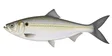
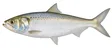
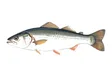
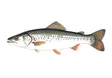
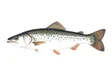
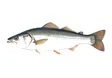
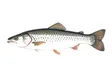
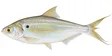
It is known for its colonization of the Great Lakes via the Welland Canal, bypassing Niagara Falls. There, its population peaked between the 1950s and 1980s to the detriment of many native species of fish. In an effort to control it biologically, Pacific salmon were introduced, only partially successfully. As a marine fish, the alewife is a US National Marine Fisheries Service "Species of Concern".
Description
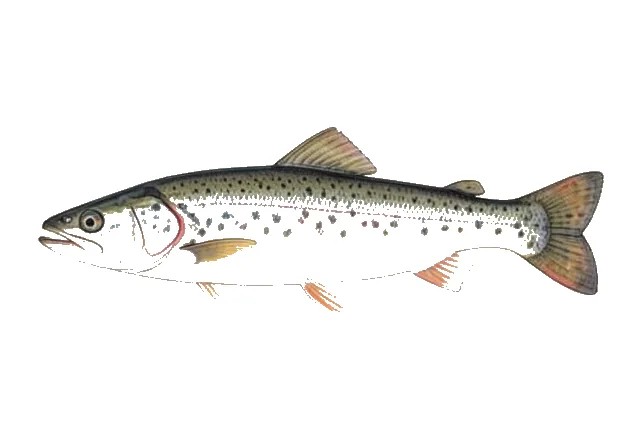
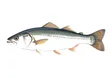
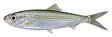
Alewife reach a maximum standard length (SL) of about 40 centimetres (16 in), but have a typical SL of about 30 centimetres (12 in). The front of the body is deep and larger than other fish found in the same waters.
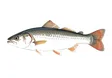
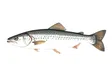
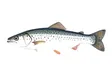
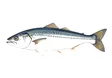
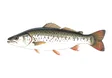
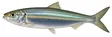
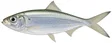
Alewife have bronze-colored heads and a grey-blue to greyish green dorsum. A humeral spot is often present. The tongue does not bear teeth. The peritoneum is light-colored with spots to dusky-appearing, an internal feature that distinguishes alewife from blueback herring (Alosa aestivalis), which have a dark peritoneum. The otolith is shaped like a letter "L", unlike its hooked shape in A. aestivalis. Additionally, the eye is larger than that of A. aestivalis; the width of the eye often exceeds the length of the snout in A. pseudoharengus.
Etymology and folklore
Its common name is said to come from comparison with a corpulent female tavernkeeper ("ale-wife"), or, alternatively, from the word aloofe, possibly of Native American origin, that was used to describe this fish in the seventeenth and eighteenth centuries.
In southwestern Nova Scotia, alewife are referred to as kiacks (or kyacks). In Atlantic Canada it is known as the gaspereau, from the Acadian French word gasparot, first mentioned by Nicolas Denys. William Francis Ganong, New Brunswick biologist and historian, wrote:
A number of locations are named after the Gaspereau around the historic region of Acadia. Acadians named three rivers after the fish, the Gaspereau River in Nova Scotia, as well as the Gaspereau River near Grand Lake and Gaspereau River near Northumberland Strait that are both in New Brunswick. Further, several lakes in Nova Scotia and New Brunswick hold the name Gaspereau Lake or Gaspereaux Lake, including in Kings County, Nova Scotia; Clare, Nova Scotia; Antigonish County, Nova Scotia; and Maugerville Parish, New Brunswick. The community of Gaspereau and the Gaspereau Valley are also found in Kings County, NS.
Both anadromous and landlocked forms occur. The landlocked form is also called a sawbelly or mooneye (although this latter name is more commonly applied to Hiodon spp.) Adult alewife are caught during their spring spawning migration upstream by being scooped out of shallow, constricted areas using large dip nets. They are the preferred bait for the spring lobster fishery in Maine, and are eaten by humans, usually smoked.
In the North American Great Lakes
Alewife are known for their invasion of the Great Lakes by using the Welland Canal to bypass Niagara Falls. Although the United States Department of Agriculture suggests they may be native to Lake Ontario, alewife colonized the other Great Lakes and became abundant mostly in Lake Huron and Lake Michigan. It appears that they had spread from Lake Erie to other Great Lakes by the Detroit River and Lake St. Clair. They reached their peak abundance from the 1950s through the 1980s. Alewife grew in number unchecked because the lakes lacked a top predator (lake trout were essentially wiped out around the same time by overfishing and the invasion of the sea lamprey)
For a time, alewife, which often exhibit seasonal die-offs, washed up in windrows on the shorelines of the Great Lakes. Various species of Pacific salmon (first coho, and later the Chinook salmon) were introduced as predators. Though marginally successful, this led to the development of a salmon/alewife fishery popular with many sport anglers.
In spite of such biological control methods, alewife remain implicated in the decline of many native Great Lakes species. It is also a common predator of numerous native and non-native zooplankton taxa (e.g. Bythotrephes longimanus, Leptodiaptomus ashlandi, Limnocalanus spp., Leptodiaptomus minutus, Leptodiaptomus sicilis, and Leptodora kindtii). Wells (1970) found that increases in population of alewife in the Great Lakes between 1954 and 1966 were associated with population declines in certain larger species of zooplankton, while an alewife die-off in 1967 was temporally related to population rebound in most of those species.
Conservation
Alewife populations have seen big declines throughout much of their range. Several threats have most likely contributed to their decline, including loss of habitat due to decreased access to spawning areas from the construction of dams and other impediments to migration, habitat degradation, fishing, and increased predation due to recovering striped bass populations.
In response to the declining population trend for alewives, the states of Massachusetts, Rhode Island, Connecticut, Virginia, and North Carolina have instituted moratoria on taking and possession.
In eastern Massachusetts, Alewife Brook flows through Arlington, Cambridge, and Somerville to the Mystic River. The brook gives its name to the Alewife Brook Parkway and the Alewife Brook Reservation. The Red Line (MBTA) of Boston's T ends at the Alewife station, so the name of this fish adorns the front of every northbound Red Line train. An extensive habitat restoration and education project, combined with a fish ladder with monitoring cameras, is yielding increasing numbers of alewife back in the improving Mystic River watershed.
The alewife is a US National Marine Fisheries Service Species of Concern, about which the National Oceanic and Atmospheric Administration, National Marine Fisheries Service, has some concerns regarding status and threats, but for which insufficient information is available to indicate a need to list the species under the US Endangered Species Act.
Article text: Wikipedia contributors, Alewife (fish) (source revision). Licensed under CC BY-SA 4.0. Retrieved 2026-10-11.
Diet and feeding
The FishTraits compilation records these diet categories for this species: invertebrates or larval fish; larger animal prey (a source category covering fish, crayfish, crabs, or frogs). These are broad categories, not a claim that every individual consumes every example in a category.
Reported feeding positions include bottom feeding and surface or water-column feeding. The compilation combines published observations; diets can vary with age, locality, and available food.
Habitat preferences
Reported habitat associations include medium to large rivers, streams and small rivers, still-water habitats.
The source records associations with open water. An association indicates reported use, rather than an exclusive requirement.
The species is classified as tolerant of a broad range of salinities. This flag does not specify a salinity range for aquarium care.
Reproduction and parental care
The compilation reports a representative maturity age of 3 years. Its maturity field summarizes mean, median, or modal estimates, usually for females; male estimates can be used when female data are unavailable. It is not a fixed age at which every fish first breeds.
Recorded spawning months are Mar for the source’s reporting region (NC). This is a regional calendar, not a range-wide schedule.
The reproductive-guild classification includes spawning on open substrates without guarding the brood.
Size and recorded longevity
FishTraits reports a maximum total length of 40 centimetres. Some entries use an estimated asymptotic length; this value should not be treated as a certified record catch.
Recorded longevity in the compilation is 5.5 years. Wild observations were preferred, but captive records were accepted where wild records were unavailable, and unspecified records were assumed wild. The value is not a guaranteed wild lifespan or an aquarium life expectancy.
Identification and appearance
The Alewife is a small herring with a dark dorsal side, bluish to greenish, and light sides with horizontal darker stripes. The head is broad and triangular, and the body is relatively deep. Eyes are large with adipose eyelids. A dull black spot is located behind the operculum. Scales are easily rubbed off and form scutes on the midline of the belly. Jaw teeth are inconspicuous, and tongue teeth are absent. Caudal fin is forked and lacks an adipose fin. Alewives are visually similar to Blueback Herring (Alosa aestivalis), but Alewives have a white peritoneal lining whereas the blueback’s is black to dusky in color. Alewives have larger eyes, and a greater body depth than Blueback Herring (Whitehead 1985, Page and Burr 1991, Etnier and Starnes 1993, Jenkins and Burkhead 1994, Scott and Crossman 1998).
Native range
Atlantic Coast from Red Bay, Labrador, to South Carolina; many landlocked populations (Page and Burr 1991).
Habitat and ecology
Alewives are anadromous and euryhaline (prefers <15 psu) but occur in landlocked water bodies including the Great Lakes (DiMaggio et al. 2016). They exist at various depths ranging throughout the year from littoral to profundal zones depending on the season. In spring, Alewives spread out across a lake, staying in warmer waters above the thermocline in schools and dispersing shoreward at night to spawn near the surface of open lake shores, bays, harbors, and lower reaches of rivers (O’Gorman et al. 2013). When nearshore, Alewives prefer rocky substrates to sandy substrates (Janssen and Kuebke 2004). During summer, young-of-year (YOY) Alewives stay in the warmer epilimnion while older fish will often venture into the thermocline and cooler waters (Wells 1968; Otto et al. 1976; Johannsson and O’Gorman 1991). In fall, Alewives move away from shore and into deeper waters as the thermocline descends and weakens and eventually overwinters in the profundal zone. Near the end of winter, alewives begin to move shoreward once again to repeat the cycle (Wells 1968; Bergstedt and O’Gorman 1989). Reproduction of Alewives is polygynandrous and lasts for around a month in spring once water temperatures surpass ~15ºC (59ºF) (Edsall 1970; Hlavek and Norden 1987). Landlocked populations generally mature a year faster than anadromous populations, taking two years for males and three for females. Females deposit between 10,000 and 360,000 eggs (typically on the lower end) at random on any type of substrate (Hlavek and Norden 1987; Scott and Scott 1988; Scott and Crossman 1998). Eggs are non-adhesive and incubation time varies with temperature, from 15 days at 7.2ºC to 3.7 days at 21.1ºC (Edsall 1970). Larvae are phototropic, pelagic, and begin feeding two days after hatching (Odell 1934; Heinrich 1981). Alewives can survive in temperatures between 3 to 31ºC but prefer waters between 16 to 20ºC (Otto et al. 1976; Spotila et al. 1979; Dufour et al. 2008). Water above 31ºC and below 3ºC can cause extreme stress and eventual death (Colby 1973; Otto et al. 1976; McCauley and Binkowski 1982). Lepak and Kraft (2008) found that Alewife experienced sublethal immunosuppression when held in ponds below 2ºC for six weeks. Die-offs of Alewife often occur in the Great Lakes and Lake Champlain and are typically concurrent with severe winter conditions and/or when fish conditions are poor due to high population densities and increased disease transfer rates (Brown 1972; Colby 1973; Bergstedt and O’Gorman 1989; Lepak and Kraft 2008). Winter temperatures sustained at or below 1ºC can cause osmoregulatory failure due to changes in lipid composition leading to fish mortality. Hence, smaller Alewife with small lipid reserves often experience higher winter mortality than their larger counterparts (Snyder and Hennessy 2003). Therefore, YOY Alewife must be at least 60 mm in total length to successfully overwinter in the Great Lakes, especially in Lake Superior where the growing season is shorter, and winter is harsher (Brown 1972; Elrod 1983; O’Gorman and Schneider 1986). As a consequence to the climate in Lake Superior, Alewives there are much fewer in number and much longer than others of the same age in the other Great Lakes due to extreme selection pressure for fast growth (O’Gorman et al. 1997). The warming effects of climate change in Lake Superior are expected to increase the favorable environment for Alewife by reducing the lethality of winter and by promoting food production (Bronte et al. 2003; Hook et al. 2007; O’Gorman et al. 2013). The diet of Alewives is diverse and impactful, as it is a proficient feeder of fish eggs, insects, zooplankton, and larval fish. It selects for the largest zooplankton in invaded water bodies and subsequently has altered the species composition of zooplankton in the Great Lakes where Alewives are abundant (Hutchinson 1971; Johannsson et al. 1991). The degree to which Alewives reduce large zooplankton populations is so severe that the seasonal movements of the fish in Lake America have been tracked by the size of zooplankton (O’Gorman et al. 1991). Alewives also prey on larval fish, benefited by their wide-ranging seasonal movements and ability to feed in midwater and low light levels (O’Gorman et al. 2013). Alewives’ predation of pelagic larval fish can be so severe that their recruitment is drastically reduced (Madenijan et al. 2008). A variety of piscivorous fish consume alewives in the Great Lakes. Alewives are vital prey for both nearshore (e.g. Yellow Perch (Perca flavescens) and Walleye (Sander vitreus)) and offshore (e.g. Rainbow Smelt (Osmerus mordax), Burbot (Lota lota), and Salmonid) predators (O’Gorman 1974; Elrod et al. 1981; Ridgway et al. 1990).
Introduction history
There is apparently disagreement concerning the native status of Alewife in Lake America. Miller (1957) and Smith (1970) point out the first record from Lake America was in 1873. Smith (1970) is of the opinion that it was introduced into the lake. Although Smith (1970) brings up the possibility that Alewife were introduced into Lake America with American Shad stockings in the 1880s, he discounts this possibility in favor of the hypothesis that they reached the lake via the Erie Canal from the Hudson River. He contends that Alewife was only able to invade the lake after the decline of predators such as Lake Trout and Atlantic Salmon in the 1860s. Other authors believe this species was probably native to Lake America (Lee et al. 1980 et seq.) and spread through the Great Lakes via the Welland Canal (Lee et al. 1980 et seq.). The species was first reported from Lake Erie in 1931, Lake Huron in 1933, Lake Michigan in 1949, and Lake Superior in 1954. The spread of Alewife in the upper Great Lakes is thought to be enabled by warmer weather in the 1950’s (O’Gorman and Stewart 1999). The Alewife was intentionally stocked in inland waters. The population in the New River, West Virginia, resulted from stockings in Claytor Lake, New River, Virginia (Jenkins and Burkhead 1994). The population discovered by VTFWD in 1997 in Lake St. Catherine, Vermont, is likely a result of an illegal stocking (Marsden and Hauser, 2009). Lakes in the Adirondack Mountains and Otsego Lake, New York were illegally stocked with Alewife for forage (Smith 1985).
Ecological impacts
Alewife is a very important species in the history of biological invasions in the Great Lakes. Periodic large-scale die-offs littered the beaches of the Great Lakes with rotting fish in the 1960's. Such die-offs can pose both a nuisance and a health hazard (Becker 1983). Prompted by calls for Alewife management, Pacific salmonids were introduced to both control Alewife populations and utilize Alewife as a food source for sport fisheries.