Etymology
The gizzard shad is so named because it possesses a gizzard, a sack filled with rocks or sand, that aids the animal in the breakdown of consumed food. Its generic name, Dorosoma, is a reflection of the fact that, when young, the fish has a lancelet-shaped body (doro meaning lanceolate and soma meaning body). The specific name, cepedianum, is a reference to amateur French ichthyologist La Cépède.
Distribution and habitat
Gizzard shad have historically ranged from North Dakota in the northwest of the United States south to New Mexico in the southwest, east to Florida in the southeast, and north to 40°N latitude (they have historically been seen no farther north than the lower New York Harbor). They were not seen in many of the Great Lakes until the late 1800s and early 1900s, although they are suspected to be native to Lake Erie, reaching it after the last ice age.
Gizzard shad typically live in lakes and reservoirs, although they can live in rivers and streams, and brackish waters. They reside in the limnetic zone, and can comprise up to 80% of fish biomass in certain lake systems. They prefer shallow lakes with muddy bottoms and relatively high turbidity. This may be due in part to their breeding preferences, but it probably arises from the fact that they have lower survival rates in clear waters and waters with high vegetative cover.
Description
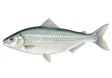
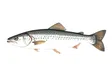
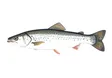
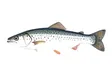
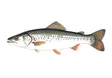
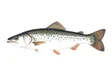
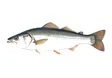
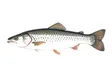
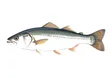
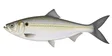
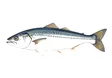
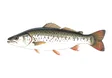
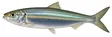
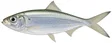
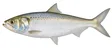
The gizzard shad's dorsal fin starts behind the insertion of the pelvic fins, and the last ray is greatly lengthened. They have a long anal fin, with 25 to 36 long soft rays on the fin. The mouth of the gizzard shad has a short, wide, upper jaw with a deep notch along the ventral margin, and a weak, relatively smaller, lower jaw. The mouth itself is subterminal to inferior (on the lower portion of the head), and the adults possess no teeth. The gizzard shad also has 90 to 275 gill rakers along the lower limbs. Their ventral (pelvic) fins are in the thoracic position, or in the chest region of the fish. The gizzard shad can range from very small size when fry to a maximum recorded length of 477 mm (18.8 in) and maximum weight of 1.56 kg (3.4 lb). The average length is typically larger in northern waters, and ranges from 284 mm (11.2 in) at age three years to 399 mm (15.7 in) at age 10. They have a branched lateral line system that is confined to the head and anterior body, similar to the lateral line systems of other clupeids.
The gizzard shad is brown or gray dorsally, becoming whitish ventrally. A humeral spot, sometimes with purple iridescence, may be faintly visible posterior to the upper operculum. The fish is often slimy.
Diet
Gizzard shad are planktivorous in early life, feeding mainly on phytoplankton and zooplankton, such as periphyton, chrysophyta and rotifera, as larvae. Consumptive demand of young of year fish (including larvae) can be intense enough to cause collapses in the zooplankton community, which has far-reaching effects through the ecosystem of which they are a part. In midwestern USA reservoirs, where gizzard shad are often the most abundant fish (by biomass), they usually switch to diets dominated by sediment detritus during the first year of life, whereas in some natural lakes they may rely heavily on zooplankton throughout their lives. As zooplankton are a nutritionally superior food than detritus, if large zooplankton (e.g., Daphnia) are available, gizzard shad probably prefer to feed on this resource. However, in many reservoirs, large zooplankton are scarce so gizzard shad rely on detritus. Gizzard shad growth rates may be lower when they feed only on detritus (compared to zooplankton), and in reservoirs they may consume more zooplankton (and less detritus) when density of conspecifics is low and the abundance of large-bodied zooplankton is high. In such cases, Daphnia and other crustaceans make up a large portion of some gizzard shad diets. Sediment and sand are also ingested by the gizzard shad, which helps it digest food in its muscular gizzard.
Gizzard shad feed mainly during the day, with minimal activity at night. They have been observed at night in Lake Mead, Arizona congregating in schools in very shallow water two to three feet deep during the fall.
Reproduction
The start of the spawning period is typically between mid-May and early June, and is triggered by rising water temperatures. The number of eggs per individual varies between populations, but typically it is 12,500 eggs for a two-year-old and peaks at 380,000 eggs for a four-year-old. The eggs are laid in shallow water in clumps, with seemingly no pairing off occurring between individuals. They spawn during the evening and the early hours of the night, and the eggs adhere to underwater vegetation and do not receive any parental attention. Feeding begins three to four days after hatching, and most individuals are 3.3 mm long upon hatching. Gizzard shad have very high fecundity and a rapid growth rate, meaning they can become a large part of an ecosystem, in terms of abundance and biomass, very quickly.
They are capable of hybridizing with the closely related threadfin shad (Dorosoma petenense).
Ecology
Gizzard shad can increase productivity in an ecosystem through redistribution of nutrients, particularly in their adult stages when they consume detritus in lower depths of the lake and both make them available to other predator species as well as excreting them in more bioavailable forms. Because of this, gizzard shad can have a strong effect on algal production even when phosphorus loading from watersheds is high, and can counteract management efforts to combat cultural eutrophication.
Aquatic toxicology
Gizzard shad are important to toxicology testing for chemical products. Due to the food web dependencies and fecundity gizzard shad are somewhat the water bound version of "canary in the coal mine."
Thiaminase activity
Ross JP et al (2009) reported that the thiaminase activity of gizzard shad in Lake Griffin was found to be 16,409 ± 2,121 pmol/g/min. This high rate of thiaminase activity was present in most months and across a wide range of shad sizes. The thiaminase activity in gizzard shad is high enough to cause thiamine (vitamin B1) deficiency in wild American alligators when shad are a major part of their diet. The alligator mortality between 1997 and 2002 at Lake Griffin was likely due to neurological impairment associated with thiamine deficiency, with poor egg hatch rates beginning as early as 1994 similarly attributed to maternal deficiency.
Introduction into non-native habitats
Gizzard shad were introduced into many lake and river systems as a source of food for game fish, such as walleye, bass, and trout, because of their small size and relatively high abundance. They were thought to be easy food for game fish and could help increase the numbers of fish available, as well as decrease the pressures on prey species (such as the bluegill). However, due to their rapid growth, they can quickly grow beyond the size available to many fish. They remain vulnerable to predation by piscivorous birds, such as great blue herons, as well as raccoons and other wetland predators.
In addition, gizzard shad spawn in large numbers and can reach densities high enough to ensure that many of them survive past the first year, making them essentially invulnerable to fish predation. They can also be harmful exploitative competitors to other species, leading to declines in other fish species' populations. Partly as a result of this, large gizzard shad are sometimes labeled as "nuisances"and"unwanted". However, gizzard shad can help to control populations of zooplankton and insect larvae in productive ecosystems through their unique capabilities as predators of small organisms.
Gizzard shad can pose a hazard to human equipment, as shown when a bloom of gizzard shad blocked the cooling water intake of a Canadian nuclear power plant, causing it to shut down.
Article text: Wikipedia contributors, American gizzard shad (source revision). Licensed under CC BY-SA 4.0. Retrieved 2026-10-11.
Diet and feeding
The FishTraits compilation records these diet categories for this species: algae or phytoplankton; aquatic or other vascular plants; detritus or unidentified plant material; invertebrates or larval fish. These are broad categories, not a claim that every individual consumes every example in a category.
Reported feeding positions include bottom feeding and surface or water-column feeding. The compilation combines published observations; diets can vary with age, locality, and available food.
Habitat preferences
Reported habitat associations include medium to large rivers, streams and small rivers, still-water habitats.
The source records associations with open water. An association indicates reported use, rather than an exclusive requirement.
The species is classified as tolerant of a broad range of salinities. This flag does not specify a salinity range for aquarium care.
Reproduction and parental care
The compilation reports a representative maturity age of 2 years. Its maturity field summarizes mean, median, or modal estimates, usually for females; male estimates can be used when female data are unavailable. It is not a fixed age at which every fish first breeds.
Batch or serial spawning has been reported somewhere in the species’ range. This does not establish the same spawning pattern for every population.
Recorded spawning months are May, Jun for the source’s reporting region (NC). This is a regional calendar, not a range-wide schedule.
The reproductive-guild classification includes spawning on open substrates without guarding the brood.
Size and recorded longevity
FishTraits reports a maximum total length of 60 centimetres. Some entries use an estimated asymptotic length; this value should not be treated as a certified record catch.
Recorded longevity in the compilation is 6 years. Wild observations were preferred, but captive records were accepted where wild records were unavailable, and unspecified records were assumed wild. The value is not a guaranteed wild lifespan or an aquarium life expectancy.
Native range
Native in the Mississippi, Atlantic, and Gulf Slope drainages from Quebec to central North Dakota and New Mexico, and south to central Florida and Mexico (Page and Burr 1991). It is unclear whether Gizzard shad are native to the southern Great Lakes or gained access through canals and rivers.
Habitat and ecology
Gizzard shad are primarily found in large rivers, reservoirs, lakes, swamps, and other freshwater environments with turbidity ranging from clear to silty. Its preference is quieter open waters although it can be commonly found in the strong current of the upper Mississippi River (Miller 1960). Adults can also be found in brackish and saline waters of estuaries and bays (Whitehead 1985). Optimal habitat for the species is warm, fertile, shallow bodies of water with soft mud bottoms, low predator abundance and high turbidity. Lacustrine habitats with optimal conditions are prone to overpopulation by Gizzard shad. Moderate to heavy predation, changing water levels, deep clear water, and steep shorelines tend to lead to lower Gizzard shad populations (Williamson and Nelson 1985). Temperature plays a large role in population size. Individuals are most frequently found in areas ranging from 22-29°C with satisfactory growth observed at temperatures up to 34°C (Williamson and Nelson 1985). Populations appear to fluctuate in response to low temperatures and die-offs are common in the winter at higher latitudes (Etnier and Starnes 1993; Becker 1983). However, Gizzard shad may survive severe winters in areas where water temperatures are uncharacteristically warm, such as near an industrial warm-water discharge. The spread of this species in Lake Michigan is thought to be connected to artificial warm spots in harbors and industrial bays (Becker 1983). Individuals avoid waters with low dissolved oxygen and are normally absent from water with less than 2 mg/L of dissolved oxygen (Williamson and Nelson 1985). Gizzard shad are planktivores, straining minute organic particles with their gill rakers into their pharyngeal organ which is thought to concentrate and process food for swallowing. They also feed heavily on detritus found on bottom sediments, individuals consume an average of 13% of their wet weight biomass in dry sediment each day. Their diet remains largely similar at different sizes and has been found to contain algae, phytoplankton, zooplankton, and plant debris. Because Gizzard shad are primary consumers, extremely large populations can be supported. Fry feed primarily on copepods and cladocerans, whereas adults consume large amounts of phytoplankton and zooplankton. Gizzard shad is part of the diet of at least 17 game fishes some of which include Walleyes, White Bass, Largemouth Bass, White Crappie, Gars, Black Crappie, Sauger, Yellow Trout, Catfish, Freshwater Drum, and Lake Trout. The Striped Bass and Muskellunge have been introduced into reservoirs to prey on Gizzard shad. Waterfowl also prey on the species. Winter die-offs cause individuals to float to the surface where they are consumed by crows, turkey vultures, bald eagles, and waterfowl. Gizzard shad grow rapidly in shallow, fertile impediments with abundant food and long growing seasons. This rapid growth frequently causes individuals to become too large for most predators, reaching 10-18 cm within the first year (Etnier and Starnes 1993; Williamson and Nelson 1985; Miller 1960; Mundahl 1990). Spawning of Gizzard shad occurs from mid-May to mid-June near the surface of water in low-gradient areas. Adult females and males gather in large aggregations and eject sperm and eggs into the water. Eggs sink to the bottom and adhere to any object or surface they come in contact with. The average female produces approximately 300,000 eggs per year, eggs will hatch in 2-3 days. Young fish travel in compact schools after hatching and will typically disperse by fall, schooling is rare at age one. Reproductive maturity is normally reached at ages 2 or 3. Lifespan depends on the environment a population is found in and shorter life spans are associated with rapid growth in the first year of life. Longer life spans are typical in the northern parts of its range and individuals live to 5-7 years and have been reported living up to 10-11 years (Etnier and Starnes 1993; Williamson and Nelson 1985; Miller 1960).
Introduction history
These fish were stocked intentionally for forage. The Wyoming populations also spread from introductions into Nebraska (Baxter and Simon 1970). In Pennsylvania, Gizzard shad were stocked accidentally with American shad (Denoncourt et al. 1975). In Vermont, they have expanded their range through the Connecticut River assisted by fishways that were constructed for American Shad Alosa sapidissima and Atlantic Salmon (Salmo salar) restoration (Ken Cox, personal communication). They likely gained access to Lake Champlain through the Hudson Barge Canal that links the lake to the Hudson River (Ken Cox, personal communication). They gained access to Lake Michigan through either the Chicago River Canal or the Fox-Wisconsin Canal (Becker 1983), and to Lake Erie through the Ohio Canal (Jordan 1882). Gizzard shad gained access into the Colorado River in 2000 after some escaped Morgan Lake in NW New Mexico, where they were accidentally stocked with largemouth bass (Knowles 2002). By early 2008, they were found as far downstream as the Grand Canyon in Arizona.
Ecological impacts
Competition for food between gizzard shad and other fish species may occur (Burns 1966; Moyle 1976). Jenkins (1994) found that gizzard shad directly compete with centrarchids resulting in decreased growth and size of the centrarchids. Aday et al. (2003) foud that gizzard shad caused reduced growth rates and maximum size in bluegill. In addition, Aday et al. (2003) found that gizzard shad can significantly increase phytoplankton levels, subsequently increasing turbidity and potentially impacting visual predators. Gizzard shad show tremendous invasion potential. After only two plantings totally 1020 fish in Lake Havasu, the species spread through the Colorado River from Davis Dam southward to the Mexican border, the Salton Sea, and associated irrigation ditches within only 18 months (Burns 1966).