American Shad

Alosa sapidissima

Clupeidae · freshwater and saltwater and brackish water fish

10 minute read · Species guide

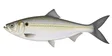
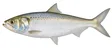
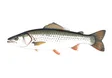
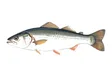
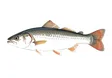
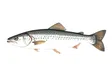
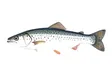
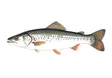
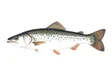
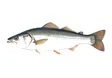
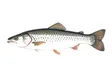
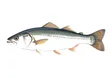
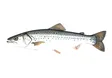
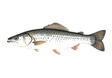
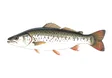
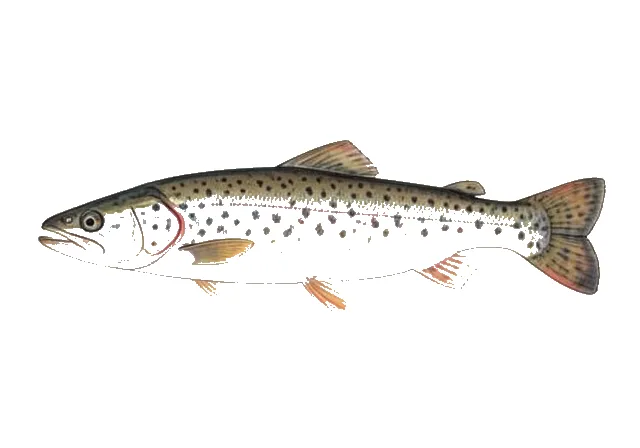
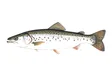
American Shad field guide illustration

About American Shad

The American shad (Alosa sapidissima) is a species of anadromous clupeid fish naturally distributed on the North American coast of the North Atlantic, from Newfoundland to Florida, and as an introduced species on the North Pacific coast. The American shad is not closely related to the other North American shads. Rather, it seems to form a lineage that diverged from a common ancestor of the European taxa before these diversified.

The American shad has been described as "the fish that fed the (American) nation's founders". Adult shad weigh between 1.5 and 3.5 kg (3 and 8 lb), and they have a delicate flavor when cooked. It is considered flavorful enough not to require sauces, herbs, or spices. It can be boiled, filleted and fried in butter, or baked. Traditionally, a little vinegar is sprinkled over it on the plate. In the Eastern United States, roe shads (females) are prized because the eggs are considered a delicacy.

The name "shad"derives from the Old English sceadd, meaning"herring"; it is a cognate to Irish, Welsh, and Scottish Gaelic words for herring.

Life history

The shad spends most of its life in the Atlantic Ocean but after three to six years they become sexually mature and swim up freshwater rivers to spawn. Northern populations are iteroparous. Thus, they may survive breeding, return to the sea, and then return to fresh waters to spawn several more times. However, southern populations exhibit semelparity, similar to Pacific salmon. In the marine environment, shad are schooling fish. Thousands are often seen at the surface in spring, summer, and autumn. They are hard to find in the winter, as they tend to go deeper before spawning season in the range 13–18 °C (55–64 °F); they have been pulled up in nets as deep as 120 metres (65 fathoms).

Like other herrings, the American shad is primarily a plankton feeder but eats small shrimp and fish eggs. Occasionally, they eat small fish, but these are only a minor item in their general diet.

The sexually mature American shad enter coastal rivers in spring or early summer, usually when the river water has warmed to 10 to 13 °C (50 to 55 °F). Cooler water appears to interrupt the spawn. Consequently, the shad run correspondingly later in the year passing from south to north along the coast, commencing in Georgia in January; in March in the waters tributary to Pamlico and Albemarle Sounds; in April in the Potomac; and in May and June in northern streams generally from Delaware to Canada.

American shad run far upstream in large rivers, such as the Connecticut. The apparent longest distance is in the St. Johns River of Florida, an extremely slow (drops 1 inch per mile, 1.5 cm per km) river that widens into large lakes; shad have been found 600 km (375 mi) upriver.

The spawning fish select sandy or pebbly shallows and deposit their eggs primarily between sundown and midnight. Females release eggs in batches of about 30,000 eggs, though very large fish deposit an estimated as many as 156,000 eggs. Total annual egg production is 200,000–600,000 eggs per female, with larger fish producing more. In rivers north of Cape Fear, the spent fish, now very emaciated, return to the sea immediately after spawning. In southern rivers, most shad die after spawning.

The eggs are transparent, pale pink, or amber, and being semibuoyant and not sticky like those of other herrings, they roll about on the bottom with the current. The eggs hatch in 12 to 15 days at 11 °C (52 °F), in six to eight days at 17 °C (63 °F), which covers the range characteristic of Maine and Bay of Fundy rivers during the season of incubation.

The fry are about 9 to 10 mm (11 ⁄ 32 to 13 ⁄ 32 in) long. Juvenile shad remain in the rivers until fall when they move down to salt water; they are now 40 to 115 mm (1 + 1 ⁄ 2 to 4 + 1 ⁄ 2 in) long, resembling their parents in appearance.

Ecology and diet

As adults, shad filter feed at sea and during their return journey to spawn. They are pursued and hunted primarily by striped bass and, at times, harbor seals. They may not actively feed on their return and are caught with special 'dart' lures instead of typical bait.

Specialist hearing

While the hearing of most fishes is limited in frequency to less than 1 kHz, American shad demonstrate an unusual ability to detect very high frequency sound (ultrasound) above 50 kHz

Nutritional information

Like most herring species, American shad are very high in omega 3 fatty acids and, in particular, contain nearly twice as much per unit weight as wild salmon. They are also very low in toxins such as PCBs, dioxins, and mercury by EPA estimates. The American or Atlantic shad (A. sapidissima) is a valued food fish.

Shad populations

Declines in the Atlantic coast shad population were documented as early as the turn of the 20th century. Traditionally, shad were caught along with salmon in set nets, which were suspended from poles driven into the river bed reasonably close to shore in tidal water. Many of the rivers where shad were once common now suffer from pollution; however, the short time spent by shad in freshwater may minimize contamination. For example, fisheries scientists have found that shad in the Hudson River are not in the river long enough to be affected by PCBs and other contaminants (however, fishing for or possessing American shad [including catch and release] in the Hudson River or Marine District is now prohibited). Pollution, however, may impact shad reproduction and studies have been undertaken to determine whether fingerlings suffer DNA damage.

Most rivers across the historic shad range are now heavily dammed, eliminating many of the spawning grounds. For example, the number of shad harvested in the Merrimack River declined from almost 900,000 in 1789 to none in 1888, likely due to the inability to reach their spawning ground following a period of heavy dam construction. Fish passage efforts, including the Chesapeake Bay program, have begun to remedy this situation. While recreational angling has almost no measurable impact on shad populations, they are susceptible to commercial overfishing. Because of their highly migratory life history and their recreational and commercial importance, American shad are co-managed by the U.S. Fish and Wildlife Service, the National Marine Fisheries Service, and state fisheries agencies. The Atlantic States Marine Fish Commission is a crucial forum for coordinating the collective effort to conserve American shad.

Introduced in the North Pacific

American shad were introduced into the San Francisco Bay / Sacramento River system in California in the 1800s, and they have spread throughout many river systems on the West Coast of North America. A large shad population occurs in the Columbia River. In recent years, shad counts at Bonneville and The Dalles Dams have ranged from over two million to over five million fish per year. Spawning shad returned to the Columbia in May and June and migrated above Lower Granite Dam on the Snake River and above Priest Rapids Dam on the Upper Columbia. Unlike many introduced species, American shad have not been confirmed to have serious negative effects on the environment or other native fish species in the Columbia.

American shad are also occasionally found on the Northwest Pacific coast in Kamchatka, Russia.

Shad fishing

Shad are also valued as a sport fish that exhibit complex and little-understood feeding behaviors while spawning. Unlike salmon, shad retain the ability to digest and assimilate food during the anadromous migration. Like other fish, turbidity and water temperature can trigger their feeding instinct.

Society and culture

Shad serve notable symbolic roles in regional politics and culture. A shad bake is a culinary tradition found up and down the East Coast, often being large community events. On the year of every gubernatorial election, would-be candidates, lobbyists, campaign workers, and reporters gather in the town of Wakefield, Virginia, for its annual Shad Planking event. Similarly, in Connecticut, the towns of Essex and Windsor hold annual shad festivals. Each spring, the town of Lambertville, New Jersey, on the Delaware River across from New Hope, Pennsylvania, also hosts an annual Shad Festival. There is a multi-day Shad Festival that has been enjoyed by thousands every spring in Grifton, NC for decades. The Salem County New Jersey Attorney Bar Association has held an annual Shad Dinner every spring since the 1940s. There is a shad museum on the Connecticut River in Haddam, Connecticut.

William Penn negotiated with the Lenape for the Schuylkill shad fishing grounds in the 1680s. Shad, he said, were "excellent Pickled or Smoked."

In Quebec, there is a major annual spring shad run in the Rivière-des-Prairies, and many people fish for shad near the Rivière-des-Prairies dam in Laval. The fish is known as saumon des pauvres, or salmon for the poor people.

Article text: Wikipedia contributors, American shad (source revision). Licensed under CC BY-SA 4.0. Retrieved 2026-10-11.
Diet and feeding

The FishTraits compilation records these diet categories for this species: aquatic or other vascular plants; invertebrates or larval fish; larger animal prey (a source category covering fish, crayfish, crabs, or frogs). These are broad categories, not a claim that every individual consumes every example in a category.

Reported feeding positions include surface or water-column feeding. The compilation combines published observations; diets can vary with age, locality, and available food.

Habitat preferences

Reported habitat associations include medium to large rivers, streams and small rivers, still-water habitats.

The source records associations with sand, gravel, cobble, open water. An association indicates reported use, rather than an exclusive requirement.

The species is classified as tolerant of a broad range of salinities. This flag does not specify a salinity range for aquarium care.

Reproduction and parental care

The compilation reports a representative maturity age of 4 years. Its maturity field summarizes mean, median, or modal estimates, usually for females; male estimates can be used when female data are unavailable. It is not a fixed age at which every fish first breeds.

Batch or serial spawning has been reported somewhere in the species’ range. This does not establish the same spawning pattern for every population.

Recorded spawning months are Mar, Apr for the source’s reporting region (NC). This is a regional calendar, not a range-wide schedule.

The reproductive-guild classification includes spawning on open substrates without guarding the brood.

Size and recorded longevity

FishTraits reports a maximum total length of 76 centimetres. Some entries use an estimated asymptotic length; this value should not be treated as a certified record catch.

Recorded longevity in the compilation is 7 years. Wild observations were preferred, but captive records were accepted where wild records were unavailable, and unspecified records were assumed wild. The value is not a guaranteed wild lifespan or an aquarium life expectancy.

Native range

Atlantic Coast from the Sand Hill River, Labrador, to the St. Johns River, Florida; ascends coastal rivers to spawn (Page and Burr 1991).

Introduction history

This species was stocked intentionally in California starting in 1871 (Dill and Cordone 1997), and then spread to Oregon, Washington, and Alaska. It was intentionally stocked in many other areas as well, for forage, food, sport, and commercial fishing. It was accidentally stocked in Nebraska (Smith 1896).

Ecological impacts

American Shad were introduced into the Columbia River over a century ago and now maintain the largest population known to exist in the world. The presence of so many American Shad likely result in competitive pressures against native salmonids, although no studies have been conducted to quantify those effects (Sanderson et al. 2009). Shad may also compete with other native fishes for space, and could cause migratory delays in salmonids and other anadromous fishes (Hasselman et al. 2012b).

Haskell et al. (2006) studied the zooplankton in the Columbia River during the outmigration of subyearling American Shad and Chinook Salmon. They found that shad eat Daphnia as a major food item. At times the Daphnia disappear from John Day Reservoir. Subyearling Chinook also depend on Daphnia. Because of the large increase in abundance of shad from 1980 to 1994, and the pressure they put on the Daphnia population, they reasoned that the salmon may be affected by these Daphnia declines.

Record fish

State records in 2 states

  • Georgia8 lb, 3 oz

    Savannah River · April 5, 1986 · Henry Baxley

  • Florida5.19 lb

    St. Johns River · Seminole County · 2/15/1990 · Bud Dankert

  • Florida5.19 lb

    St. Johns River · Volusia County · 3/18/1992 · Albert Judy

Each figure is the state agency’s own certified record. The site holds record tables for 11 states so far, so a state missing here has not been read yet. It is not a state where this fish holds no record.

Statute

The official state fish of 2 states

A state fish is chosen by statute. It says nothing about how common the fish is in the state. See every official state fish.

Range

Where it lives

Share of 3,126 GBIF observation records with a state location, across 25 states. The orange dots are USGS stream-survey sites where this species was caught.
0%
51%
Share of 3,126 GBIF observation records with a state location, across 25 states. The orange dots are USGS stream-survey sites where this species was caught.

A blank area on the dot layer usually means nobody sampled there, not that the fish is absent. Turn on “every survey site” to see where the survey looked.

The USGS stream survey caught it at 54 of its sites, in 17 states. That survey and the GBIF records are two different counts of two different things, so the site keeps them apart.

Habitat

Water and movement

Water
WoRMS records this species in fresh water, brackish water and the sea.
USGS NAS habitat
Freshwater;Marine
US status
Native transplant — native to part of the United States, moved to other waters inside it.
Migration
Migratory
Pattern
  • Diadromous — moves between fresh water and the sea
  • Anadromous — spawns in fresh water, grows at sea

Classification

Taxonomy

Kingdom
Animalia
Phylum
Chordata
Superclass
Actinopterygii
Class
Teleostei
Order
Clupeiformes
Family
Clupeidae
Genus
Alosa
Species
Alosa sapidissima
ITIS TSN
161702
WoRMS AphiaID
158670
GBIF key
2412661
Outside the US
ITIS also files it in Canada, Mexico.

Common questions about American Shad

What is the scientific name of American Shad?
The scientific name is Alosa sapidissima, in the family Clupeidae. Classification follows ITIS.
Does American Shad live in fresh water or salt water?
WoRMS records this species in fresh water, brackish water and the sea.
Where has American Shad been recorded in the United States?
GBIF has observations in 25 states, with the most records in Maine, North Carolina, New Jersey. The map shows observation records, which do not establish the complete natural range.

Closest relatives

Other Alosa species

Same family

More Clupeidae

Alabama Shad13 states
Alosa alabamaeClupeidaeNativeFreshSaltBrackish
Alewife29 states
Alosa pseudoharengusClupeidaeNative and introducedFreshSaltBrackish
American Gizzard Shad41 states
Dorosoma cepedianumClupeidaeNative and introducedFreshSaltBrackish
Atlantic Herring17 states
Clupea harengusClupeidaeNativeSaltBrackish
Atlantic Menhaden19 states
Brevoortia tyrannusClupeidaeNativeSaltBrackish
Atlantic Red Herring15 states
Etrumeus teresClupeidaeNativeSalt
Atlantic Thread Herring13 states
Opisthonema oglinumClupeidaeNativeSalt
Blueback Herring21 states
Alosa aestivalisClupeidaeNative and introducedFreshSaltBrackish
Bluestripe Herring2 states
Herklotsichthys quadrimaculatusClupeidaeIntroducedFreshSaltBrackish
Dwarf Herring2 states
Jenkinsia lamprotaeniaClupeidaeNativeSalt
False Herring3 states
Harengula clupeolaClupeidaeNativeSaltBrackish
Finescale Menhaden4 states
Brevoortia gunteriClupeidaeNativeSaltBrackish
Florida Round Herring1 states
Jenkinsia stoliferaClupeidaeNativeSalt
Gulf Menhaden8 states
Brevoortia patronusClupeidaeNativeSalt
Hickory Shad15 states
Alosa mediocrisClupeidaeNativeFreshSaltBrackish
Marquesan Sardinella1 states
Sardinella marquesensisClupeidaeIntroducedSalt
Middling Thread Herring1 states
Opisthonema medirastreClupeidaeNativeSalt
Pacific Herring4 states
Clupea pallasiiClupeidaeNativeFreshSaltBrackish
Pacific Sardine5 states
Sardinops sagaxClupeidaeNativeSalt
Redear Herring5 states
Harengula humeralisClupeidaeNativeSalt
Round Sardinella12 states
Sardinella auritaClupeidaeNativeSaltBrackish
Scaled Sardine10 states
Harengula jaguanaClupeidaeNativeSaltBrackish
Skipjack Shad24 states
Alosa chrysochlorisClupeidaeNative and introducedFreshSaltBrackish
Threadfin Shad30 states
Dorosoma petenenseClupeidaeNative and introducedFreshSaltBrackish

All 26 species in Clupeidae