Threadfin Shad

Dorosoma petenense

Clupeidae · freshwater and saltwater and brackish water fish

4 minute read · Species guide

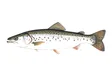
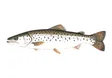
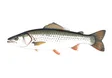
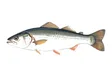
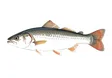
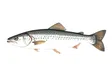
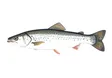
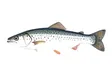
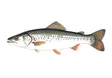
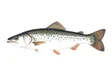
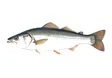
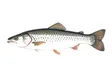
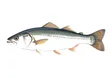
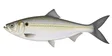
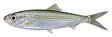
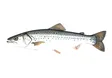
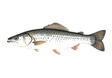
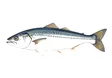
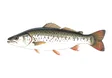
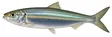
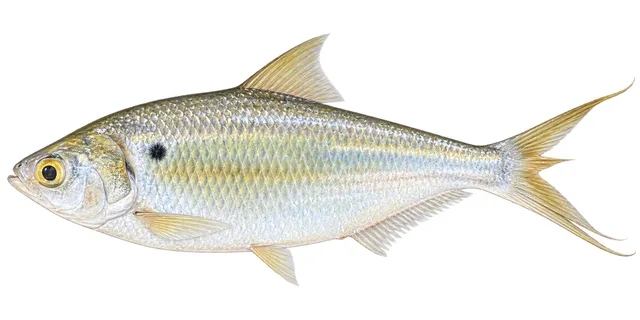
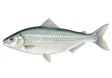
Threadfin Shad field guide illustration

About Threadfin Shad

The threadfin shad (Dorosoma petenense) is a small pelagic freshwater forage fish common in lakes, large streams and reservoirs of the Southeastern United States. Like the American gizzard shad, the threadfin shad has an elongated dorsal fin, but unlike the gizzard shad, its mouth is more terminal without a projecting upper jaw. The fins of threadfin shad often have a yellowish color, especially the caudal fin. The back is grey to blue with a dark spot on the shoulder. D. petenense is more often found in moving water, and is rarely found deep in the water column. It occurs in large schools, sometimes with gizzard shad, and can be seen on the surface at dawn and dusk. The threadfin shad may reach lengths of 8 in (200 mm), but only rarely. This fish is very sensitive to changes in temperature and dissolved oxygen, and die-offs are frequent in late summer and fall, especially when water temperature drops to 42 °F. The threadfin shad is a favorite food for many game fishes, including striped bass, largemouth bass, smallmouth bass, and catfish. This fish is widely introduced throughout the United States as a forage for game fish.

Description

Adult shad grow to a maximum size of 7–8 inches (18–20 cm), but most specimens are about 1 inch (2.5 cm) long. They have yellowish fins.

Geographic distribution

The threadfin shad is native to the U.S., west of the eastern Appalachian Mountains, through the Mississippi basin all along the Gulf of Mexico down to Belize. This species tends to do best in large lakes and rivers. The construction of dams has created more reservoirs, providing more water bodies for the shad to inhabit. This has expanded the home range of the fish, as has the rise in temperatures in northern lakes.

Threadfin shad have been introduced outside of their original as a supplemental forage. Populations have become established on the American West Coast from Oregon south to San Diego Bay and the Gulf of California.

Ecology

The threadfin lives a pelagic life in natural lakes, reservoirs, and large streams. In addition to freshwater habitats, it also inhabits brackish waters such as estuaries and lagoons. It prefers areas with limited vegetation. It is found to a depth of 50 metres (160 ft), and moves between deep water during the day and shallow areas at night.

The young and adults feed on a variety of planktonic organisms and organic debris. Many researchers believe that threadfin shad often compete for plankton with young-of-the-year predator species, especially largemouth bass. Threadfin shad is a very important food source for many game fish such as the largemouth bass. It has little known competition, but one species known to have a similar lifestyle is the gizzard shad (Dorosoma cepedianum).

Life history

The shad spawns in the spring when the water temperature is in the upper 60s (°F). Threadfin shad are a pelagic (open water) schooling species that is typically found in large numbers. The shad spawn occurs in the spring and early summer with a secondary spawn often occurring in the early fall. Spawning usually occurs early in the morning on available vegetation. The eggs adhere to submerged and floating objects. Females lay from 2,000 to 24,000 eggs. The young reach reproductive adulthood at one year of age. Life expectancy seldom exceeds 2 to 3 years.

Current management

Many populations of threadfin shad have been introduced by humans to the far north, resulting in large die-offs in the winter when water temperatures fall below 42 °F. This die-off affects both humans and wildlife. A tide of dead fish floats ashore, creating a strong odor unpleasant to humans. The die-off also gives some bird species an unnatural feeding habit, as well. The species should not be transplanted into water bodies that drop below 42 °F. This species is not endangered and has relatively healthy populations.

Article text: Wikipedia contributors, Threadfin shad (source revision). Licensed under CC BY-SA 4.0. Retrieved 2026-10-11.
Native range

Given the fact that they were stocked in the Tennessee River and were able to migrate from there, and the fact that there are no early records, we consider it not-native to areas upstream of the lower Tennessee River (on both the Tennessee and the Mississippi and Ohio rivers). Many of the areas of Arkansas are also questionable. The earliest record for the state is 1955 despite a fair amount of sampling in the state (as depicted by FishNet2.net).

Habitat and ecology

Prefers lakes, ponds, rivers, reservoirs and estuaries, but does not endure cold water (7-14°C). Spawning occurs often before one year of age over vegetation or logs in open water at 21°C.

Introduction history

It is unknown whether the populations on the east coast of Georgia resulted from past stocking or from dispersal through estuarine waters (Miller and Jorgenson 1969; Dahlberg and Scott 1971b). Populations in other locations were intentionally stocked as forage.

Ecological impacts

Concern exists regarding possible impacts on other fish species with planktonic larvae, such as minnows and suckers, and on young centrarchids. Dill and Cordone (1997) stated that threadfin compete with young centrarchids for food and that they have destroyed kokanee fishing in some areas. Population increases and crashes of threadfin shad caused diet shifts from zooplankton to zoobenthos, as well as an increase in tissue mercury content due to benthic foraging, in several species of zooplanktivorous fishes (inland silverside; young-of-year largemouth bass and bluegill) in Clear Lake, California (Eagles-Smith et al. 2008).

Range

Where it lives

Share of 34,516 GBIF observation records with a state location, across 30 states. The orange dots are USGS stream-survey sites where this species was caught.
0%
63.1%
Share of 34,516 GBIF observation records with a state location, across 30 states. The orange dots are USGS stream-survey sites where this species was caught.

A blank area on the dot layer usually means nobody sampled there, not that the fish is absent. Turn on “every survey site” to see where the survey looked.

The USGS stream survey caught it at 284 of its sites, in 20 states. That survey and the GBIF records are two different counts of two different things, so the site keeps them apart.

Habitat

Water and movement

Water
WoRMS records this species in fresh water, brackish water and the sea.
USGS NAS habitat
Freshwater;Marine
US status
Native transplant — native to part of the United States, moved to other waters inside it.
Migration
Migratory
Pattern
Disagreement
3 published references do not agree on the pattern: Anadromous, Potamodromous. The site shows every assignment rather than picking one.

Classification

Taxonomy

Kingdom
Animalia
Phylum
Chordata
Superclass
Actinopterygii
Class
Teleostei
Order
Clupeiformes
Family
Clupeidae
Genus
Dorosoma
Species
Dorosoma petenense
ITIS TSN
161738
WoRMS AphiaID
276310
GBIF key
2413553
Outside the US
ITIS also files it in Caribbean Territories, Mexico.

Common questions about Threadfin Shad

What is the scientific name of Threadfin Shad?
The scientific name is Dorosoma petenense, in the family Clupeidae. Classification follows ITIS.
Does Threadfin Shad live in fresh water or salt water?
WoRMS records this species in fresh water, brackish water and the sea.
Where has Threadfin Shad been recorded in the United States?
GBIF has observations in 30 states, with the most records in Texas, Alabama, Georgia. The map shows observation records, which do not establish the complete natural range.

Closest relatives

Other Dorosoma species

Same family

More Clupeidae

Alabama Shad13 states
Alosa alabamaeClupeidaeNativeFreshSaltBrackish
Alewife29 states
Alosa pseudoharengusClupeidaeNative and introducedFreshSaltBrackish
American Gizzard Shad41 states
Dorosoma cepedianumClupeidaeNative and introducedFreshSaltBrackish
American Shad25 states
Alosa sapidissimaClupeidaeNative and introducedFreshSaltBrackish
Atlantic Herring17 states
Clupea harengusClupeidaeNativeSaltBrackish
Atlantic Menhaden19 states
Brevoortia tyrannusClupeidaeNativeSaltBrackish
Atlantic Red Herring15 states
Etrumeus teresClupeidaeNativeSalt
Atlantic Thread Herring13 states
Opisthonema oglinumClupeidaeNativeSalt
Blueback Herring21 states
Alosa aestivalisClupeidaeNative and introducedFreshSaltBrackish
Bluestripe Herring2 states
Herklotsichthys quadrimaculatusClupeidaeIntroducedFreshSaltBrackish
Dwarf Herring2 states
Jenkinsia lamprotaeniaClupeidaeNativeSalt
False Herring3 states
Harengula clupeolaClupeidaeNativeSaltBrackish
Finescale Menhaden4 states
Brevoortia gunteriClupeidaeNativeSaltBrackish
Florida Round Herring1 states
Jenkinsia stoliferaClupeidaeNativeSalt
Gulf Menhaden8 states
Brevoortia patronusClupeidaeNativeSalt
Hickory Shad15 states
Alosa mediocrisClupeidaeNativeFreshSaltBrackish
Marquesan Sardinella1 states
Sardinella marquesensisClupeidaeIntroducedSalt
Middling Thread Herring1 states
Opisthonema medirastreClupeidaeNativeSalt
Pacific Herring4 states
Clupea pallasiiClupeidaeNativeFreshSaltBrackish
Pacific Sardine5 states
Sardinops sagaxClupeidaeNativeSalt
Redear Herring5 states
Harengula humeralisClupeidaeNativeSalt
Round Sardinella12 states
Sardinella auritaClupeidaeNativeSaltBrackish
Scaled Sardine10 states
Harengula jaguanaClupeidaeNativeSaltBrackish
Skipjack Shad24 states
Alosa chrysochlorisClupeidaeNative and introducedFreshSaltBrackish

All 26 species in Clupeidae